
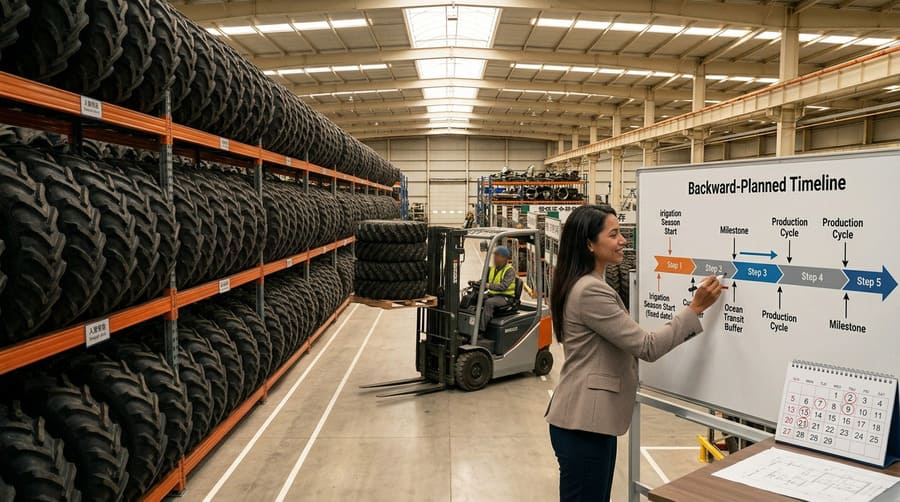
Your irrigation tires arrived two weeks late, missing the crucial planting window. Now you have angry customers waiting and a warehouse full of stock you can't sell until next year.
You must plan backward because the irrigation season1 is a fixed deadline you cannot change. By starting from that immovable date, you can build a realistic timeline that accounts for uncertain logistics and customs.
I learned this lesson the hard way early in my career. A new client, a large distributor in South America, placed a big order for pivot tires. We finished production on time, and I gave them a standard 45-day shipping estimate. Everything looked perfect. But the shipment got held up in customs for an extra three weeks for a random inspection. By the time the irrigation tires arrived, the short, intense irrigation window was over. My client was stuck with the inventory for a full year. He wasn't just mad about the delay; he was frustrated that I hadn't warned him about the possibility. It taught me that my job isn't just to make and ship tires; it's to get them there on time.
Why Can't You Trust Standard Lead Times?
Your supplier confidently promised a 60-day delivery. But it's day 75, and your tires are still stuck at the port. Your selling season is shrinking with each passing day.
Because standard lead times2 are often just factory production estimates. They are optimistic guesses that ignore the most common points of failure: shipping congestion3, holidays, and customs inspections4. These variables are constraints, not assumptions.

When you get a "lead time" from a factory, you are getting the answer to the question, "How long does it take you to make this?" But that's the wrong question to ask. The right question is, "How long until it is in my warehouse?" The second question includes all the unpredictable parts of the journey. The factory's schedule is flexible; the agricultural calendar is not. A farmer cannot postpone the growing season because your container is delayed. Your planning must start from the farmer's non-negotiable deadline5 and work backward, treating logistics not as a smooth process but as a series of potential roadblocks.
Optimistic vs. Backward Planning
This table shows why a simple forward plan is so risky compared to a realistic backward plan.
| Timeline Stage | Optimistic Forward Plan (Risky) | Realistic Backward Plan (Safe) |
|---|---|---|
| In-Warehouse Deadline | Assumes it's flexible. | Day 0: Fixed & Non-Negotiable |
| Inland Freight | 3 Days | 5-7 Days (Buffer for truck availability) |
| Customs Clearance | 5 Days | 10-21 Days (Buffer for inspections/holidays) |
| Ocean Transit | 30 Days (Best case) | 35-40 Days (Buffer for port congestion) |
| Production & QC | 25 Days | 30 Days (Buffer for material delays) |
| Order Placement Date | Places order 63 days before needed. | Places order 80-98 days before needed. |
As you can see, the realistic plan accounts for the things that actually go wrong.
How Much Safety Stock Is Enough?
You know you need a buffer, but holding inventory is expensive. You're worried about tying up too much cash in irrigation tires that are just sitting there, waiting for the season to start.
Your safety stock6 should be treated as a strategic insurance policy7, not just a cost. The right amount is enough to cover your key customers through any foreseeable delay, because that cost is almost always lower than the cost of a lost season.
Thinking of safety stock6 as "unsold goods" is a mistake. It is a risk control tool. You are not just storing rubber and steel; you are storing guaranteed uptime for your most important clients. The key is to be strategic. You don't need a huge buffer for every single irrigation tire size. You need it for the 20% of SKUs that make up 80% of your business during that critical window. For these items, you should establish a clear reorder trigger point. The moment your existing inventory dips below the amount needed to survive a "worst-case" delivery timeline, a new order is automatically placed. This is how you move from hoping your shipment arrives on time to ensuring it doesn't matter if it's a little late. The peace of mind this provides for you and your clients is worth every penny of the holding cost.
Where Do Most Delivery Plans Actually Fail?
You had a plan. You accounted for production time and shipping. Everything was calculated. So why are you still fielding angry calls from customers about a late delivery?
Because your plan had no cushion. Operational plans rarely fail from bad intentions; they fail because there was no buffer built in for small, common disruptions. Without extra days reserved for each stage, any minor hiccup cascades into a missed deadline.
A perfect plan where every stage happens exactly on schedule is a fantasy. In the real world of global logistics8, delays are normal. A national holiday can shut down a port for three days. A random customs check can add a week. A typhoon can force a container ship to reroute. A "no buffer" plan assumes none of this will happen. A professional plan9 assumes it will. The difference between an amateur and a pro is that the pro builds the delays into the timeline from the very beginning. They add a few extra days for production. They add a week for transit. They add ten days for customs. When a small delay inevitably happens, it just eats into the buffer time10. The final delivery date is unaffected. Your customer never even knows there was a problem.
What Does Backward Planning Signal to Your Supplier?
You worry that being too demanding about timelines will strain your relationship with your supplier. How can you enforce this discipline without sounding like a difficult customer?
It signals that you are a professional who understands the realities of the business. A good supplier prefers a client with a clear, realistic plan. It shows you are a serious partner, which helps them plan their own production and manage their capacity better.

When I receive a backward-planned purchase order from a client, I don't see them as demanding. I see them as a professional. It immediately tells me three things: 1) they know their market, 2) they respect the complexities of logistics, and 3) they are planning for success. This kind of client is a partner, not just a customer. It allows us at Gescomaxy to have a more honest conversation. We can review their timeline and use our 12+ years of experience to validate it. We might say, "Your customs buffer is good, but let's add five more days for ocean transit in that season." This collaborative planning builds a stronger, more resilient supply chain for everyone. It turns the supplier relationship11 from a simple transaction into a strategic alliance12.
Conclusion
Plan your irrigation tire deliveries backward from the fixed seasonal deadline. This simple shift in perspective accounts for real-world delays13, builds in a necessary buffer, and protects your business from catastrophic losses14.
Understanding the irrigation season is crucial for planning agricultural activities and ensuring timely delivery of necessary supplies. ↩
Standard lead times can be misleading as they often don't account for real-world variables like shipping congestion and customs delays. ↩
Shipping congestion can cause significant delays in delivery, affecting business operations and customer satisfaction. ↩
Customs inspections can lead to unexpected delays in shipping, affecting delivery schedules and business operations. ↩
A non-negotiable deadline ensures that all planning revolves around a fixed date, reducing the risk of missing critical timelines. ↩
Safety stock acts as a buffer against unforeseen delays, ensuring continuous supply and customer satisfaction. ↩
Treating safety stock as a strategic insurance policy helps businesses mitigate risks associated with supply chain disruptions. ↩
Global logistics involves complex challenges like customs, shipping delays, and international regulations that affect delivery timelines. ↩
A professional plan includes buffers for delays, ensuring that minor disruptions don't affect the final delivery date. ↩
Buffer time allows for flexibility in schedules, accommodating unexpected delays and ensuring timely project completion. ↩
Backward planning signals professionalism and helps build stronger partnerships with suppliers, enhancing collaboration. ↩
A strategic alliance with suppliers fosters collaboration, improving supply chain resilience and business success. ↩
Accounting for real-world delays ensures that plans are realistic and achievable, preventing disruptions in operations. ↩
Backward planning mitigates risks by accounting for delays, protecting businesses from significant financial losses. ↩