
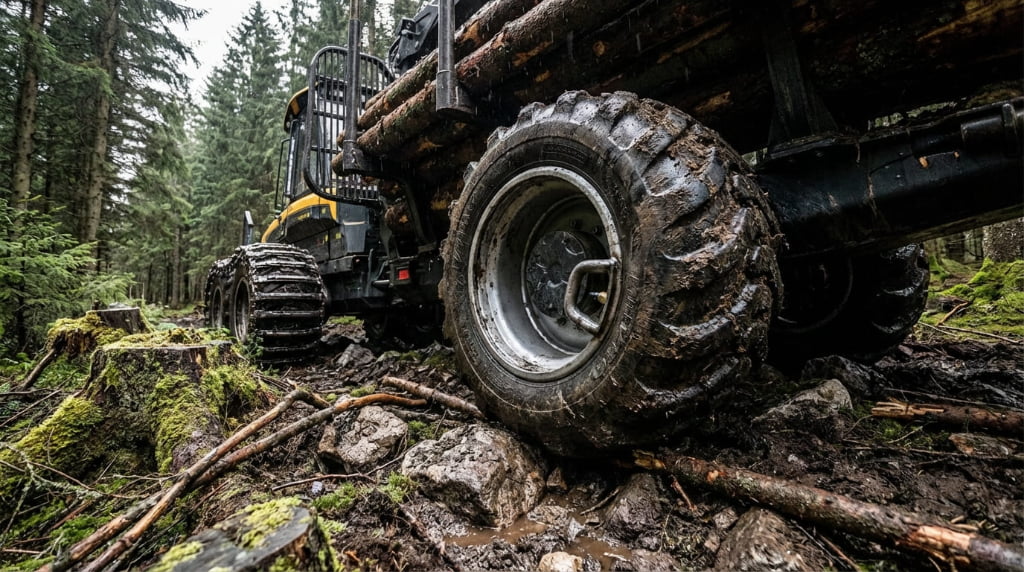
Your new forestry machine looks tough, but warranty claims for wheel failures are piling up. Your brand's reputation for reliability is being damaged by a component you thought was simple: the rim.
Standard agricultural rims1 are not designed for the brutal impacts and debris of forestry work2. Smart OEMs partner with specialists to engineer custom-built rims3 with reinforced flanges4, valve guards5, and thicker steel, preventing field failures6 and protecting their brand.
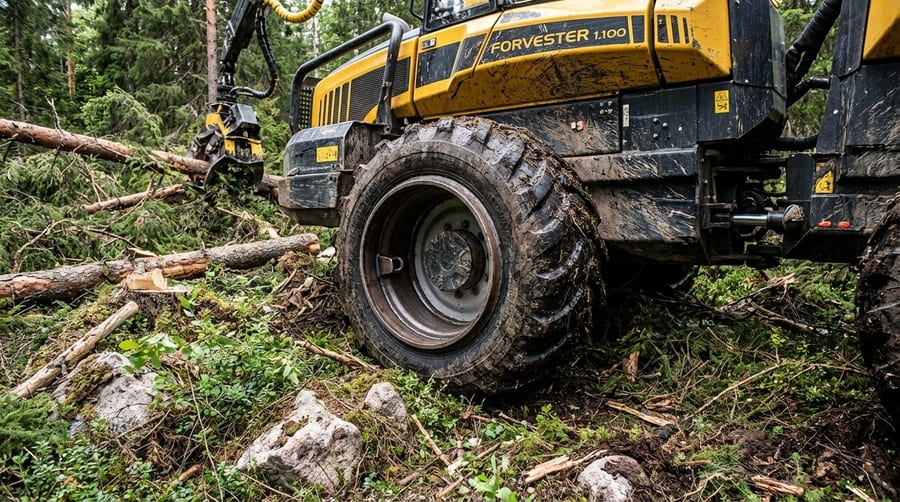
I remember a meeting with the engineering team for a well-known equipment manufacturer. They were baffled. Their new forwarder was performing brilliantly in tests, but in the real world, customers were reporting constant wheel and tire issues. They had used a top-spec agricultural rim, thinking it was strong enough. But they overlooked the unique violence of a forestry environment. It's a common mistake, assuming "heavy-duty" in agriculture is the same as "heavy-duty" in forestry. They are two completely different worlds, and learning that difference is key to building a truly reliable machine.
How Do Branches and Impacts Turn Standard Rims into Scrap Metal?
You’ve equipped your machine with robust tires, but field reports show constant flats and damaged wheels. Your engineering is being let down by a component you assumed was adequate.
Unprotected valve stems are easily snapped off by branches, causing instant deflation. Separately, the repeated, heavy impacts from rocks and stumps bend the edges of standard rims, breaking the tire's airtight seal and leading to eventual tire destruction7 and wheel failure.
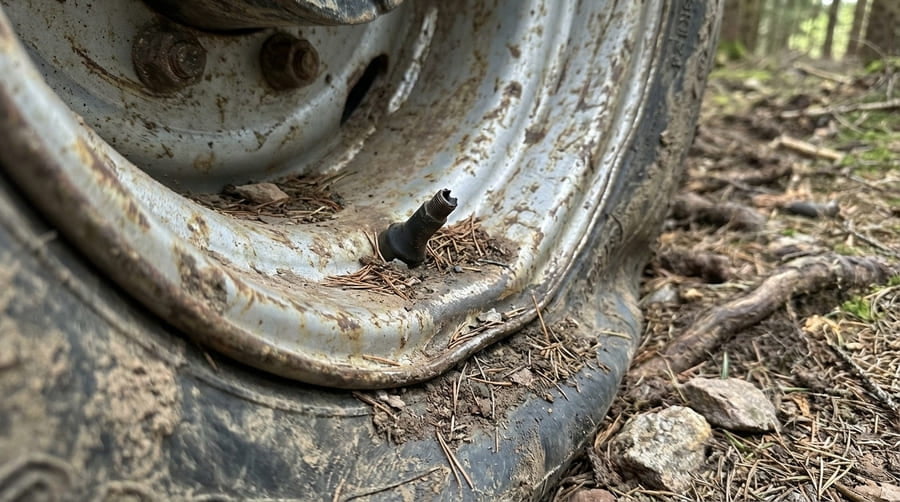
In a forest, the ground is littered with hazards. A fallen branch, when caught by a moving wheel, can act like a crowbar against an exposed valve stem. The result is immediate and total air loss, leaving a multi-ton machine stranded. Standard agricultural rims1 offer zero protection for this critical component. At the same time, the rim flange—the edge of the rim—takes a constant beating from rocks, stumps, and debris. Standard rims use a thinner steel flange that deforms under these impacts. Once the edge is bent, it can no longer hold a perfect seal with the tire bead, causing chronic air leaks. This leads to underinflation, which destroys the tire and puts enormous stress on the compromised rim itself. This is not a defect; it's a design mismatch.
Standard Agricultural Rim vs. Reinforced Forestry Rim
| Feature | Standard Agricultural Rim | Our Reinforced Forestry Rim |
|---|---|---|
| Valve Protection | None (Exposed Stem) | Fully Welded Valve Guard |
| Flange Design | Standard Thickness | Reinforced, Thicker Steel |
| Material Grade | General Purpose Steel | High-Strength, Impact-Resistant Steel |
| Failure Risk | High in Forestry Conditions | Extremely Low by Design |
What Engineering Solutions Prevent These Common Failures?
You know standard rims are failing, but what specific design changes actually create a rim that can survive in the woods? It's more than just using slightly thicker steel.
A true forestry rim requires purpose-built solutions: a heavy-duty, welded valve guard to shield the stem, a significantly thicker and reinforced rim flange to resist impact deformation8, and a higher-grade steel construction throughout the entire wheel.
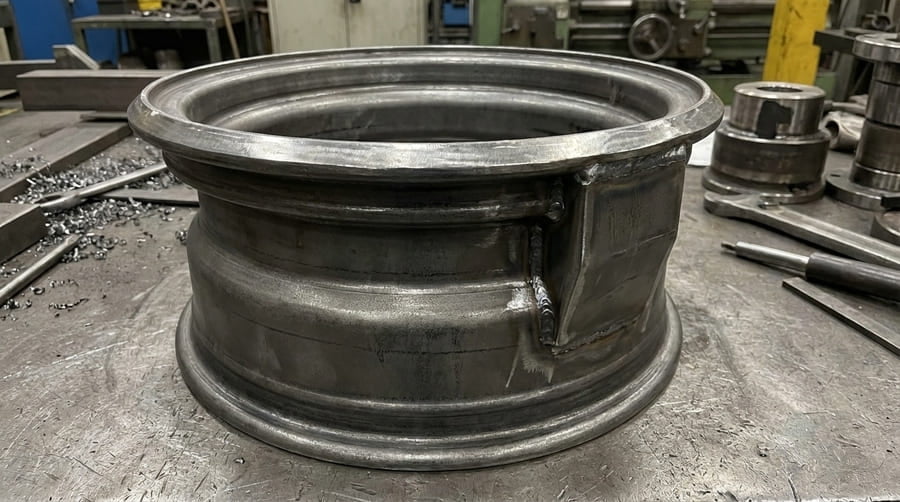
When we approach a forestry application, we don't just modify an existing design; we engineer from the ground up for survival. The first point of defense is the valve guard. This isn't a flimsy cover; it's a fortress of welded steel built around the valve stem, designed to deflect direct hits from branches and rocks. Next, we address the flange. We use steel that is substantially thicker than the agricultural standard, and we reinforce the profile of the flange itself to better distribute impact forces without bending. This preserves the critical air seal. The entire rim, from the center disc to the outer barrel, is constructed from a higher grade of steel chosen specifically for its ability to absorb sharp impacts without cracking or deforming. These aren't just features; they are essential engineering decisions that make the difference between a field failure and reliable operation.
Why Is a Custom Wheel Assembly the Smartest OEM Strategy?
You need a reliable wheel, but is it better to source tires and rims separately or as a complete package? Mixing and matching components can introduce new, unforeseen risks.
A complete wheel assembly9, with the rim and tire specified and mounted by a single expert partner, guarantees perfect compatibility. It eliminates guesswork and ensures the entire unit is optimized for the machine's specific weight, torque, and operating environment.
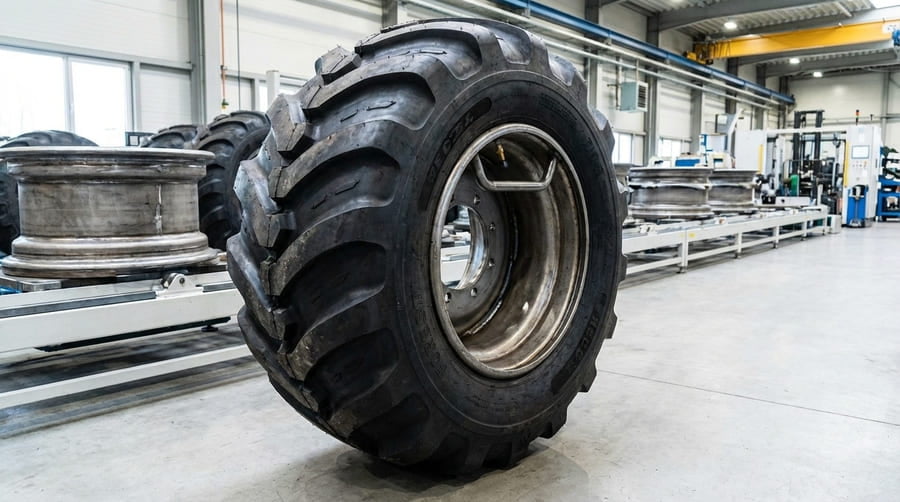
The smartest OEMs I work with have stopped thinking about tires and rims as separate parts. They think in terms of a complete wheel system. Why? Because the rim and tire must work in perfect harmony. A fantastic forestry tire on a weak rim is a failed system. A strong rim with an improperly matched tire is also a failed system. Our process involves OEM customization10 at its core. We analyze your machine's specs—load index, speed rating, typical terrain—and engineer a rim tailored to those demands. Then, we recommend and source the ideal forestry tire to match. By delivering a pre-mounted and inflated assembly, we remove all compatibility risks from your production line. You receive a bolt-on solution that is guaranteed to perform, reducing your internal labor, simplifying your supply chain, and providing maximum reliability for your end customer.
Conclusion
Stop letting standard rims undermine your machine's performance and your brand's reputation. Partner with us to engineer a custom, complete wheel assembly9 that is built to survive the forest.
Explore the differences between agricultural and forestry rims to understand their specific applications. ↩
Understanding the unique challenges of forestry work can help you appreciate the need for specialized equipment. ↩
Explore how custom-built rims can enhance the durability and performance of forestry machinery. ↩
Learn about the benefits of reinforced flanges in preventing wheel failures in harsh environments. ↩
Discover the critical role valve guards play in maintaining tire integrity in forestry conditions. ↩
Identifying common causes of field failures can help you make informed decisions about equipment. ↩
Explore the factors leading to tire destruction and how to prevent them in forestry applications. ↩
Understanding impact deformation can help you appreciate the need for specialized rim designs. ↩
Understanding complete wheel assemblies can help you optimize machinery performance and reliability. ↩
Discover how OEM customization can lead to better performance and reliability in machinery. ↩