
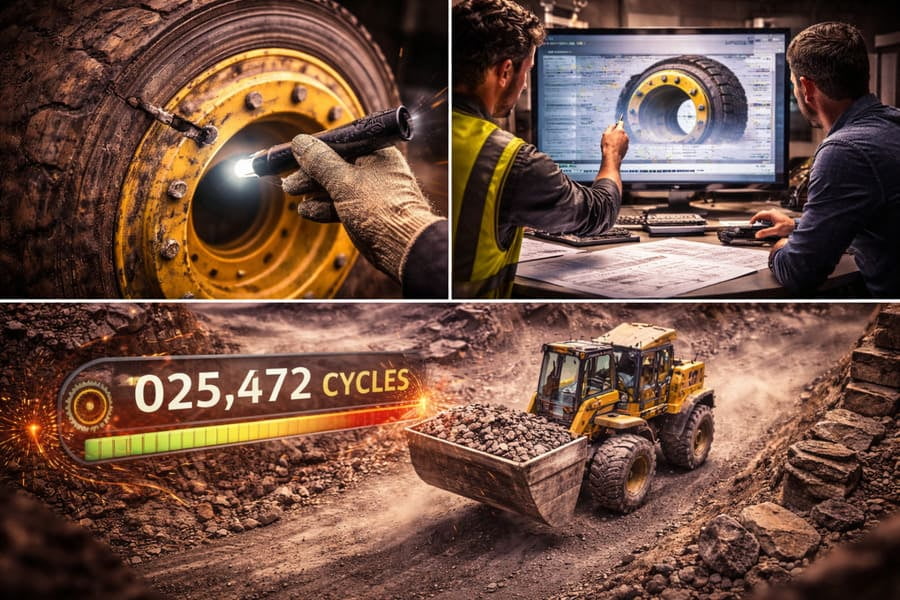
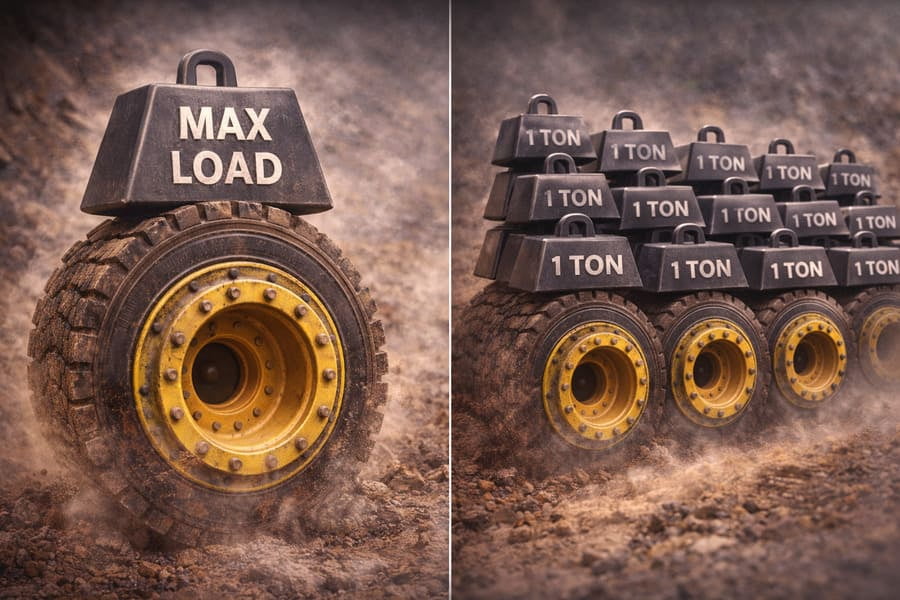
You’ve done your homework. You chose an OTR wheel with a maximum load capacity1 that's 20% higher than your machine's heaviest lift. You feel secure, but a year later, you're looking at cracked welds and bent flanges.
Focusing only on maximum load ignores metal fatigue2, the real cause of most wheel failures. This damage isn't from one big event; it's the accumulated stress from millions of smaller, repeated load cycles that happen every single day, all well below the peak rating.
I remember a client who ran a large container yard. He was frustrated because the wheels on his reach stackers were failing. He insisted, "We never exceed the weight limit for a single container!" He was right. But what he didn't focus on was that the reach stackers drove the same route, over the same pavement expansion joints, hundreds of times a day. Each time a wheel hit that one-inch bump, it created a small stress cycle. It wasn't the single heaviest container that killed his wheels; it was the millions of tiny bumps that acted like a hammer, slowly causing fatigue cracks3 to form near the welds. The max load rating only proved the wheel could survive a disaster, not the daily routine.
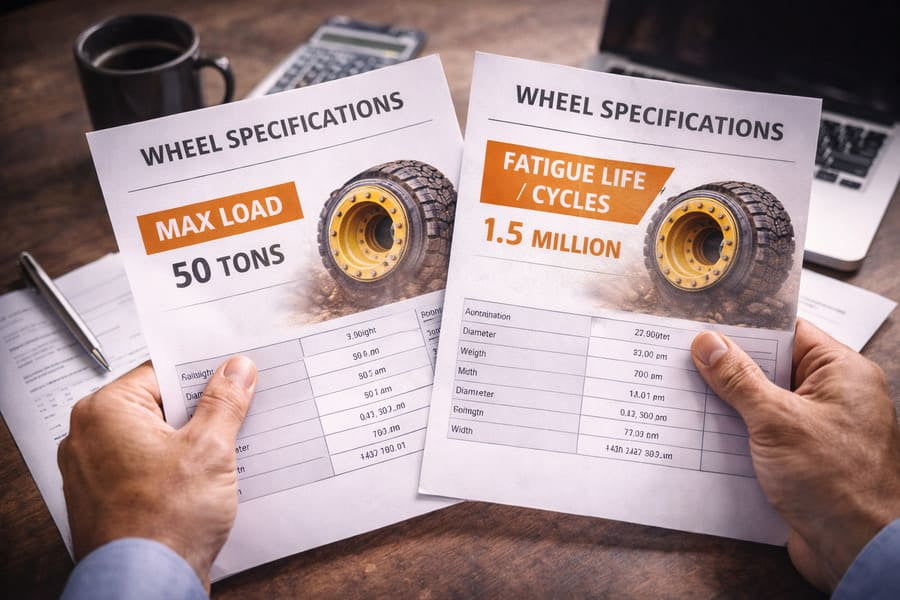
How Can a Wheel Rated for 50 Tons Fail Under a 30-Ton Load?
You bought a wheel with a massive safety margin4, rated for 50 tons, for a machine that never lifts more than 30. You assume it's indestructible, but then it cracks anyway.
A wheel fails below its max rating because the rating tests for a single, ultimate strength event, not for endurance5. The real enemy is fatigue, which is the slow accumulation of damage from millions of repeated stress cycles6 that gradually weaken the steel.
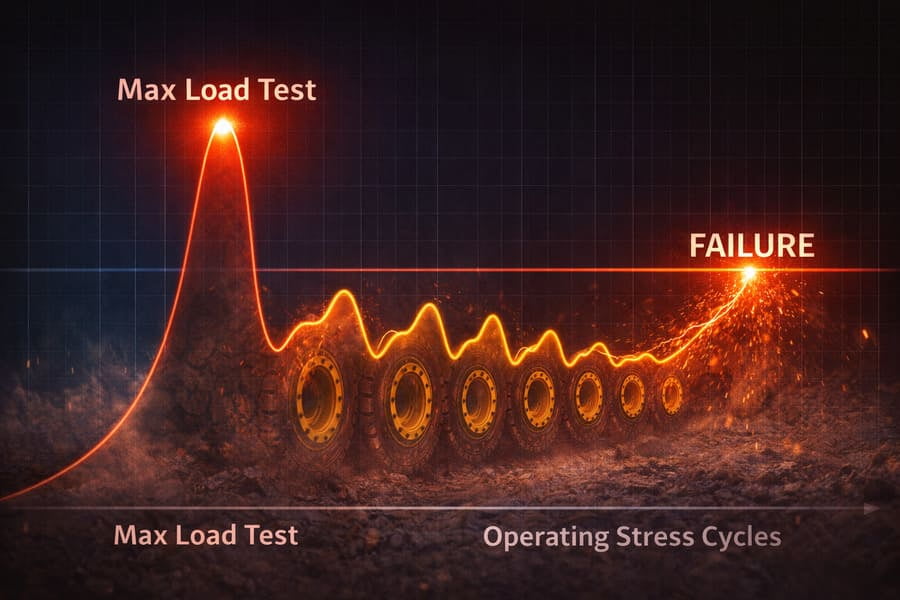
Think of it like this: You can't break a steel paperclip by pulling it apart with your hands. Its maximum tensile strength is too high. But you can easily break it by bending it back and forth a dozen times. Each bend is a small stress cycle that does a tiny amount of damage, and that damage adds up. An OTR wheel is the same. Its max load rating is the "pulling apart" test. But its real life is the "bending back and forth" test. Every single rotation of the wheel under load creates a stress cycle. This constant repetition, even at low loads, is what causes microscopic cracks to form and grow over time, eventually leading to a complete failure.
Two Different Kinds of Strength
| Category | Maximum Load Strength | Fatigue Strength (Endurance) |
|---|---|---|
| Purpose | To survive a single, rare, peak event. | To survive millions of normal, repeated operating cycles. |
| Tested By | Applying force until the wheel breaks or deforms. | Applying a repeated, lower-level load for millions of cycles. |
| Real-World Analogy | A car surviving a crash. | A car's engine running for 200,000 miles. |
| Primary Cause of Failure | A single, massive overload. | The total number and range of stress cycles6. |
If It's Not the Peak Load, What Actually Determines a OTR Wheel's Lifespan?
You've avoided overloads and stuck to the spec sheet, but your wheel replacement schedule is still unpredictable. If the highest weight isn't the problem, what is?
A wheel's lifespan is determined by the total number of stress cycles7s](https://www.arxiv.org/pdf/1207.6581v2.pdf)%%%FOOTNOTE_REF_6%%% it endures. The distance traveled, the roughness of the terrain8, and the frequency of loading and unloading are far more important than a single peak value.
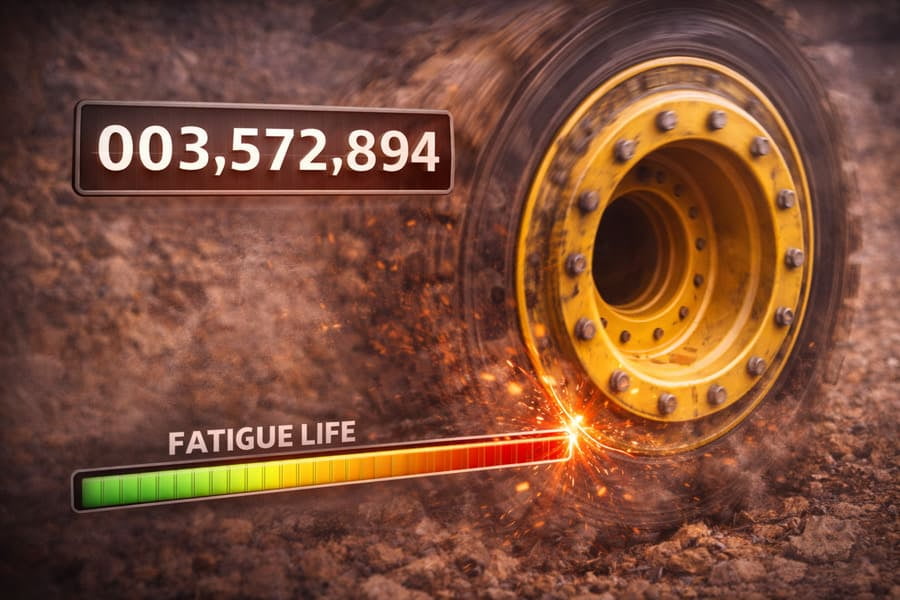
The most critical factor is not how high the load is, but how often the load is applied. A OTR wheel on a loader that moves materials 10 kilometers every day will experience vastly more stress cycles6 than a wheel on a crane that barely moves, even if the crane's load is heavier. The loader's wheels are constantly rotating, flexing, and creating fatigue damage. Every rotation is one tick off its total lifespan. This is why we, as manufacturers, are obsessed with details that seem small. We ask about the average haul distance, the condition of the yard surface, and the number of shifts per day. This information helps us calculate the total number of cycles the wheel will face, which is the true predictor of its service life. A wheel designed for low cycles will fail quickly in a high-cycle application, regardless of its max load rating.
Why Does Focusing on Cycles Instead of Peak Load Lead to Better Decisions?
Your current selection process is simple: match machine weight to OTR wheel capacity. How can a more complex, cycle-based approach actually make your job easier and save you money?
Focusing on cycles shifts the conversation from a single, misleading number to the wheel's actual job. This allows you to choose a wheel designed for your specific application's endurance5 needs, preventing early failures and reducing long-term costs.
When you start asking "How many cycles does this wheel need to survive?" instead of "What's the max load?", you change the entire game. It forces a deeper look at the application. For a machine that travels long distances, you will prioritize a design with smooth welds and high-quality steel optimized for fatigue resistance. For a stationary machine, you might focus more on static load capacity. This approach protects you from buying a wheel that is technically "strong enough" on paper but completely wrong for the job. I had a client who switched from a standard high-capacity wheel9 to one of our custom fatigue-resistant designs10 for their port shuttles. The price was slightly higher, but their wheel lifespan more than doubled, saving them a huge amount in replacement costs and downtime. They stopped buying a specification and started buying a solution for their actual operating conditions.
Conclusion
Stop focusing on the one-time maximum load. A wheel's true strength is its ability to endure millions of repeated cycles. Understanding this is the key to preventing premature failure and reducing your total cost of ownership.
Understanding maximum load capacity helps in selecting the right wheel for your machine's needs. ↩
Learn about metal fatigue to better understand the long-term durability of wheels under repeated stress. ↩
Discover the formation of fatigue cracks to prevent premature wheel failures in your operations. ↩
Understanding safety margins can help you make informed decisions about wheel selection. ↩
Learn about endurance to select wheels that can withstand daily operational demands. ↩
Explore how stress cycles contribute to wheel wear and failure, crucial for maintenance planning. ↩
Understanding this concept is vital for predicting and extending the service life of wheels. ↩
Explore how terrain impacts wheel performance to optimize your equipment for specific conditions. ↩
Discover the advantages of high-capacity wheels to enhance your machinery's efficiency. ↩
Explore custom designs to find solutions that fit your specific operational needs. ↩