

Your brand-new tractor vibrates violently on the road, but the tires are perfectly balanced. You're facing a frustrating and dangerous problem, and you can't seem to find the source.
A center bore error1 of just 0.1mm creates a "lug-centric2" fit, where the wheel is off-center and the bolts carry the entire load. This causes severe vibration3 and can lead to catastrophic bolt shear failure4. The wheel must be "hub-centric5" for a safe, stable ride.
I once met a fleet manager who was at his wit's end. He had a tractor that shook so violently above 20 km/h that his operators refused to drive it. He had replaced the tires, balanced the wheels multiple times, and even checked the axle alignment. Nothing worked. He called me, and I asked him to send me one of the wheels. I didn't even need to put it on a machine. A quick measurement with my calipers told the whole story: the center bore was nearly a millimeter too large. The wheel was "hanging" on the bolts. It’s a cheap manufacturing shortcut that puts lives at risk.
What Is the Difference Between Hub-Centric and Lug-Centric Wheels?
You assume that as long as the bolts line up, the wheel fits correctly. But this common misconception can lead to dangerous vibration3s and put extreme stress on your equipment without you even knowing it.
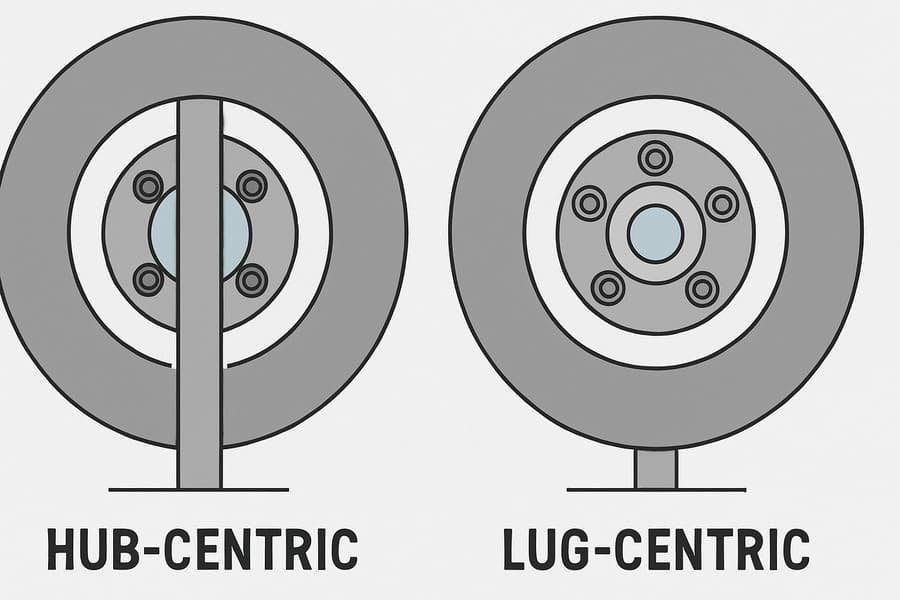
Hub-centric wheels are centered by a precise, snug fit between the wheel's bore and the tractor's hub, which carries the load. Lug-centric wheels have an oversized bore and rely only on the bolts for centering and support, a fundamentally unstable and unsafe design.

Understanding this difference is crucial for safety and performance. Think of the tractor's hub as a strong, solid peg designed to carry the vehicle's weight. A hub-centric5 wheel has a hole (the center bore) machined to fit that peg perfectly. The weight of the tractor rests securely on the hub. The wheel bolts simply clamp the wheel tightly against the hub face. In contrast, a lug-centric2 wheel has an oversized center bore, creating a gap around the hub. The wheel is only centered by the tightening of the lug nuts. This means the five or six small wheel bolts are forced to do a job they were never designed for: carrying the entire weight and absorbing all the force. It’s an unstable design that inevitably leads to problems.
Design Philosophy Comparison
| Feature | Hub-Centric Design (Correct) | Lug-Centric Design (Incorrect) |
|---|---|---|
| Load Support | The vehicle hub carries the full load. | The wheel bolts carry the full load. |
| Centering Method | Precision-machined center bore fits snugly on the hub. | Wheel is loosely centered by the tightening of lug nuts. |
| Stability | Excellent; perfectly centered, no vibration3. | Poor; prone to being off-center, causing vibration3. |
| Safety Risk | Low; forces are distributed as intended. | High; risk of bolt fatigue and shear failure. |
How Do We Guarantee a Perfect Hub-Centric Fit?
You need to trust that your wheels are manufactured to the highest standards. But how can you be sure that the invisible, critical dimension of the center bore is perfectly accurate?
We guarantee a perfect fit by machining every center bore on a CNC vertical lathe6, controlling the tolerance to the H7 grade. This is an automotive-level standard of precision that ensures the wheel is perfectly centered and supported by the hub.
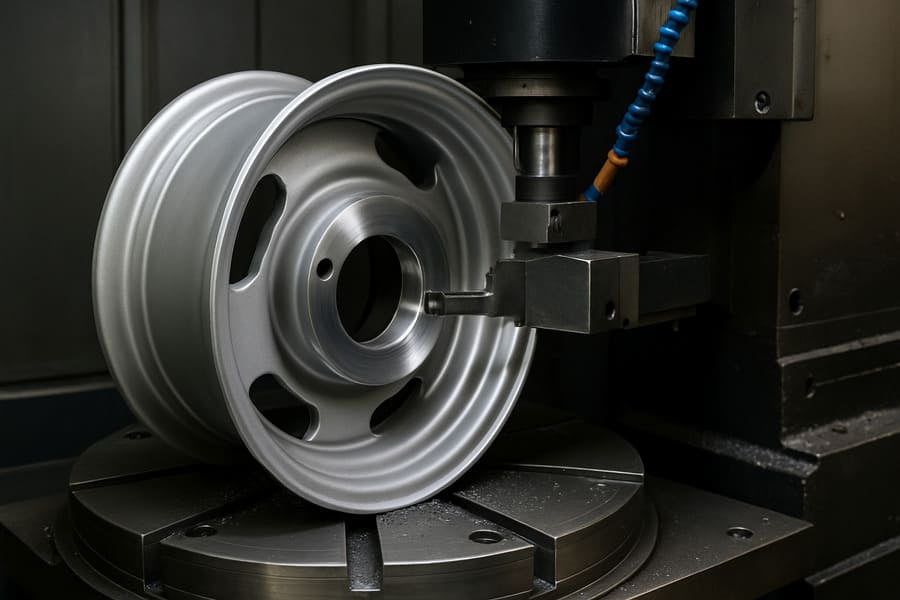
For us, there is no room for error. While some manufacturers cut corners by using less precise methods, we treat the center bore as one of the most critical dimensions of the wheel. Every single wheel we produce is mounted on a CNC (Computer Numerical Control) vertical lathe. This machine allows us to control the machining process with extreme precision. We machine the center bore to an H7 tolerance grade. In engineering terms, this defines a very specific and small range of acceptable sizes for the hole, ensuring a perfect "transition fit7" with the hub. It's not too tight to install, but it's not loose enough to allow for any movement or vibration3. This is the same standard used in the automotive industry, and we apply it to our agricultural wheels because safety and performance are just as important on the farm as they are on the highway.
What Happens When a Lug-Centric Wheel Fails?
You might think a little vibration3 is just an annoyance. But that vibration3 is a symptom of a much more dangerous problem: your wheel bolts are being subjected to immense and repeated shearing forces8.
When a lug-centric2 wheel is in use, the constant vibration3 and load cycles fatigue the wheel bolts. Eventually, this leads to metal fatigue9 and catastrophic shear failure, where the bolts snap and the wheel can detach from the vehicle.
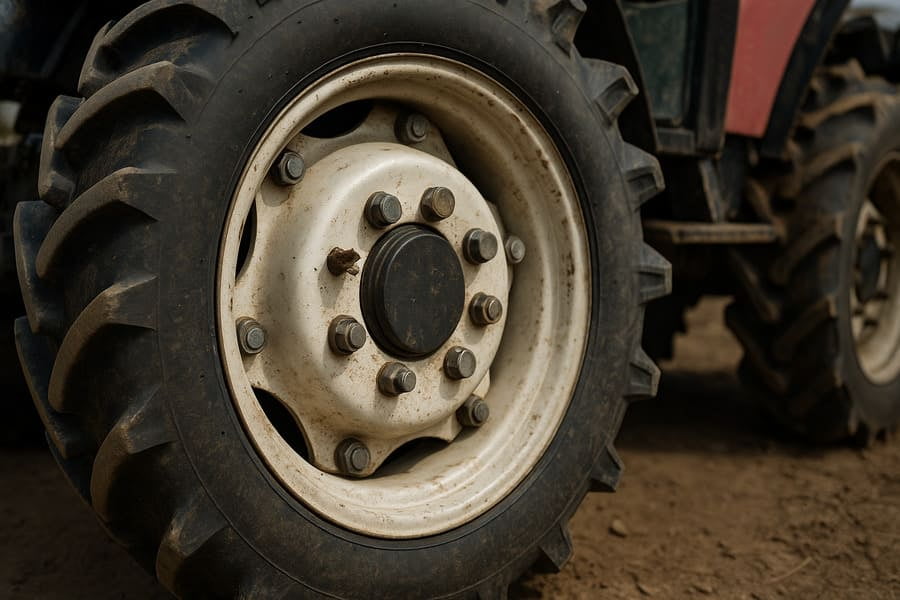
This isn't just a theoretical problem; I have seen the aftermath firsthand. We were once asked to analyze a failure for a customer who had bought cheap, low-end wheels from another supplier. The operator was driving on a paved road when he heard a loud bang and the tractor lurched violently. He managed to stop safely, but when he got out, he saw that three of the six wheel bolts had completely sheared off. The remaining bolts were bent and cracked. Our analysis was simple: the wheel's center bore was over 1.5mm too large. For months, every rotation of the wheel had put a massive shearing force on those bolts, flexing them back and forth. Metal can only endure so much of this before it snaps. The vibration3 wasn't just an annoyance; it was the sound of the bolts screaming for help before they failed.
Conclusion
Insist on automotive-level precision10 for your agricultural wheels. A perfectly machined, hub-centric5 wheel is not a luxury—it is essential for preventing dangerous vibration3s, eliminating bolt failure, and ensuring operational safety.
Understanding center bore error is crucial for ensuring wheel safety and performance, preventing dangerous vibrations. ↩
Learn about the risks associated with lug-centric wheels and how they can lead to catastrophic failures. ↩
Discover the causes of vehicle vibrations and effective solutions to ensure a smooth ride. ↩
Understanding bolt shear failure can help you take preventive measures to ensure vehicle safety. ↩
Explore the advantages of hub-centric wheels for stability and safety in vehicle performance. ↩
Gain insights into the precision of CNC vertical lathes and their role in producing safe wheels. ↩
Discover the concept of transition fit and its significance in ensuring proper wheel installation. ↩
Learn about shearing forces to understand their impact on wheel bolt integrity and safety. ↩
Learn about metal fatigue to understand its impact on vehicle safety and maintenance. ↩
Explore the importance of automotive-level precision in ensuring the safety and performance of wheels. ↩