
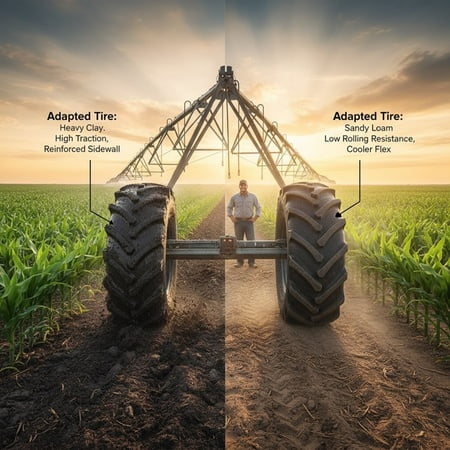
You found a fantastic irrigation tire that works perfectly in one market. You confidently deploy it in a new region, expecting the same success, but instead, you get premature failures1 and angry customers.
The same irrigation tire behaves differently because its performance is dictated by regional conditions2, not just its design. Factors like soil composition3, moisture, and operational habits4 create unique stress patterns that can make a tire a star in one environment and a failure in another.
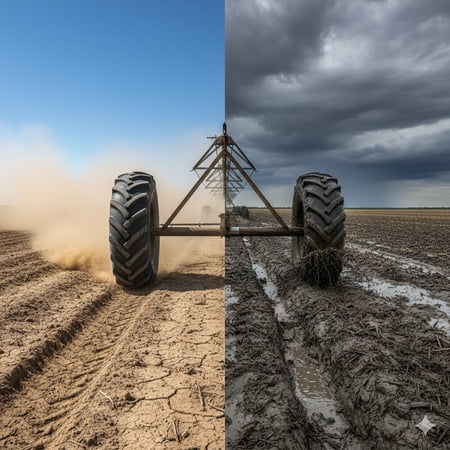
I'll never forget a conversation with a client who was expanding his business from the sandy soils of Egypt5 to the heavy clay regions of Brazil6. He insisted on ordering the exact same tire model that had been a huge success for him for years. "If it works, it works," he said. Six months later, he called me, frustrated. The tires were showing severe cracking on the sidewalls. The issue wasn't the irrigation tire; it was the context. In the sandy soil, the tire had minimal friction. In the heavy, sticky Brazilian clay, the tire had to fight for every rotation, causing extreme sidewall flexing7 and heat buildup8 it wasn't designed for. We didn't have a product failure; we had an application failure.
How Can Identical Operations Create Wildly Different Irrigation Tire Stresses?
Your spec sheets are identical for two different farms. Same pivot, same weight, same watering schedule. Yet, tires on one farm last twice as long as the other. What's the hidden variable?
Soil structure, moisture levels, and terrain are the hidden variables9. What appears identical on paper becomes a completely different set of physical demands on the ground, changing how the tire grips, flexes, and carries its load.
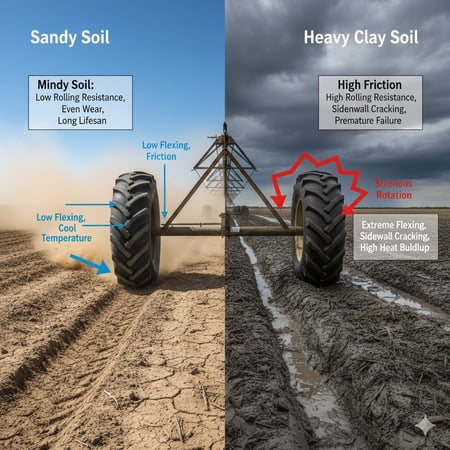
As a procurement manager, you trust your data. The problem is that the data for system weight and speed doesn't account for the ground itself. The ground isn't a constant; it's a dynamic and powerful force. A tire rolling on loose, sandy soil experiences very different stresses than one pushing through dense, wet clay. The clay sticks to the irrigation tire, adding weight and creating immense drag. This forces the tire's sidewall to flex and bulge with every rotation, generating internal heat that degrades the rubber. The same operation in a rocky field introduces sharp, unpredictable impacts. You might think you're comparing two identical scenarios, but from the tire's perspective, they are two completely different jobs with different levels of risk.
The Tire's Job Description: Region vs. Region
| Stress Factor | Region A: Sandy Loam | Region B: Heavy Clay |
|---|---|---|
| Traction Demand | Low to Moderate. Tire rolls easily. | High to Extreme. Tire must fight the soil. |
| Sidewall Flex | Minimal. Consistent and predictable. | Severe. Constant, deep flexing with each turn. |
| Heat Buildup | Low. Heat dissipates effectively. | High. Internal temperature rises, weakening the rubber. |
| Primary Risk | Puncture from hidden debris. | Sidewall failure, lug tearing, premature aging. |
Why Is a "Proven" Irrigation Tire Your Biggest Gamble in a New Market?
You're launching in a new country and decide to use your best-selling tire model. It's a safe bet, a proven winner. But this "safe" choice could become your biggest liability.
Replicating success from other regions carries hidden risk. A tire isn't "proven" in isolation; it's proven to work in a specific environment. Transferring it without adapting to new regional conditions2 is a recipe for quiet, costly failure.
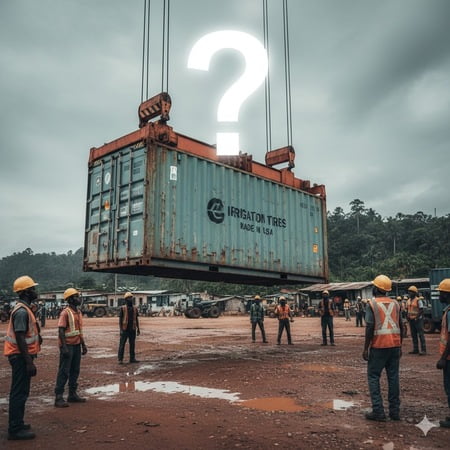
The most dangerous assumption a brand manager can make is that a good product will be a good product everywhere. In the world of agricultural tires, regional conditions2 often matter more than brand differences. I've seen premium, expensive tires from top brands fail miserably because they weren't suited for the local soil. At the same time, I've seen our custom-formulated, mid-range tires outperform them because they were specifically designed for those exact conditions. The failure usually happens because of overconfidence in "similarity." From a satellite, two fields might look the same. But on the ground, one has higher salinity in the soil, which accelerates rubber degradation. The other has a specific type of sharp shale just below the surface. These small, underestimated differences are what turn a proven solution into a new problem.
Why Do We Underestimate What We Can't See?
You've checked the pivot specifications, the weight, and the usage hours. Everything matches. So why are the results so different? It's because the most critical factors are often invisible.
Adaptation failures almost always come from overconfidence in what we assume is similar. The problem isn't that regions are different, but that their critical differences—like UV intensity10, soil chemistry, or local repair habits—are underestimated or ignored completely.

When we evaluate a new market, we focus on the obvious data points. But a irrigation tire's life is also determined by a host of "soft" factors. For example, in some regions, intense, direct sunlight with high UV radiation can cause rubber to become brittle much faster. In others, local maintenance practices might mean tires are consistently run underinflated, which is a death sentence for any tire, regardless of its quality. These aren't things you'll find on a technical spec sheet. As a supplier, our job is to ask these questions. We've learned that a successful partnership isn't just about selling a tire; it's about understanding the entire operational ecosystem. The managers who succeed are the ones who are humble enough to admit that what they don't know about a new region is their biggest risk.
Conclusion
To ensure success, stop looking for a universally "best" tire. Instead, focus on finding the right tire that is perfectly adapted to the unique, specific challenges of each individual region you operate in.
Understanding the causes of premature failures can help you prevent costly mistakes and improve the longevity of your irrigation tires. ↩
Exploring how regional conditions impact tire performance can guide you in selecting the right tire for specific environments. ↩
Learning about soil composition's role in tire performance can help you choose the best tire for your agricultural needs. ↩
Discovering the impact of operational habits on tire lifespan can lead to better maintenance practices and longer-lasting tires. ↩
Understanding the challenges in sandy soils can help you adapt your tire choice for similar environments. ↩
Exploring the effects of heavy clay soils can help you avoid tire failures in similar conditions. ↩
Learning about sidewall flexing can help you prevent tire damage and improve performance in challenging terrains. ↩
Understanding heat buildup's impact on tires can guide you in selecting materials and designs that withstand high temperatures. ↩
Identifying hidden variables can help you make informed decisions and optimize tire performance in various regions. ↩
Exploring UV intensity's effects on tire durability can help you select materials that resist environmental degradation. ↩