
You budget for tire replacement1 based on tread wear, a predictable expense. But then a tire is destroyed with 80% of its tread left, wrecking your budget and schedule.
In most heavy-duty, off-road conditions, tires fail at the sidewall, not the tread. Sudden cuts, impacts, or fatigue from heavy loads cause catastrophic sidewall failure2 long before the tread is worn, making sidewall strength3 the true measure of a tire's lifespan and value.
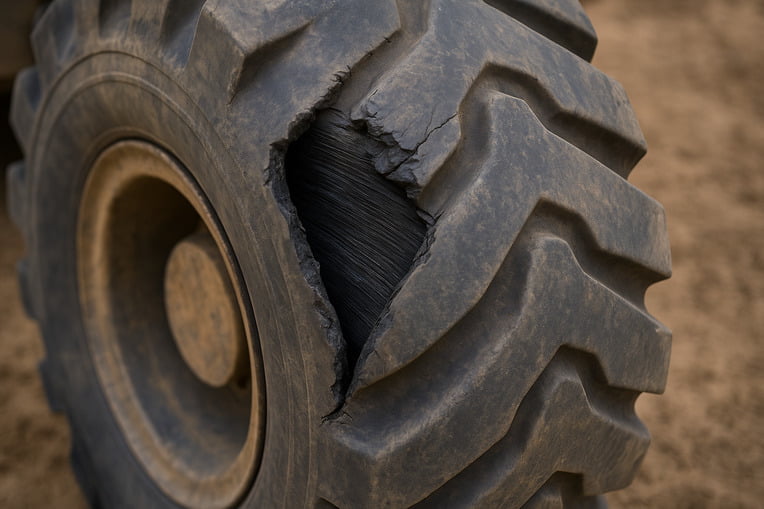
For years, I've watched clients get frustrated. They'd show me a tire graveyard filled with units that looked almost new from the front, but were useless because of a single, fatal wound to the side. They thought they bought bad tires. I had to explain that they bought the wrong tires. They were focused on tread life4, a metric that matters on the highway, but is often irrelevant in a quarry, a forest, or a demolition site. Understanding this difference is the first step to protecting your investment.
Why do off-road tires5 die with their tread still on?
It’s a frustrating sight: a perfectly good-looking tire, full of tread, being thrown on the scrap heap. This feels like burning money and makes you doubt the quality of your entire purchase.
The work environment for off-road machinery is a minefield of threats for a tire's sidewall. Sharp rocks, broken debris, and tree roots don't wear down a tire; they execute it with a single, fatal puncture or cut to its most vulnerable area.
When I visit a client's site, the first thing I look at isn't their machines; it's the ground they drive on. Is it scattered with sharp stones? Are there rebar and concrete chunks? Tree stumps? This terrain is the enemy. A tire tread is the thickest, toughest part, designed to handle abrasion from the road surface. A sidewall, however, has a different job. It needs to flex constantly to absorb shock and support the load. This need for flexibility makes it inherently thinner and more susceptible to sudden impact damage.
The Sidewall's Enemies
In these harsh environments, a tire isn't in a race against gradual wear; it's in a fight for survival against immediate threats. The tread is like the sole of a soldier's boot, but the sidewall is like the thin fabric on the sides.
Here’s how the vulnerabilities break down:
| Tire Part | Primary Function | Primary Threat | Mode of Failure |
|---|---|---|---|
| Tread | Grip & Abrasion Resistance | Friction on surfaces | Gradual wear-down over time |
| Sidewall | Flexing & Load Support | Sharp objects, impacts, pinching | Sudden cuts, punctures, tearing |
Think of it this way: the tread gets worn down, but the sidewall gets taken out. For any job outside of a smooth, paved road, you are far more likely to lose a tire to a sidewall injury than to run out of tread. This is the central truth of off-road tire economics6.
Is a tougher tread or a stronger sidewall more important for your bottom line?
You’re reviewing tire specs and focus on tread depth and wear-resistant compounds. But this focus can be a costly mistake when those tires are later destroyed by sidewall damage7, making your initial calculations completely useless.
For any off-road application, a stronger sidewall is infinitely more important to your bottom line. Tread wear is a predictable operating cost, while a sudden sidewall failure is a total asset loss, compounded by expensive downtime and replacement labor.
I’ve had this conversation with procurement managers hundreds of times. They show me a spreadsheet comparing the cost-per-hour based on tread wear projections. I have to gently point out that their projections are only valid if the tire actually lives long enough to wear down. A destroyed sidewall makes that entire spreadsheet irrelevant. The true cost of a tire isn't just its purchase price divided by its expected hours; it's the risk of total failure at any moment. A tire with a bulletproof sidewall that wears out its tread is a win. A tire with a long-lasting tread that gets cut in the first week is a total loss.
Bias vs. Radial: A Sidewall Strength Story
This is where understanding tire construction becomes critical. The choice between bias and radial isn't just about ride comfort; it's about structural integrity.
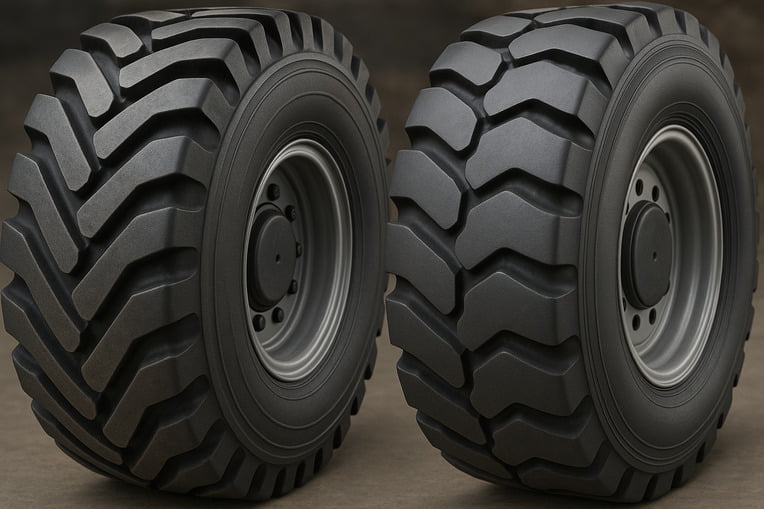
- Bias-Ply Tires: The overlapping layers of ply material create a thick, unified casing from bead to bead. This results in an inherently stiff and robust sidewall that is highly resistant to cuts and punctures.
- Radial Tires: The plies run straight across, creating a very flexible sidewall. While this is great for ride quality and heat dissipation at speed, it creates a significant vulnerability in harsh, debris-filled environments.
| Tire Type | Sidewall Construction | Key Sidewall Advantage | Key Sidewall Disadvantage |
|---|---|---|---|
| Bias-Ply | Overlapping plies, thick and rigid | Superior cut and impact resistance | Less flexible, more heat buildup |
| Radial | Plies run radially, flexible sidewall | Better ride comfort | More vulnerable to sidewall cuts |
For my clients in quarries or demolition, bias-ply tires8 are often the only sensible choice. The daily risk of sidewall impact is so high that the superior defense of a bias tire's construction is non-negotiable.
How can you tell if a tire is truly built for sidewall survival?
All heavy-duty tires look tough, but the spec sheets often focus on load and speed. You make a purchase based on these numbers, only to suffer a costly sidewall failure that could have been avoided.
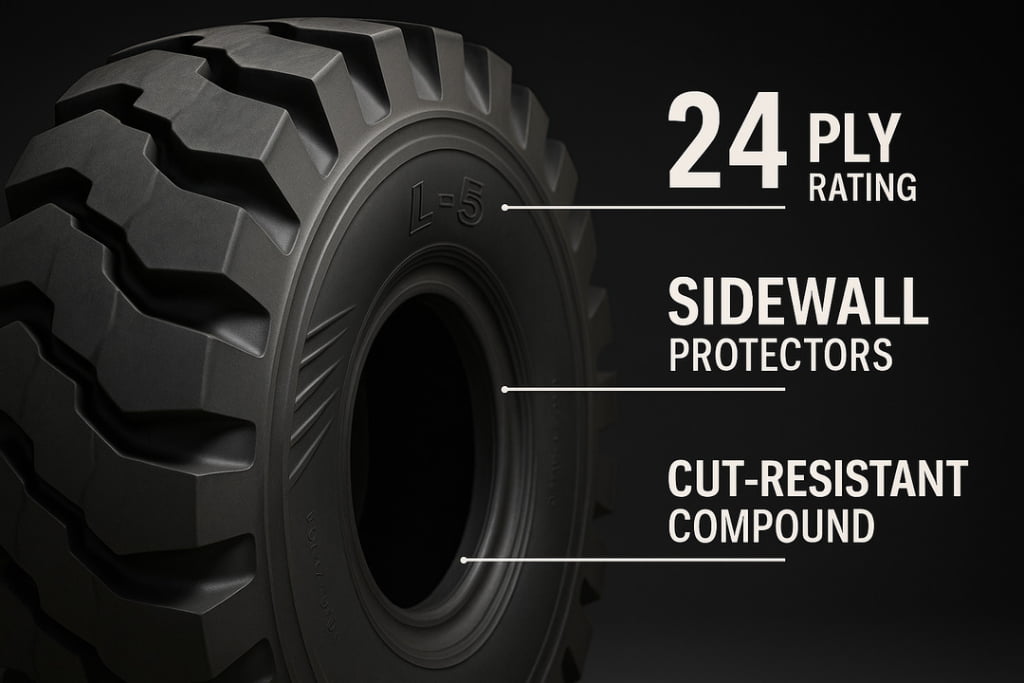
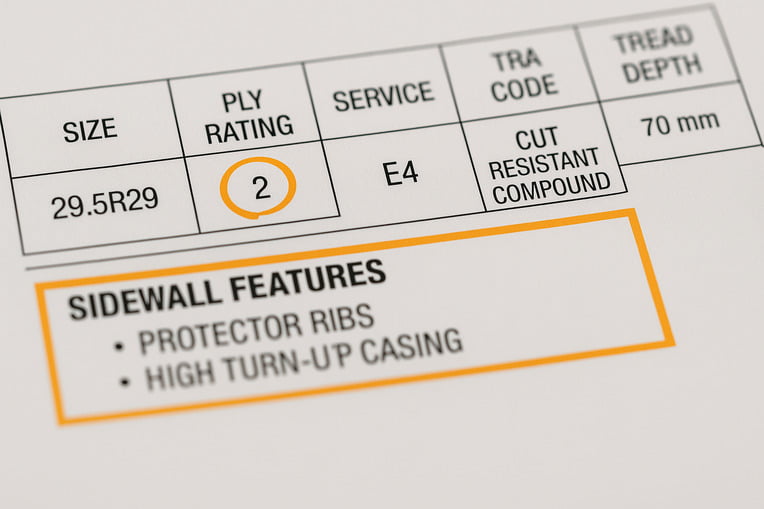
Look beyond the basic stats for specific indicators of sidewall reinforcement. Check for a high ply rating9, features like protector ribs, cut-resistant compounds10, and specialized service classifications like 'L5' for rock handling, which explicitly promises maximum sidewall protection.
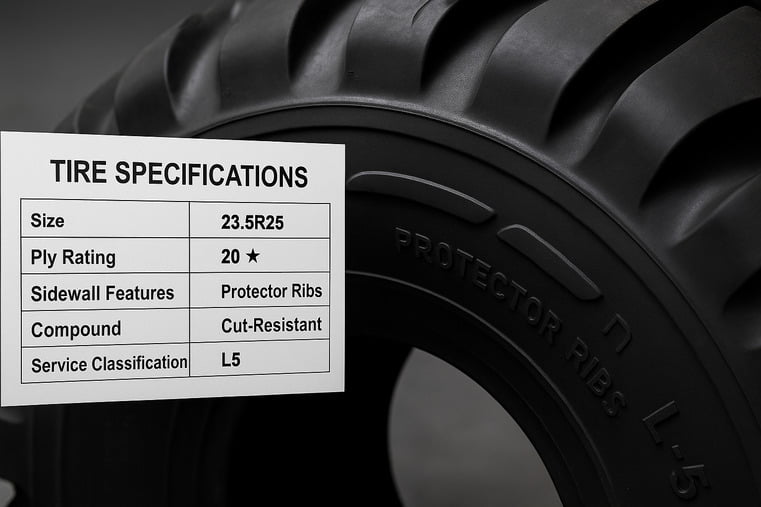
When a client asks me for the "toughest" tire, I don't just point them to the one with the deepest tread. We have to become detectives and look for the clues that the manufacturer has prioritized sidewall protection. These features aren't always in the main headline of a brochure, but they are the details that determine whether a tire will survive in the real world. As a supplier, it's my job to know what these clues are and guide my clients to the product that truly matches their hazardous environment. It builds trust and saves them a fortune in the long run.
What to Look For on the Spec Sheet and the Tire Itself
You need to know the language of durability. When evaluating a tire for a high-risk environment, ignore the flashy marketing and find these concrete features.
- Ply Rating / Star Rating: This is a classic indicator of a tire's overall strength. A higher number (e.g., a 24-ply rating9 vs. a 16) means a stronger casing, which directly contributes to a tougher sidewall.
- Sidewall Protectors: Some tires have thick ribs or a "curb guard" built into the sidewall. These are sacrificial rubber features designed to absorb impacts and deflect debris.
- Tire Classification: The service code tells you the intended job. An E-3 (Earthmover) tire is standard, but an L-5 (Loader) tire is specifically designed for rock-loading service with maximum cut resistance and an extra-deep tread. The L-5 classification is a promise of extreme durability, especially in the sidewall and casing.
- Compound Description: Look for terms like "chip-and-cut resistant." This indicates the rubber itself is formulated to resist tearing and gouging, which is vital for sidewall integrity.
Choosing the right tire is about matching its defensive characteristics to the threats on your job site.
Conclusion
Stop gambling on tread life4 in environments that kill tires from the side. Prioritize sidewall strength3 in your purchasing decisions to reduce failures, minimize downtime, and protect your profit margin.
Learn effective budgeting strategies for tire replacement to avoid unexpected costs. ↩
Discover the causes of sidewall failure to better protect your tire investment. ↩
Understanding sidewall strength can help you choose tires that last longer in harsh conditions. ↩
Explore the factors that influence tire tread life to make informed purchasing decisions. ↩
Find the best off-road tires designed to withstand tough environments. ↩
Understand tire economics to make smarter purchasing decisions for your business. ↩
Discover prevention strategies for sidewall damage to extend tire life. ↩
Learn about the benefits of bias-ply tires for heavy-duty applications. ↩
Understand ply rating to assess tire strength and durability effectively. ↩
Explore cut-resistant compounds to enhance tire durability in harsh environments. ↩