
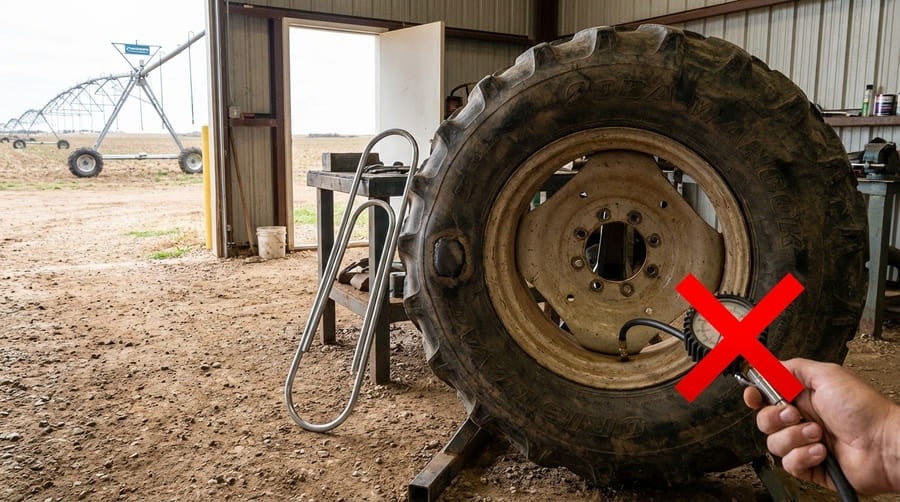
You see a bit of wear on a pivot tire and think adjusting the pressure or patching it will solve the problem. But you're trying to fix something that can't be healed.
Damage in irrigation tires is irreversible because it's not surface wear; it's cumulative structural fatigue1. Microscopic tears in the internal rubber and steel cords build up with every stress cycle2. This damage can't be undone, only managed until inevitable failure.
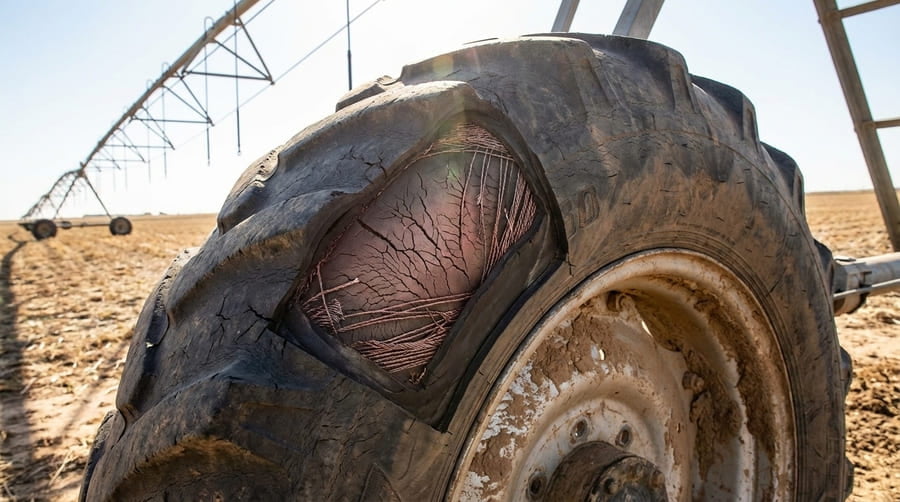
I once consulted for a large farm where the manager was meticulous. He’d proudly show me how he "saved" aging tires by lowering their pressure to reduce stress. One day, he called me in a panic. A pivot had gone down. The tire that failed was one he had been "babying" for months. He couldn't understand it. "But I did everything right to take care of it!" he said. The problem was, the damage was already done. His actions only delayed the inevitable. He wasn't fixing the tire; he was just managing its decline. That experience taught me that with irrigation tires, you can't turn back the clock.
Can't You Just 'Rest' a Tire to Heal It?
You let a tired field worker rest, and they recover. It seems logical that letting a tire sit, or giving it a break, might help it regain its strength.
A tire cannot "heal" because its fatigue is mechanical, not biological. Every flex creates tiny, permanent tears in its rubber and steel structure. This damage accumulates over time, like bending a paperclip until it breaks.
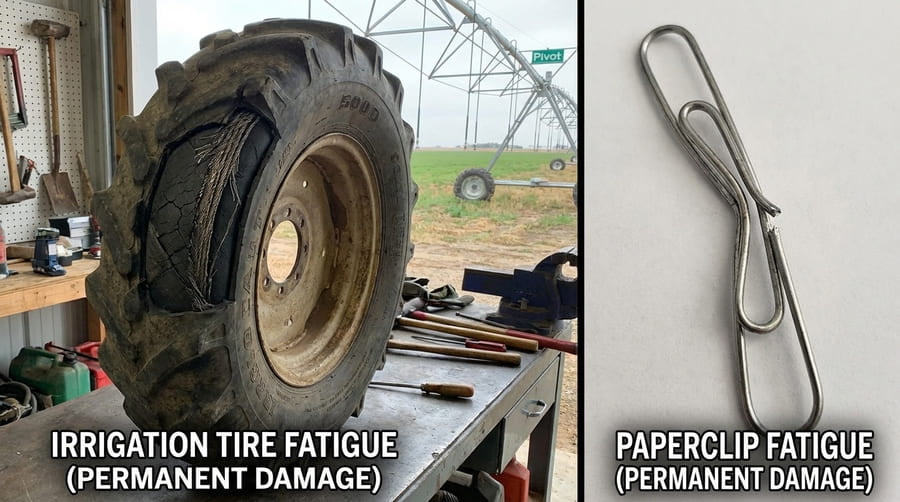
The best analogy I know is the paperclip. If you bend it once, it seems fine. You can bend it back, but it's already slightly weaker in that spot. If you keep bending it back and forth, it doesn't suddenly break. It breaks because the cumulative stress of every single bend has weakened the metal's internal structure to the point of failure. An irrigation tire is exactly the same. Each revolution, each day sitting under load, is another "bend." You can't see the damage, but it's adding up. Unlike a living muscle that repairs itself, the rubber and steel cords have no way to mend those microscopic tears3. The material is permanently changed, and its integrity is forever compromised. Resting the tire doesn't reverse the process; it just pauses it.
The Stages of Irreversible Fatigue
| Stage | Internal State | Reversibility |
|---|---|---|
| New Tire | Cohesive, strong internal structure. | N/A |
| Initial Use | First micro-tears appear in high-stress areas. | No. The damage has begun. |
| Mid-Life | Micro-tears connect, weakening plies and belts. | No. Structural integrity is now measurably lower. |
| End of Life | Widespread internal damage. A single stress event can cause failure. | No. The tire is a ticking clock. |
Doesn't Lowering the Pressure Fix the Problem?
You spot a bulge or signs of stress4 and immediately lower the tire pressure. You think you've just averted a crisis by reducing the strain.
Lowering pressure only reduces the rate of future damage; it does absolutely nothing to repair the weakness that is already there. It's like slowing down a car with broken brakes—it doesn't fix the brakes.
This is a common but dangerous misunderstanding. Let's say a tire's internal structure is already weakened. Lowering the pressure might reduce the overall strain on a specific bulge, but it also creates a new problem: increased sidewall flexing. Now, the tire bulges more at the bottom, and with every slow rotation, that weakened sidewall is being bent and unbent more severely. You may have traded one problem for another. The critical point is that you are not performing a repair. You are simply changing the conditions under which the already-damaged tire will continue to degrade. It creates a false sense of security, making you believe the tire is now "safe" when in reality, its failure point has just become less predictable. You're gambling, not managing.
Corrective Action vs. Actual Result
| Corrective Action | Perceived Goal | Actual Result |
|---|---|---|
| Lowering Pressure | Relieve stress, "fix" a bulge. | Slows some damage but accelerates sidewall fatigue. Masks the real problem. |
| Applying a Patch | Seal a leak, repair damage. | Seals a hole but does nothing for the surrounding brittle, fatigued rubber. |
| Rotating Tires | Even out wear. | Irrelevant for static UV/ozone damage. The oldest tire is still the oldest tire. |
Why Is Early Judgment So Critical in This 'Game'?
You think you have time, that you can wait until a tire looks really bad before replacing it. But with every day you wait, you are choosing to accept more permanent risk.
Early judgment is critical because tire management5 is a one-way street of accumulating risk. Since damage cannot be reversed, the only way to truly control risk is to remove the compromised tire from service before it fails.
Managing irrigation tires isn't like managing other equipment where you can repair parts to a "like new" state. It's more like managing a budget with no income—you only have so much to spend, and every expenditure is final. In this case, a tire's "budget" is its structural integrity6. Every day under the sun, every slow rotation under load, is a small, permanent withdrawal. Because you can't make a deposit to restore that integrity, your only real management tool is deciding when to close the account. Waiting until the tire is visibly failing means you've already let the risk accumulate to a critical level. The truly effective manager makes the call early, based on age and operating history, not just on visible symptoms. They play the game by preventing mistakes, because they know they can't undo them.
Conclusion
Stop trying to fix the unfixable. Irrigation tire damage is permanent. Effective management isn't about repair; it's about early judgment7 and proactive replacement to avoid the inevitable cost of failure.
Understanding cumulative structural fatigue is crucial for effective tire management and preventing failures. ↩
Understanding stress cycles can help you manage tire health and prevent premature failure. ↩
Learn how microscopic tears compromise tire integrity and lead to failure over time. ↩
Find out the best actions to take when you notice tire bulges or stress signs. ↩
Explore effective tire management strategies to extend tire life and ensure safety. ↩
Learn about the importance of structural integrity in maintaining tire safety and performance. ↩
Discover why making early judgments can prevent costly tire failures and enhance safety. ↩