
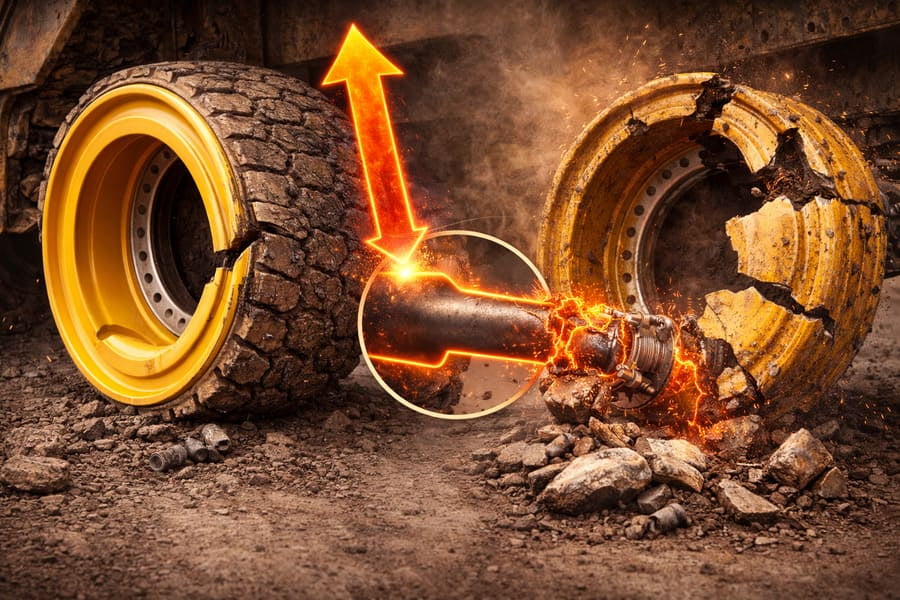
You specified a OTR wheel made from high-strength steel1, expecting superior safety. Yet, you're seeing failures in other parts of the vehicle, and the promised durability isn't there.
Stronger materials often add weight, which increases dynamic loads2 during operation. This extra stress is transferred to other components like axles and hubs, potentially creating new, more critical failure points and making the entire system less safe, not more.
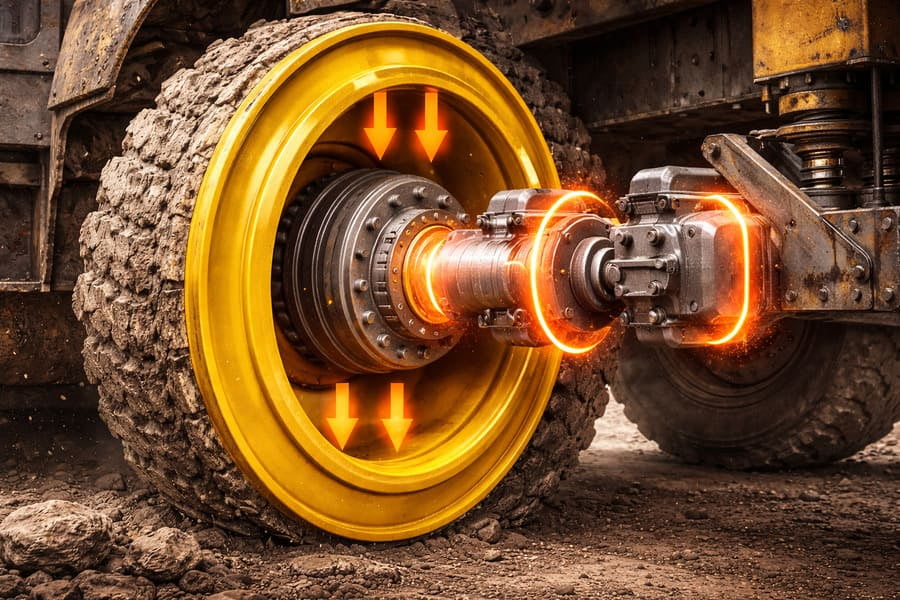
For years, I've had conversations with procurement managers who believe that upgrading to a "stronger" material is a simple, direct path to a more reliable product. It's a logical assumption. We build our business on high-performance products3, and materials are a huge part of that. But I’ve learned from countless field cases that a OTR wheel doesn't operate in a vacuum. It's part of a dynamic system. Bolting on a heavier, more rigid wheel can be like replacing a fuse with a copper pipe; you've stopped the fuse from blowing, but you've just moved the failure point somewhere far more expensive and dangerous. True safety is about balance, not just brute force.
Does Using a Stronger Material Automatically Make a Wheel Heavier?
You chose a high-grade steel alloy for your OTR wheels, thinking it's a clear upgrade. Now, you're dealing with unexpected side effects like reduced fuel efficiency and increased suspension wear.
Yes, in many cases it does. While some advanced alloys offer better strength-to-weight ratios, the most common "stronger" materials used for OTR wheels are denser or require more volume to achieve that strength, resulting in a heavier component.
When we talk about making a OTR wheel "stronger," we're often talking about its ability to resist deformation (yield strength4) and fracture (tensile strength5). But these properties don't exist in isolation. An engineer must balance them with other factors, especially weight and cost. A more robust design might simply use thicker steel, which directly adds weight. Alternatively, a different steel alloy might be chosen that has higher strength but is also denser. This added mass, known as unsprung weight6, is not carried by the vehicle's suspension. It directly impacts handling, traction, and the forces transmitted to the chassis. The goal isn't just a strong wheel; it's a wheel that is strong enough while remaining as light as possible to optimize the entire vehicle's performance.
How Does Extra Weight Increase the Load on a OTR Wheel?
Your new, heavier wheels feel solid and indestructible. But in the field, they seem to be causing more problems with bearings and axles than the lighter ones they replaced.
Extra weight multiplies the force of every impact. In motion, that added mass generates higher dynamic loads2 when hitting bumps or uneven terrain, putting immense stress on the wheel itself and everything it's connected to.
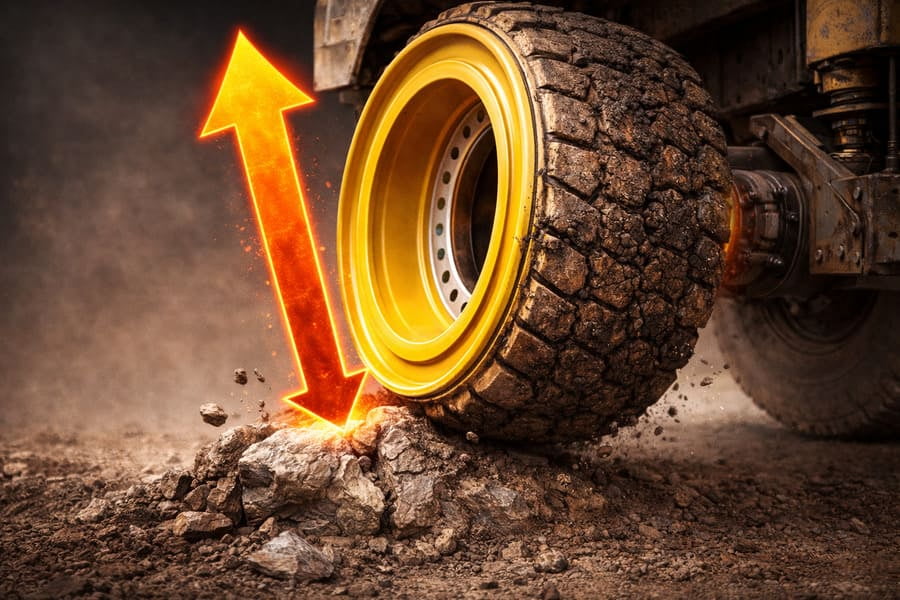
Physics gives us a simple rule: Force equals Mass times Acceleration (F=ma). When a vehicle is sitting still, the load is static. But the moment it starts moving, dynamic loads2 come into play. Every time a wheel hits a rock or a pothole, it accelerates upwards instantly. The heavier the wheel (the more mass), the greater the force of that impact. A few extra kilograms of steel can translate into hundreds of kilograms of additional shock load during a severe event. This repeated hammering is what causes metal fatigue7. A OTR wheel that seems perfectly strong on paper can fail prematurely because its own weight is creating forces far beyond what the initial static load calculations predicted. The wheel is, in effect, beating itself and the vehicle to death.
Can a Stronger OTR Wheel Actually Make the Whole Vehicle Less Safe?
You've successfully reinforced the wheel so it no longer cracks. But now, you're getting reports of catastrophic axle failures and damaged hubs, which are far more costly and dangerous.
Yes, it can. By making one component overly rigid, you can turn it into a tool that breaks other parts of the system. A wheel should be a durable part of a balanced system, not the indestructible link that causes everything else to fail.
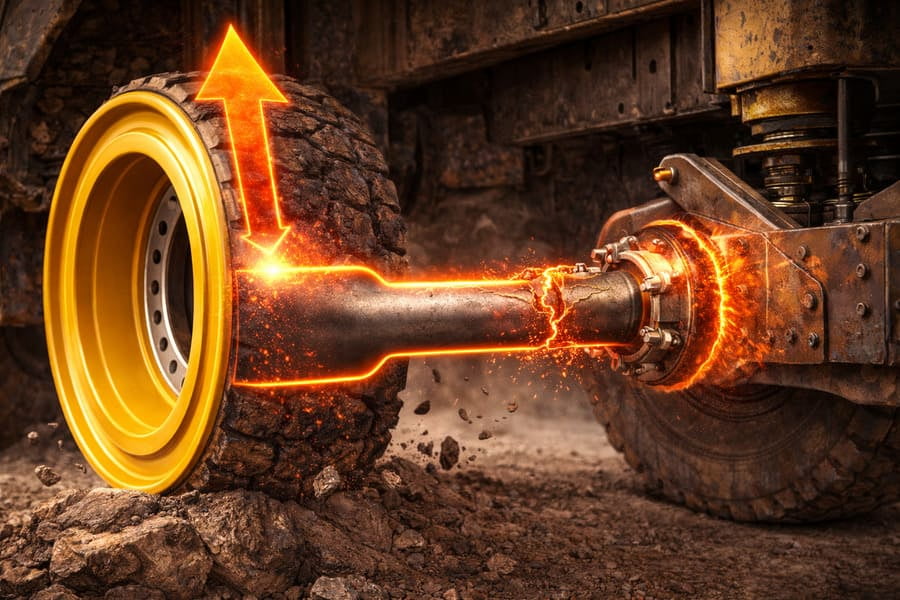
Think of an OTR vehicle's drivetrain and suspension as a complete system designed to manage and absorb energy. Each component has a certain tolerance. In a well-designed system, the wheel might be designed to bend slightly under an extreme overload. This is a form of "graceful failure8"—it prevents a catastrophic failure elsewhere. When you introduce a wheel that is too strong or rigid, it no longer absorbs its share of the impact energy. Instead, it transfers 100% of that force directly to the next components in line: the hub, the bearings, the axle, and even the chassis. You haven't eliminated the stress; you've just redirected it to parts that are often more critical and much more expensive to replace. You fixed the symptom (cracked wheels) but created a much worse disease (broken axles).
How Can a Strong Material Amplify System Risk?
You've invested in premium materials to build customer trust. But now, the consequences of a failure seem much more severe, turning minor incidents into major equipment write-offs.
A material that is very strong but not tough can be brittle. It resists bending but can fracture suddenly and catastrophically under impact, whereas a less strong but tougher material might bend and provide a warning before complete failure.
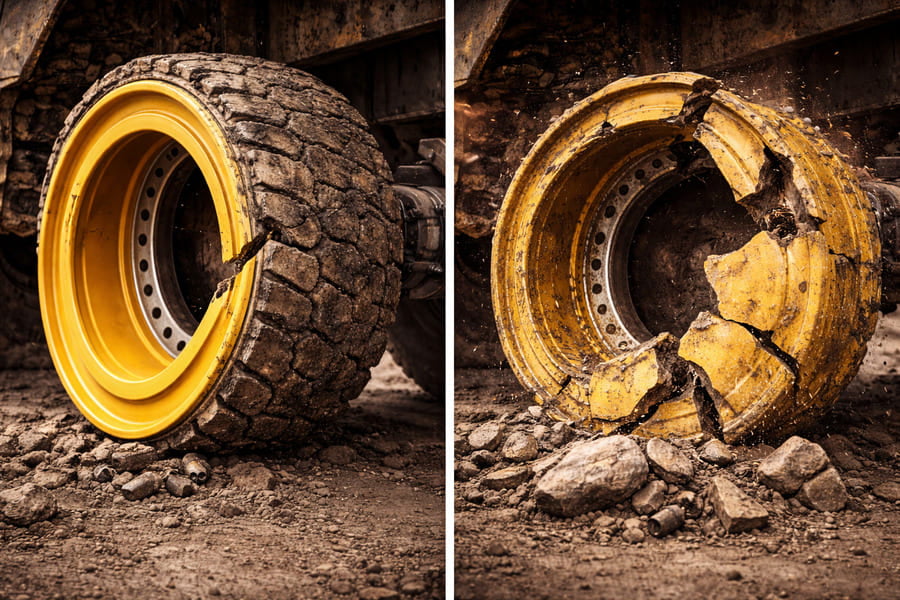
The material science behind this is the difference between strength and toughness9. Strength is the ability to resist a force. Toughness is the ability to absorb energy and deform without fracturing. Some high-strength materials have low toughness9, making them brittle.
| Material Property | Description | Implication for Safety |
|---|---|---|
| Strength | Resists bending under load. | A high-strength wheel won't easily deform. |
| Toughness | Absorbs impact energy before fracturing. | A tough wheel might bend, not shatter. |
| Brittleness | Fractures with little to no deformation. | A brittle wheel can fail suddenly and completely. |
A wheel made from a material that is strong but not tough might seem fine until it receives one sharp impact beyond its limit. At that point, it can shatter catastrophically. A wheel made from a tougher, slightly less strong material might have bent under the same impact. A bent wheel is a problem that needs fixing, but a shattered OTR wheel can cause a complete loss of control, leading to a much more dangerous and costly accident. The "stronger" material, in this case, amplified the risk by eliminating any warning signs of failure.
Conclusion
True safety comes from intelligent system design and material balance10, not just from chasing the highest material strength. A durable OTR wheel works with the vehicle, not against it.
Explore how high-strength steel enhances vehicle safety and performance, providing insights into its applications. ↩
Understanding dynamic loads is crucial for optimizing vehicle design and ensuring safety during operation. ↩
Discover the characteristics of high-performance products and their impact on industry standards. ↩
Discover the significance of yield strength in material selection for engineering applications. ↩
Gain insights into tensile strength and its role in ensuring material reliability under stress. ↩
Learn about unsprung weight and its impact on handling and ride quality in vehicles. ↩
Explore the factors leading to metal fatigue and how to mitigate its effects in engineering. ↩
Understand the concept of graceful failure and its importance in creating safer systems. ↩
Explore the difference between toughness and strength, and why it matters for material performance. ↩
Understand the importance of material balance in creating efficient and safe engineering solutions. ↩