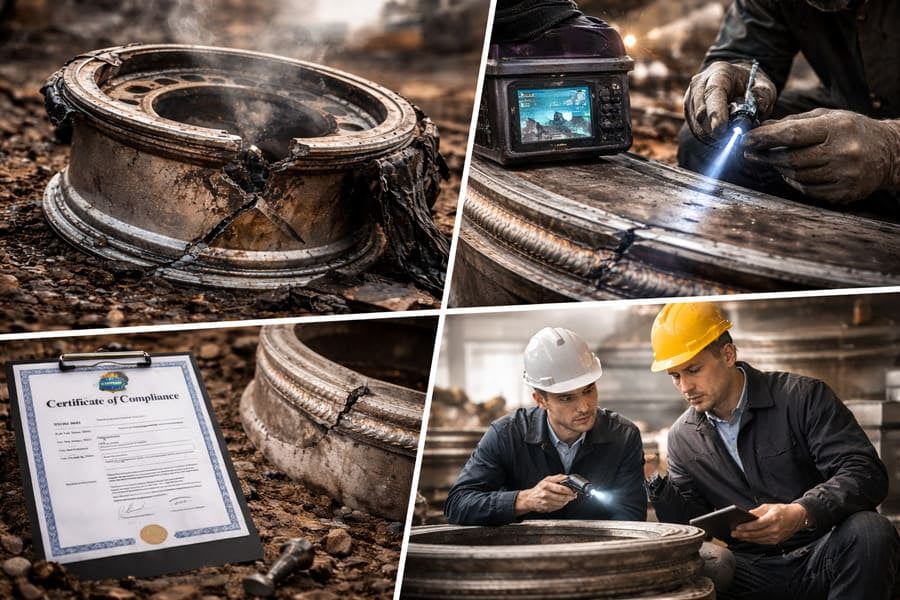
You've sourced OTR rims that proudly "meet the standard." But when a failure happens in the field, that certificate won't protect your brand or cover your operational losses.
The phrase "meets the standard1" is dangerous because it only confirms a product passed a minimum baseline test. It ignores real-world dynamic stress2, critical functional quality3 like welds, and crucially, it often transfers the ultimate liability for field failures from the factory to you.
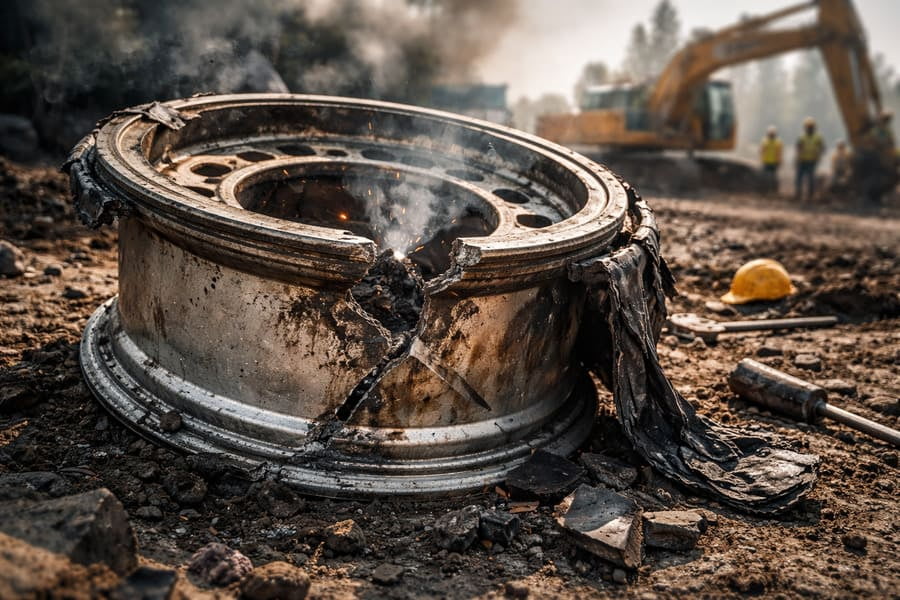
For over a decade, I've seen procurement managers breathe a sigh of relief when they see a compliance certificate4. I used to feel the same way. But I learned the hard way that in the heavy-duty world of OTR equipment, the standard is the starting line, not the finish line. A catastrophic failure doesn't care about paperwork. The real question is what happens after the failure, and that's a question the standard rarely answers. Let's dig into where the real risks are hiding.
If a Rim Fails in the Field, Who Really Takes the Blame?
Your team sourced a compliant rim. It fails, causing massive downtime and potential safety issues. The supplier points to their certificate, leaving you to deal with the fallout.
"Meets the standard" doesn't eliminate risk; it simply assigns it. When a certified rim fails, the failure is often traced back to the buyer for "improper application" or "exceeding operational limits5," because the standard itself becomes the manufacturer's primary legal defense.
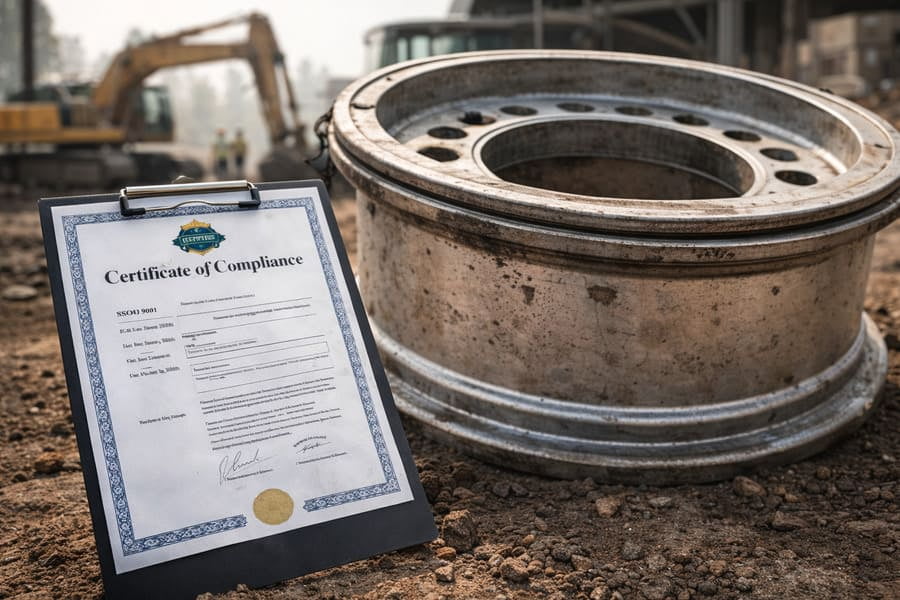
I remember a client who faced this exact scenario. A fleet of their machines was grounded because of rim failures. Their supplier showed them the ISO certificates6 and claimed the product was not at fault. The burden of proof shifted entirely to my client. This taught me a critical lesson: the real question isn't if a product will fail, but who is contractually responsible7 when it does. A simple certificate often makes you responsible. A true partner, however, shares the responsibility because their quality goes beyond the minimum standard.
The Standard vs. Real-World Liability
The gap between certification and field reliability is where your risk lives. Understanding this distinction is key to protecting your business.
| Aspect | "Meets the Standard" Supplier | True Quality Partner |
|---|---|---|
| Philosophy | The certificate is the goal. | The certificate is the starting point. |
| Risk Position | Risk is transferred to the buyer upon sale. | Risk is shared through quality guarantees. |
| Failure Response | "Our product met the standard." | "Let's analyze the failure and find a solution." |
| Your Liability | High. You must prove the standard was flawed. | Low. The partner helps resolve the issue. |
A supplier who only talks about standards is selling you a product and a potential problem. A partner who talks about performance, material traceability, and joint failure analysis8 is selling you a solution and peace of mind.
Is a "Standard" Weld Strong Enough for Real-World Stress?
You see a clean, uniform weld on an OTR rim and assume it's good. But under the immense torque and load of a haul truck or loader, that "good-looking" weld cracks.
A compliant weld doesn't guarantee structural safety. In OTR rims, the weld is not a cosmetic feature; it is a critical load-bearing function. Standards may only test for basic penetration and appearance, ignoring the weld's resilience to the constant twisting and impact forces of real-world use.
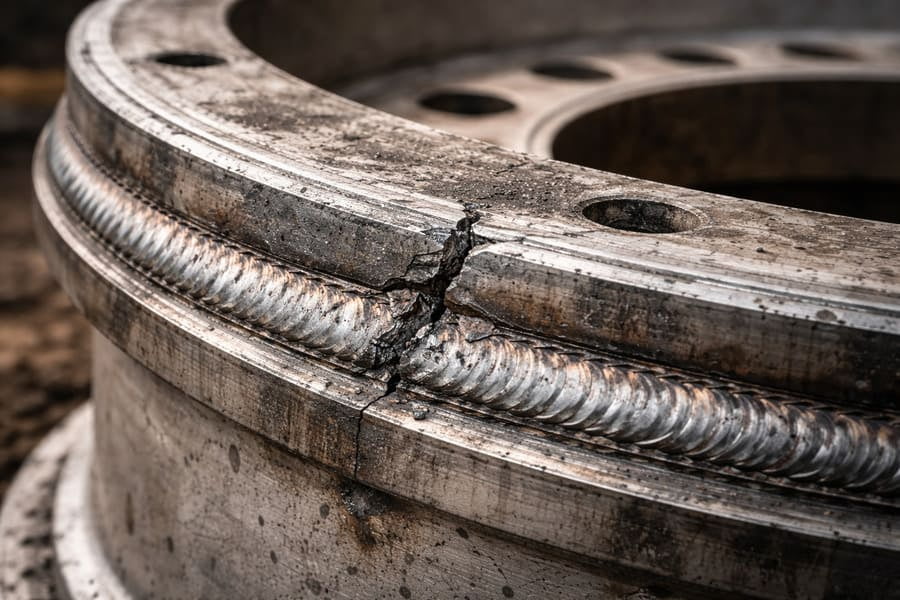
Early in my career, I visited factories where weld quality9 was judged primarily by eye. It looked clean, so it passed. But I've since seen the destructive results of such an approach. We now know that a weld's internal structure, its heat treatment, and its profile are what determine its strength. At Gescomaxy, our production lines use advanced inspection methods far beyond basic visual checks. We perform ultrasonic tests and metallographic analysis because we understand that a single weld is often what stands between a productive day and a catastrophic, dangerous failure.
What to Look for Beyond a "Compliant" Weld
A weld is the backbone of an OTR rim. Here’s what truly matters:
- Full Penetration: Is the weld fused completely through the metal thickness? Surface-level welds are dangerously weak.
- Material Quality: Was the correct welding wire and gas mixture used for the specific grade of steel? A mismatch can create a brittle joint.
- Heat Treatment: Was the rim properly stress-relieved after welding? Without it, the area around the weld can be weak and prone to cracking under load.
- Testing & Traceability: Does the manufacturer provide data from non-destructive testing (NDT)10? Can they trace the weld back to a specific machine, operator, and batch of materials?
A pretty weld is nice. A tested, traceable, and structurally sound weld is non-negotiable.
What Does "After-Sales Support" Truly Mean When Something Goes Wrong?
Your supplier's contract mentions "after-sales support11." But when you report a failure, you get a slow, bureaucratic response that asks you to fill out forms and wait for weeks.
Unclear after-sales responsibility isn't a neutral policy; it's a pre-assigned liability. If the support process is not clearly defined, fast, and solution-oriented, it is designed to protect the supplier, not to help you. The liability for downtime and replacement costs defaults to you.

This is the hidden cost in sourcing. A low upfront price often comes with a non-existent support structure. I've built my business on the opposite principle. True after-sales support11 is not about processing a warranty claim eventually. It’s about having a technical expert12 on a call with you within 24 hours to analyze the problem. It’s about working with you to get your machine running again, because we know your losses from downtime are far greater than the cost of a rim. A vague support policy13 is a red flag that you will be on your own when a problem occurs.
Defining Real After-Sales Support
Don't accept vague promises. Demand a clear framework for support.
| Vague Support (High Risk) | Clear Partnership (Low Risk) |
|---|---|
| "Contact us for warranty information." | "Dedicated technical contact for immediate issue analysis." |
| Response time: "within 5-10 business days." | Response time: "within 24 hours." |
| Process: Form submission, internal review. | Process: Joint failure analysis, immediate feedback. |
| Goal: Determine who is at fault. | Goal: Get the customer's equipment operational. |
Before you sign any supply agreement, ask this simple question: "Describe, step-by-step, what happens when I call you with a field failure." The answer will tell you everything you need to know about who is truly carrying the risk.
Conclusion
Relying on "meets the standard1" is a gamble with your brand's reputation and operational stability. You need a partner who builds to a performance standard14, not just a compliance one.
Understanding this phrase is crucial to avoid potential liabilities in your procurement process. ↩
Learn about the impact of real-world conditions on product reliability and safety. ↩
Discover why critical functional quality is essential for product durability and performance. ↩
Explore the significance of compliance certificates in ensuring product safety and quality. ↩
Understanding operational limits can help you avoid costly failures and liabilities. ↩
Find out how ISO certifications can impact your procurement decisions and product safety. ↩
Explore the implications of contractual responsibility in supplier agreements. ↩
Discover how joint failure analysis can lead to better solutions and partnerships. ↩
Learn about the importance of weld quality in ensuring structural integrity. ↩
Discover how NDT can prevent failures and ensure product reliability. ↩
Understanding after-sales support can save you from future operational headaches. ↩
Learn how having a technical expert can expedite problem resolution and minimize downtime. ↩
Explore the potential pitfalls of unclear support policies in your supply chain. ↩
Understanding this difference can help you choose better suppliers for your needs. ↩