
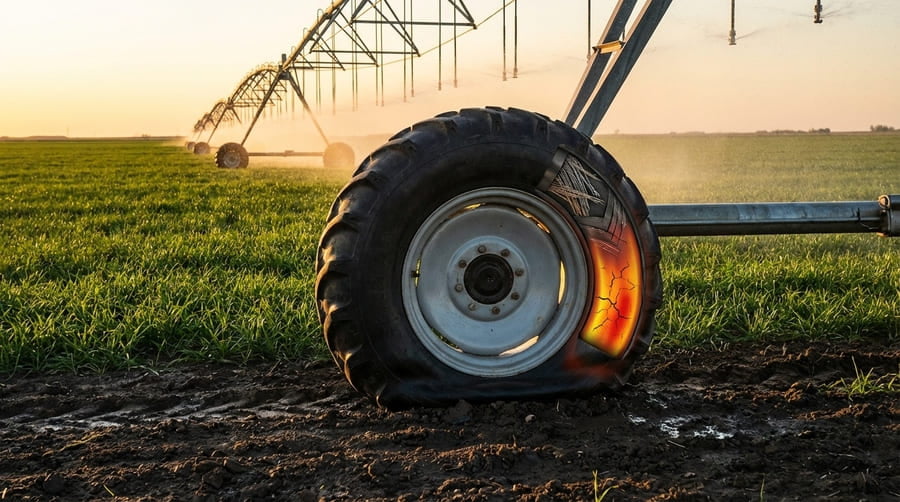
You lower your pivot tire pressure1 to protect your soil, thinking you’re making the smart, sustainable choice. But this well-intentioned action is silently destroying your tires from the inside, leading to failures that seem to come out of nowhere.
Lowering pressure on irrigation tires increases carcass deflection2. Under the constant, sustained load of a center pivot, this excessive flexing dramatically accelerates internal material fatigue3. While it benefits the soil, it compromises the tire’s structural integrity, causing it to fail much faster.
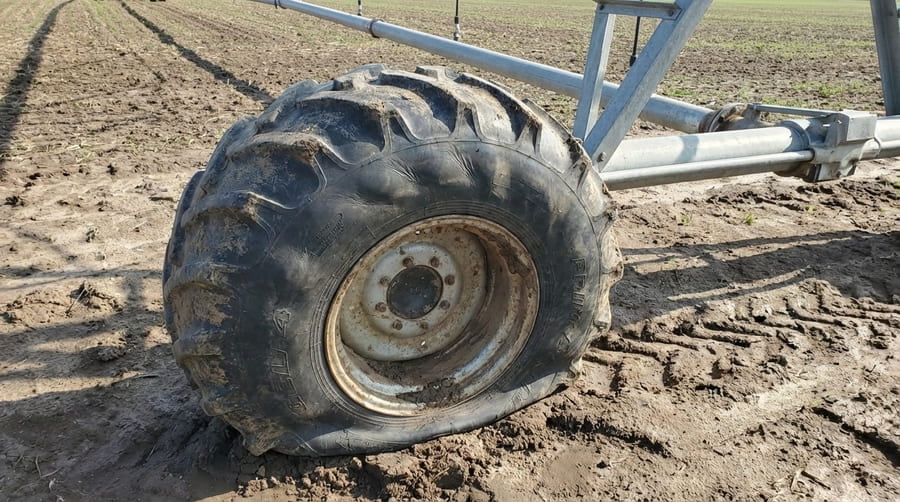
I once met a farm manager in Iowa who was incredibly proud of his low-compaction setup. He showed me how his pivot left minimal ruts by running the tires at a very low PSI. On the surface, it looked perfect. But when I looked closer, I could see the subtle but unmistakable signs of extreme sidewall stress4 on his tires. I tried to explain that what he was gaining in soil health, he was losing in irrigation tire life5. He waved it off. Six months later, he called me, frustrated that a third of his irrigation tires had failed, not from punctures, but from what he called "just falling apart." He had accidentally traded a visible problem for an invisible one, and the cost was much higher.
How Does Protecting Your Soil End Up Destroying Your Tires?
You reduce the irrigation tire pressure, and your soil breathes a sigh of relief. But inside the tire's structure, a battle is being lost, setting you up for an expensive replacement.
Lowering pressure to reduce soil compaction6 forces the irrigation tire's carcass to bend and flex more with every single rotation. This increased deflection, happening under the pivot's relentless weight, is the primary driver of accelerated internal fatigue.
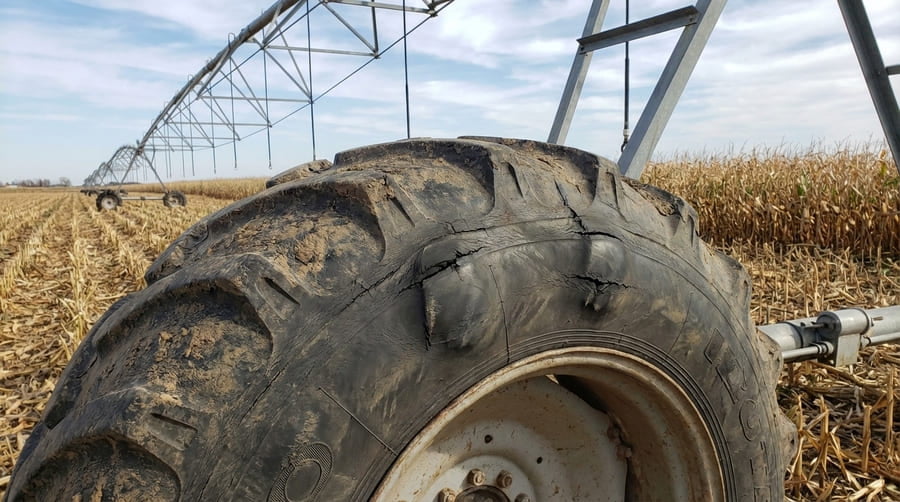
Think of it like bending a paperclip. If you bend it just a little, you can do it many times. But if you bend it sharply back and forth, it snaps quickly. A irrigation tire's carcass is no different. The air inside is meant to carry most of the load. When you lower the pressure, you force the rubber and internal cords to do more of the work by flexing more deeply. This is the "sharper bend." For a tractor that works for a few hours and then stops, this might be manageable. But a center pivot runs for days on end. The tire is constantly bending, flexing, and accumulating fatigue. You can't see this damage until it's too late. The tire doesn't fail because of one bad rut; it fails because it has been bent one million times too many.
The Deflection Dilemma: Soil Gain vs. Tire Pain
The choice to lower pressure involves a direct trade-off between the ground and the tire itself. What helps one often hurts the other.
| Parameter | Optimal Pressure | Low Pressure |
|---|---|---|
| Soil Compaction | Higher | Lower |
| Tire Footprint | Smaller | Larger |
| Carcass Deflection | Minimal | Excessive |
| Internal Fatigue Rate | Normal | Accelerated |
| Long-Term Reliability | High | Low |
This table shows the conflict clearly. The very thing that creates a larger, soil-friendly footprint—excessive carcass deflection2—is also what systematically destroys the tire's internal structure over time.
Are Your 'Soil-Friendly' Settings Secretly Tire-Hostile?
You've set your system to be gentle on your fields. But this "eco-friendly" approach creates a hostile environment for your irrigation tires, creating a hidden conflict that costs you money.
A "soil-friendly" low-pressure setting7 is fundamentally tire-hostile for an irrigation system. Tires are engineered for an optimal pressure range8 to support a specific load. Operating below this range shifts the stress from the tread to the sidewalls, which are not designed for that kind of continuous flexing.
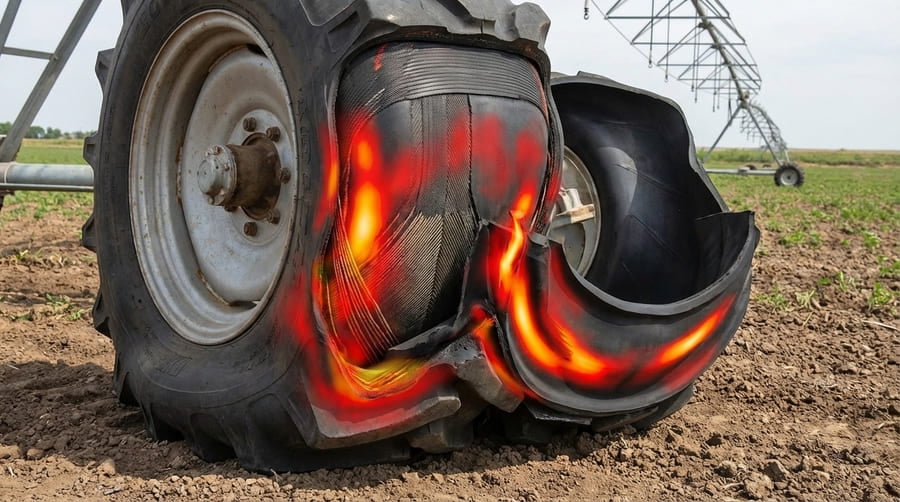
In an ideally inflated tire, the load is distributed evenly, and the sidewalls act as stable pillars. When you reduce the pressure, those pillars begin to bulge and buckle with every rotation. The internal cords are stretched and relaxed, and heat builds up in the rubber. This is the definition of fatigue. What makes this worse for irrigation tires is the nature of their work: constant load, non-stop operation. A tractor tire gets a break. An irrigation tire does not. It is subjected to this sidewall-punishing cycle 24 hours a day for weeks on end. You are essentially asking the weakest part of the tire to do the heaviest work, continuously. It's an unsustainable equation, and the only possible outcome is premature failure9. The setting isn't just soil-friendly; it's a planned obsolescence program for your tires.
Why Do Static Pressure Settings Create Such Dynamic Risks?
You set your tire pressure at the beginning of the season and forget about it. This "set it and forget it" mentality is the biggest mistake you can make with irrigation tires.
The primary risk comes from applying a single, static pressure setting to a highly dynamic irrigation environment10. Temperature fluctuations and changing ground conditions alter the tire's state, but the pressure isn't adjusted to match, allowing unseen stress to accumulate rapidly.
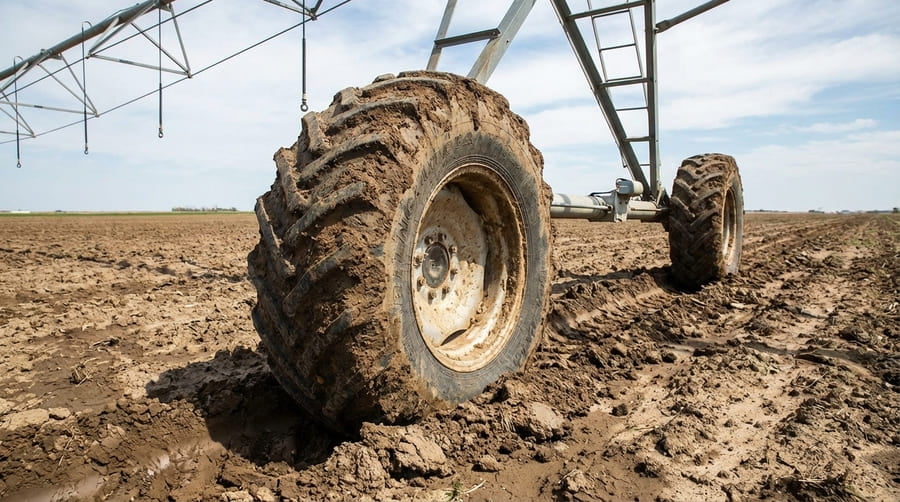
Let’s get practical. You set your tire pressure on a cool 60°F (15°C) morning. By mid-afternoon, the sun has baked the black rubber to a surface temperature of over 120°F (50°C). This heat increases the air pressure inside the tire, changing its footprint and stiffness. Then, the pivot moves from dry, hard ground into a wet, muddy patch. The rolling resistance skyrockets, putting immense new stress on the tire's bead and structure. Your static pressure setting, which might have been acceptable in one condition, is now completely wrong for another. This mismatch is where the danger lies. The tire is constantly operating outside its ideal parameters, but there are no warning lights to tell you. Every hour, it accumulates a little more damage, a little more fatigue, until it finally reaches its breaking point. True safety and reliability come from adapting to conditions, not from a single setting you hope will work everywhere.
Conclusion
Stop treating low pressure as a universal solution. For irrigation tires under constant load, the right pressure isn't about protecting the soil; it's about preserving the irrigation tire to keep your system running.
Understanding the balance between tire pressure and soil health can help optimize both. ↩
Learn about carcass deflection and its effects on tire performance and longevity. ↩
Discover the factors leading to tire fatigue and how to mitigate them. ↩
Understanding sidewall stress can help prevent premature tire failures. ↩
Find effective strategies to prolong the lifespan of your irrigation tires. ↩
Explore how soil compaction influences crop yields and farming practices. ↩
Explore the potential dangers of low-pressure tire settings in agriculture. ↩
Find out the ideal pressure range to ensure tire longevity and performance. ↩
Learn about the common causes of tire failure to avoid costly replacements. ↩
Learn how changing conditions impact tire efficiency and safety. ↩