
You see a tire and think you know its limits from your experience with tractors or trailers. But applying that same logic to irrigation tires1 leads to unexpected, costly failures.
Comparing irrigation tires1 to others distorts risk because their operational demands—constant static loads2, slow rotational stress, and high UV exposure3—are fundamentally different. This flawed analogy leads to underestimating their unique failure modes4, causing preventable downtime when they're needed most.
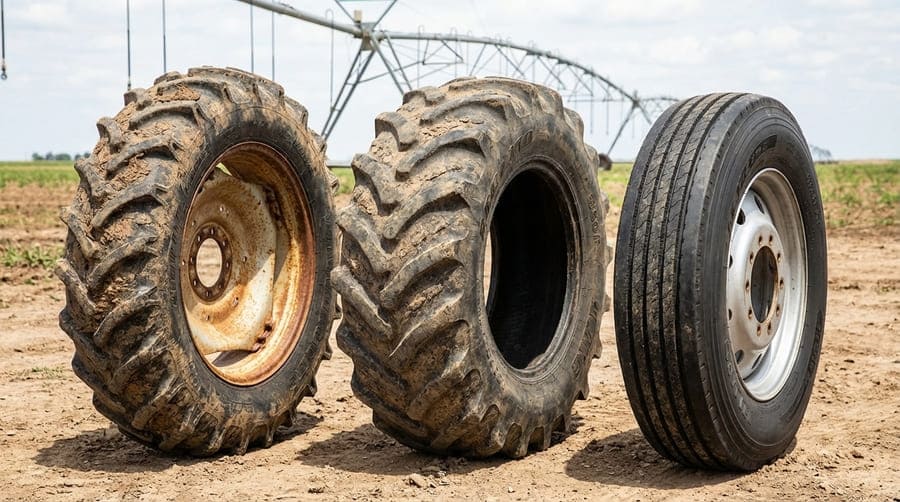
I've seen this happen many times. A purchasing manager, who was an expert with his fleet of highway trailers, applied the same replacement logic to his center pivots. He figured if a tire had good tread, it was good to go. He ended up with a field full of flat tires in the middle of a two-week dry spell. He judged the book by its cover, and it cost him his crop yield that year. He learned the hard way that even though they are all black and round, these tires live in completely different worlds.
How Are an Irrigation Tire's Job Demands So Different?
You assume a tire's job is just to roll and carry a load. But an irrigation tire's life is one of constant strain and slow, grinding work, unlike any other tire.
An irrigation tire's job is unique. It bears a constant, heavy load while stationary for long periods, then moves at extremely low speeds. This combination creates sustained internal heat5 and material fatigue6 that high-speed trailer or drive tires are simply not designed to handle.
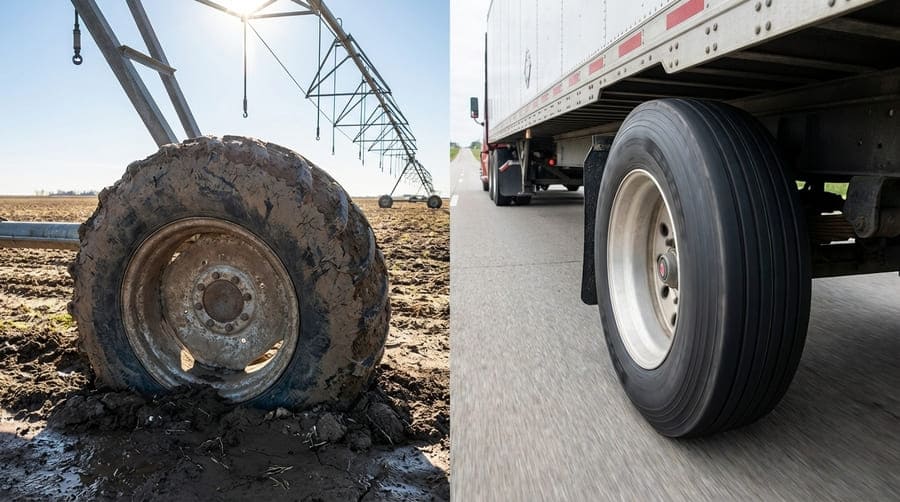
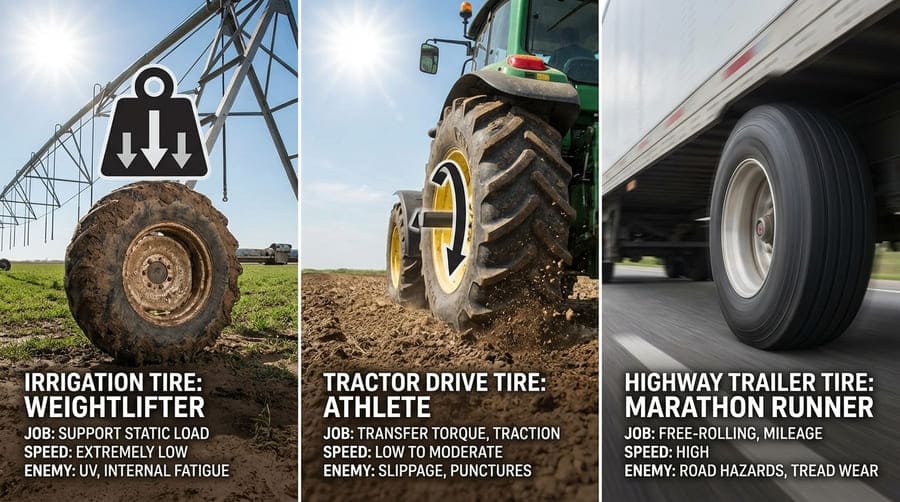
The fundamental mistake is thinking all tires are measured by the same yardstick. They aren't. A drive tire on a tractor is an athlete, built for power and traction. It's designed to transfer torque to the ground, and its high speed helps dissipate the immense heat it generates. A trailer tire is a marathon runner, designed for efficiency and durability over long distances at high speeds. It needs to roll freely and resist wear from mileage. An irrigation tire is a weightlifter. Its primary job is to stand still and hold a massive weight, day after day, under the hot sun. When it does move, it moves so slowly that it gets no cooling airflow. This constant, static load combined with slow, repetitive flexing creates a unique and punishing stress profile that breaks down a tire from the inside out.
Comparing Tire Job Descriptions
| Feature | Tractor Drive Tire | Highway Trailer Tire | Irrigation Tire |
|---|---|---|---|
| Primary Function | Transfer Torque, Traction | Free-Rolling, Mileage | Support Static Load |
| Typical Speed | Low to Moderate | High | Extremely Low |
| Load Type | Dynamic, Varies | Consistent at Speed | Constant, Static |
| Main Enemy | Slippage, Punctures | Road Hazards, Tread Wear | UV/Ozone, Internal Fatigue |
| Heat Management | Cooled by Rotation | Cooled by Airflow | Heat is Trapped |
Why Does a Bad Comparison Lead to Bad Decisions?
You use past experience to make smart choices, a proven strategy. But when that experience is based on the wrong model, your "smart" choice becomes a hidden gamble.
A bad comparison creates a flawed mental model for risk. By thinking a pivot tire is like a trailer tire, you misjudge its lifespan, maintenance needs, and failure signs. This leads to applying the wrong replacement criteria7 and being blindsided by failures you never saw coming.
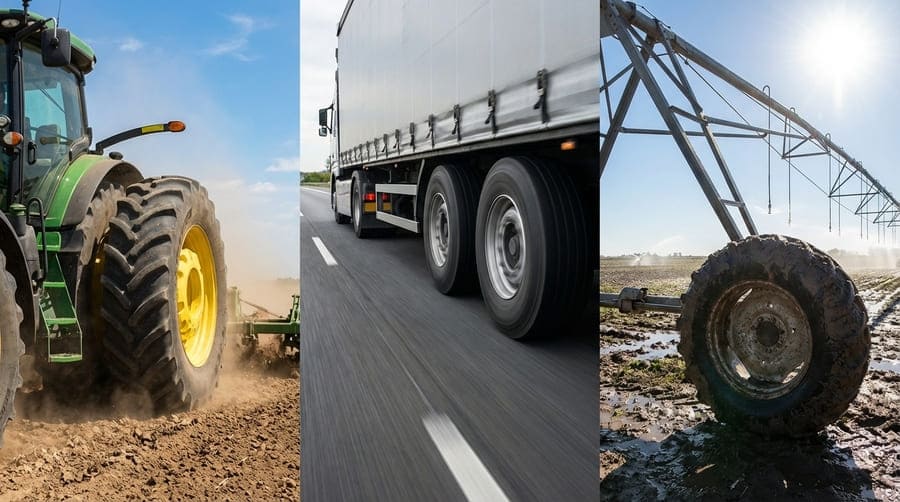
When we face a problem, our brain looks for a shortcut, often an analogy. We think, "This is like that other thing I know." It's an efficient way to make decisions, but it's dangerous when the analogy is wrong. If you manage your pivot tires like trailer tires, your entire risk management8 system is built on a faulty foundation. You'll measure the wrong things and miss the real warning signs. For example, you might base your replacement schedule on tread depth9. On a trailer tire, that makes sense because wear from mileage is the primary reason for replacement. But an irrigation tire can have nearly perfect tread and still be on the verge of catastrophic failure due to internal decay caused by age, UV exposure3, and static load stress. You end up keeping a dangerous tire in service simply because your flawed comparison told you it was "still good."
How the Wrong Analogy Biases Your Judgment
- You Underestimate Age: You ignore the 7-year "best by" date for rubber because your trailer tires last for a certain number of miles, not years.
- You Overvalue Tread: You keep a tire with deep tread, not realizing its casing is internally compromised and brittle from sun exposure.
- You Miss the Real Signals: You look for punctures and cuts but ignore the fine cracks in the sidewall (ozonolysis10) which signal the rubber is failing.
If They Look Alike, What Are the Hidden Differences?
You see two black, round rubber products. It's natural to assume they are built the same. But with tires, the most critical differences are completely invisible to the eye.
While they look similar, the crucial differences are in the construction and chemistry. Irrigation tires use specific rubber compounds11 to resist UV and ozone and have a casing design12ed for constant flexion under static load, unlike tires designed for speed and dynamic loads.
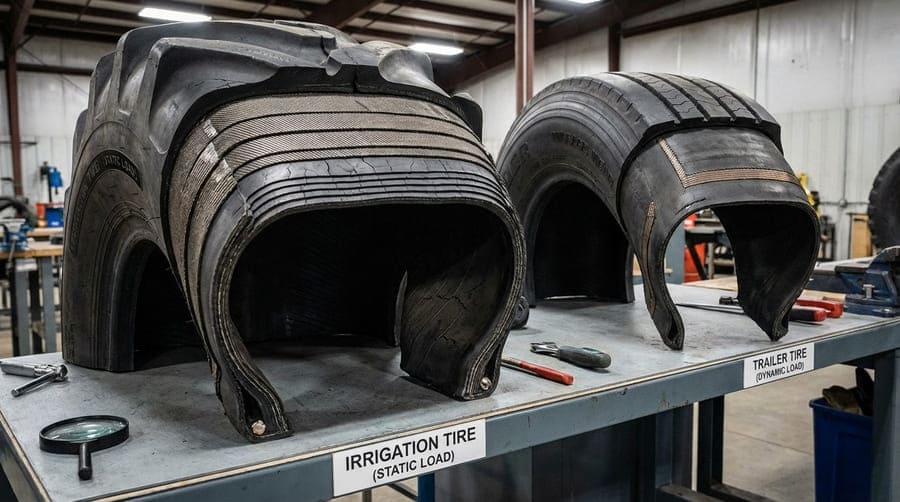
The assumption that "rubber is rubber" is where risk truly takes root. The engineering that goes into a tire is tailored specifically to its job. The differences aren't things you can see by kicking the tire. They are in the chemical formula13 of the rubber and the design of the internal structure. For instance, at Gescomaxy, we work with manufacturers to specify rubber compounds11 with high concentrations of anti-ozonants and antioxidants. These chemicals are expensive, and a company making a budget highway tire would minimize them. But for an irrigation tire that sits in the sun for a decade, they are the key to its survival. The same goes for the casing. The angle of the internal nylon or polyester plies is engineered differently to handle the constant downward pressure and sidewall bulge of a pivot, versus the forces on a tire rolling down a highway at 60 mph. These invisible details are everything.
Critical Invisible Differences
- Rubber Chemistry: Irrigation tires require specialized compounds to fight off degradation from sunlight and ozone. A highway tire is not built for this kind of prolonged environmental attack.
- Casing Design: The internal structure is designed to support a constant, heavy load without deforming. The sidewalls are built for slow, repeated flexing.
- Bead Construction: The part of the tire that holds it to the wheel is designed to handle the forces of a stationary, loaded system, preventing separation from the rim.
Conclusion
Stop comparing apples and oranges. Judging irrigation tires1 by trailer or drive tire standards is a recipe for failure. Understand their unique job to manage your risk effectively and keep your operation running.
---Explore the specific features of irrigation tires that differentiate them from other types, ensuring better decision-making. ↩
Learn about the impact of static loads on tire durability and performance, crucial for effective tire management. ↩
Discover how UV exposure can degrade tire materials over time, essential for maintaining tire health. ↩
Identify the unique failure modes of irrigation tires to avoid unexpected breakdowns during critical times. ↩
Learn how internal heat buildup can shorten tire lifespan, crucial for effective tire maintenance. ↩
Understand the factors leading to material fatigue in tires, helping you prevent costly failures. ↩
Find out the best practices for tire replacement to ensure safety and efficiency in your operations. ↩
Explore how effective risk management strategies can enhance tire performance and reduce failures. ↩
Understand the role of tread depth in tire safety and performance, helping you make informed decisions. ↩
Explore the process of ozonolysis and its impact on tire integrity, vital for maintaining tire quality. ↩
Discover the best rubber compounds for tires to enhance durability and performance in specific applications. ↩
Learn how casing design affects tire performance and longevity, essential for selecting the right tire. ↩
Learn how the chemical formula of tire materials influences their durability and performance over time. ↩