
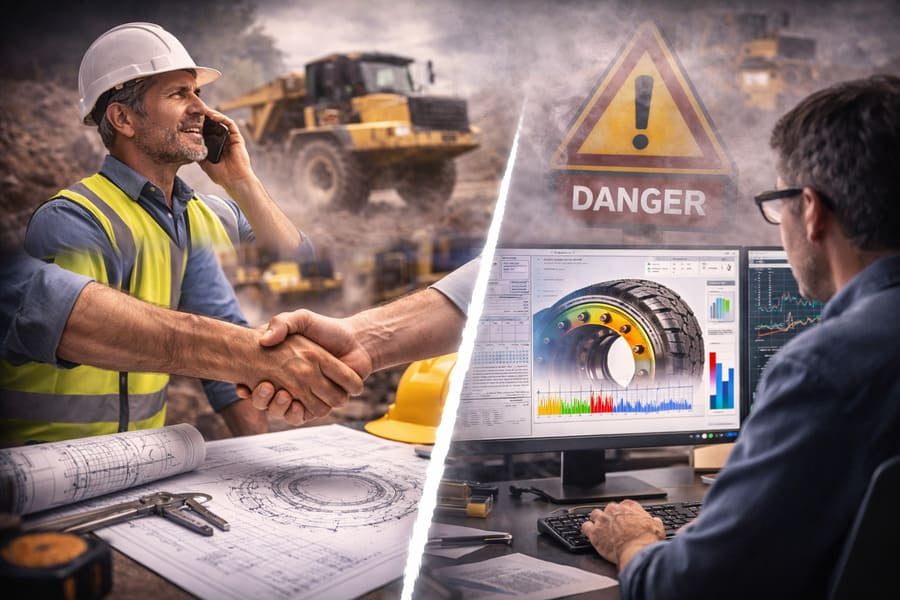
You provide your OTR wheel supplier with a detailed description of your worksite and operations. Yet, the custom wheels you ordered are still failing, and you're left wondering what information was missing.
Customer descriptions are invaluable but incomplete because they are subjective interpretations, not objective data. They describe feelings and general conditions, while engineering requires precise measurements of forces, cycles, and stresses—the critical details that are almost always left unsaid.
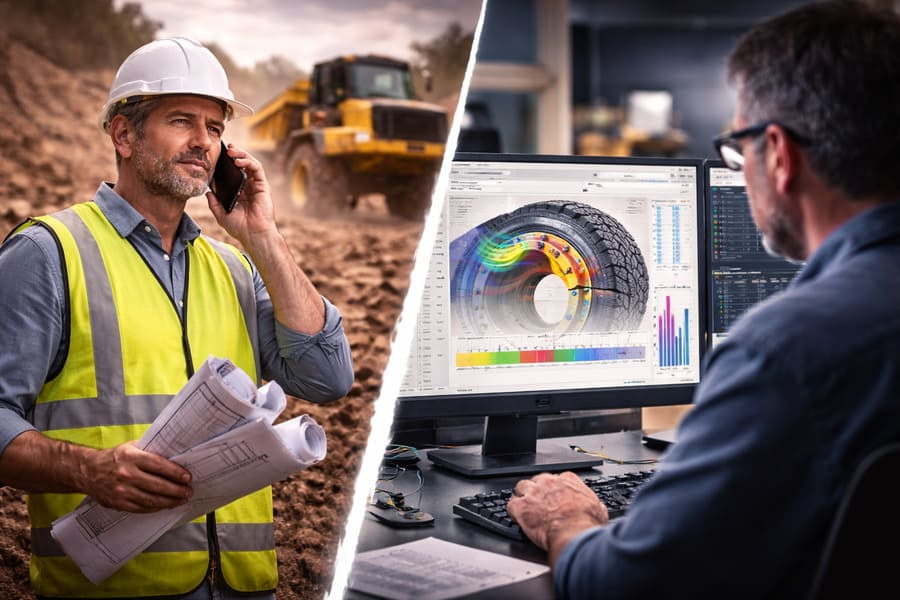
I see this all the time. A new client, a quarry manager, once told me his loaders operate under "standard, normal conditions." He needed a stronger wheel because his current ones were cracking. When I pressed for details, I learned that "normal" meant hauling rock up a steep, 15-minute-long ramp, making a sharp, off-camber turn at the top, and then braking hard on the way down. This cycle repeated every 30 minutes, all day long. His description wasn't wrong, it was just his version of normal. But from an engineering perspective, that "normal" day was a brutal, non-stop fatigue test that involved combined high torque, lateral force, and thermal stress. The problem wasn't what he told me; it was the engineering reality hidden within his simple description.
Why Is What a Customer Feels Different From What a OTR Wheel Experiences?
You tell your supplier the haul road is "bumpy" and the turns are "tight." You've described the experience perfectly, but the wheels designed based on this information still don't last.
A customer describes the feeling of the operation—the jolt from a bump, the strain of a turn. A wheel experiences quantifiable forces—a shock load of 3 Gs, a lateral force of 8 tons. These are two different languages describing the same event.
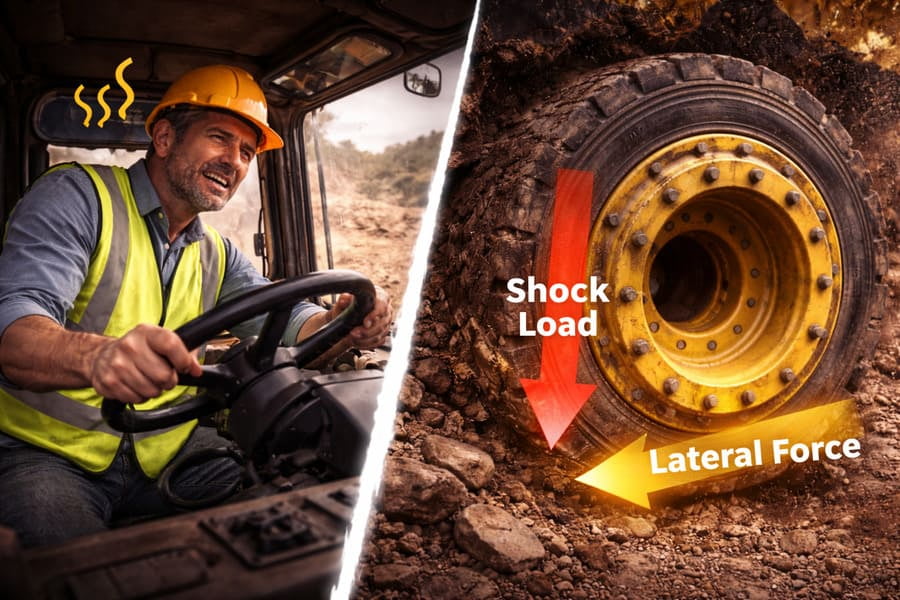
When an operator says a ride is "rough," they are giving us a valuable clue. But it doesn't tell us the whole story. Is it rough because of high-frequency vibrations from a corrugated surface, or is it rough because of single, massive impacts from deep potholes? Each of these scenarios puts a completely different type of stress on the OTR wheel. High-frequency vibration can accelerate fatigue in the welds, while a massive impact can bend a flange. As a manufacturer, our job is to act as a translator. We have to take the customer's feeling—"it's a tough site"—and convert it into engineering data to build a wheel that can withstand the forces they can't see or measure.
Translating Feelings into Forces
| Customer's Feeling / Description | Engineer's Question / Data Point |
|---|---|
| "The ground is soft and muddy." | What is the rolling resistance? How much extra torque is needed? |
| "It's a very hilly site." | What is the maximum grade percentage? What is the duration of the climb? |
| "The operators drive fast." | What is the average and maximum speed? What is the TKPH/TMPH requirement? |
| "We carry heavy loads." | What is the peak load, including shock loads from dropping material? |
Where Does the Biggest Risk Hide in a Customer's Description?
You give your supplier all the information you think is relevant about your daily operations. You're honest and thorough, but dangerous, unexpected failures still happen. What are you missing?
The biggest risk hides in what isn't said. The occasional overload, the one "problem driver" who pushes the limits, the unusual emergency stop—these edge cases are rarely mentioned but are responsible for the most extreme stresses a wheel will ever face.

People naturally describe the average, the typical, the 95% of their day. No one includes the time a trainee accidentally dropped a full bucket load from twice the normal height. No one mentions the emergency brake test that put maximum torque on the wheels. Or the fact that on Fridays, operators rush to finish, taking turns faster and braking harder. But these are the moments that define the true performance limits required. A wheel must be designed not just for the normal day, but for the worst day. As a manufacturer, I've learned that the most important questions are about the exceptions, not the rules. The real risk isn't in the daily routine; it's in the spike of force from that one "oops" moment that nobody put in the report.
Why Can't a Manufacturer Simply Outsource Judgment to the Customer?
You've provided all the data you can. It's tempting to think the responsibility now lies solely with you to give perfect information. Why isn't that a safe or effective approach?
A manufacturer cannot outsource judgment because the customer is the expert on their operation, not on wheel engineering. A supplier's core responsibility is to use their specialized knowledge to interpret, question, and translate the customer's world into a safe and reliable product.

Asking a customer for their load data is essential. But relying on that information alone is like a doctor letting a patient write their own prescription. The patient can describe the symptoms, but the doctor uses their expertise to diagnose the underlying cause and determine the correct treatment. My role as a wheel manufacturer is the same. I listen to the customer's "symptoms"—cracking welds, bent flanges, premature failures. Then, I use our 12+ years of experience to diagnose the root cause, which is often a force they weren't even aware of. This requires engineering judgment. It's our duty to ask the right questions, anticipate the unmentioned risks, and take ultimate responsibility for the product's design. This judgment is the most critical component we supply; it cannot be outsourced.
Conclusion
A customer's description is the start of the conversation, not the end. True safety and reliability come from a partnership where the supplier uses their engineering judgment to uncover the full story.