
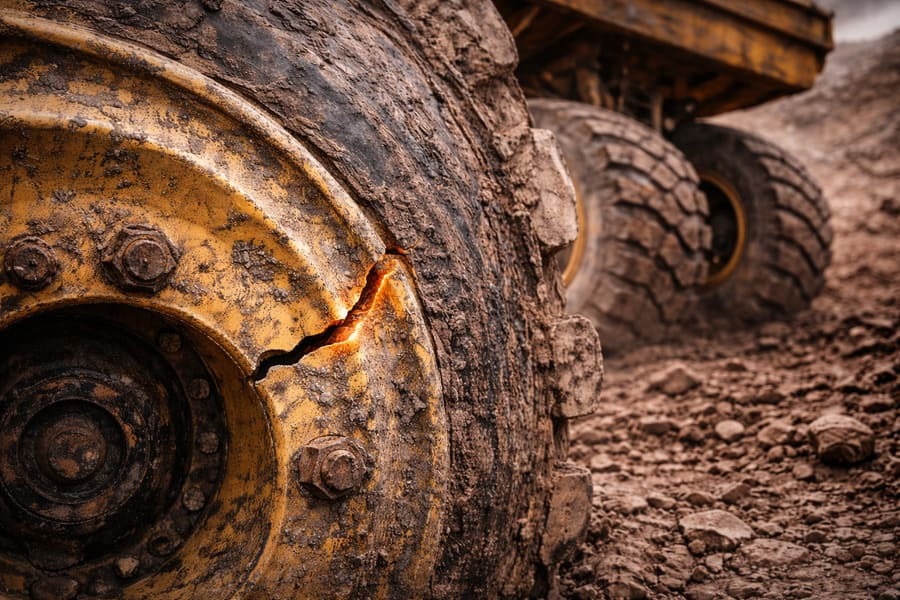
You trust the high load capacity on the spec sheet, yet wheels keep failing prematurely. This hidden risk costs you money and damages your brand's reputation with warranty claims.
The real risk is defined by fatigue life1—how many stress cycles2 a wheel can endure before a microscopic crack grows into a complete failure. Most failures are not from a single overload but from the accumulated damage of everyday use.
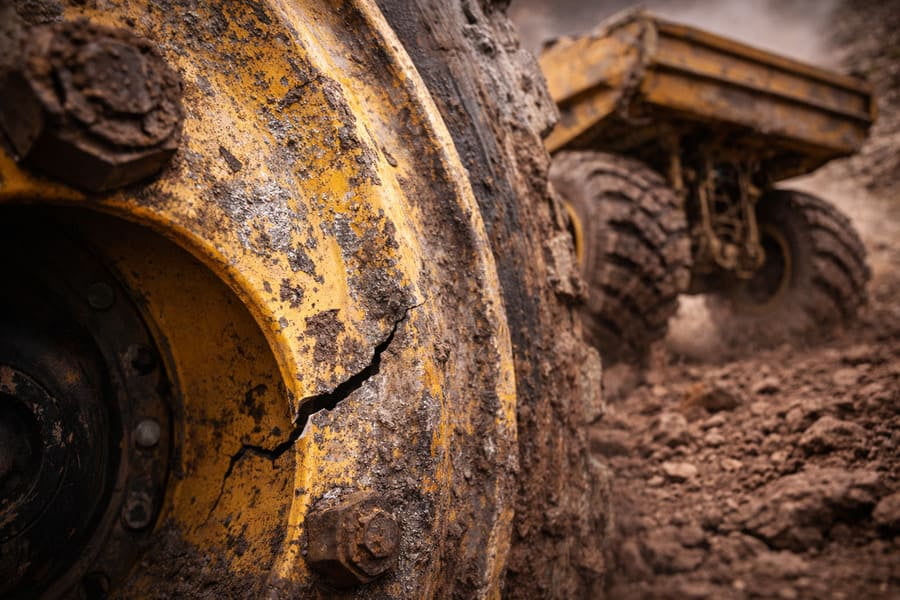
I remember inspecting a wheel returned from a large farm in Brazil. The procurement manager was frustrated. "Your load rating3 was sufficient," he said, "but the wheel still cracked." He was right. The OTR wheel hadn't collapsed or bent from a massive impact. Instead, a small, clean crack had worked its way from a weld seam right through the disc. It wasn't a failure of strength; it was a failure of endurance4. That day reinforced a lesson I've seen proven time and again: we are often measuring the wrong thing. The static load number is a starting point, but the story of how a OTR wheel truly performs is written in the language of fatigue.
Do OTR Wheels Suddenly Snap Under Pressure?
You worry about a wheel hitting a massive rock and catastrophically failing. It’s a dramatic image, but is it how most wheels actually break in the field?
No, it's extremely rare. The vast majority of OTR wheel failures5 are not from a single overload event. They are classic fatigue failures, where small cracks grow slowly over time until the wheel can no longer support its load.
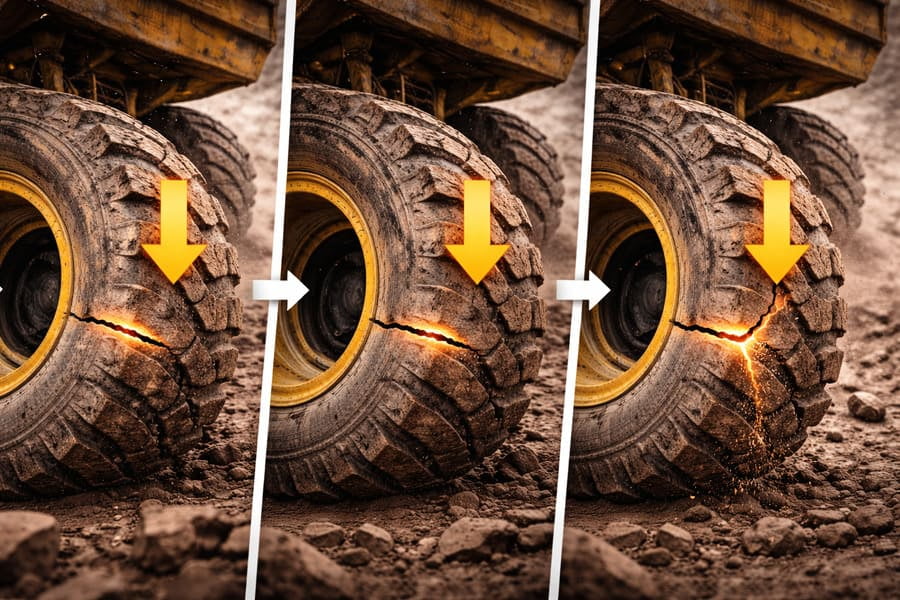
A single, dramatic overload failure is what we call a "ductile failure6." It requires a force so extreme that it exceeds the steel's ultimate tensile strength, causing it to bend or tear. While our designs must account for this, it's not the common enemy. The real enemy is fatigue. Think of it like bending a paperclip. You can't break it by pulling on it (overload). But if you bend it back and forth in the same spot repeatedly (cyclic stress7), it will eventually snap with very little effort. A wheel on a tractor goes through millions of these "bend" cycles in its lifetime. Each rotation, every bump, and every turn flexes the metal. These small, repetitive stresses create microscopic cracks that grow with each cycle until they reach a critical size. This is why a wheel that looks fine one day can be found cracked the next. It didn't suddenly break; it just finished its long journey of wearing out.
What Actually Wears Out a OTR Wheel Over Time?
If it's not one big hit, then what are the specific forces that cause a OTR wheel to wear out and eventually crack? It seems invisible, happening slowly over months or years.
A wheel's lifespan is determined by two key factors: the stress range8 (the difference between the highest and lowest stress in a cycle) and the total number of cycles. Both a high stress range8 and a high number of cycles use up the wheel's finite fatigue life1.
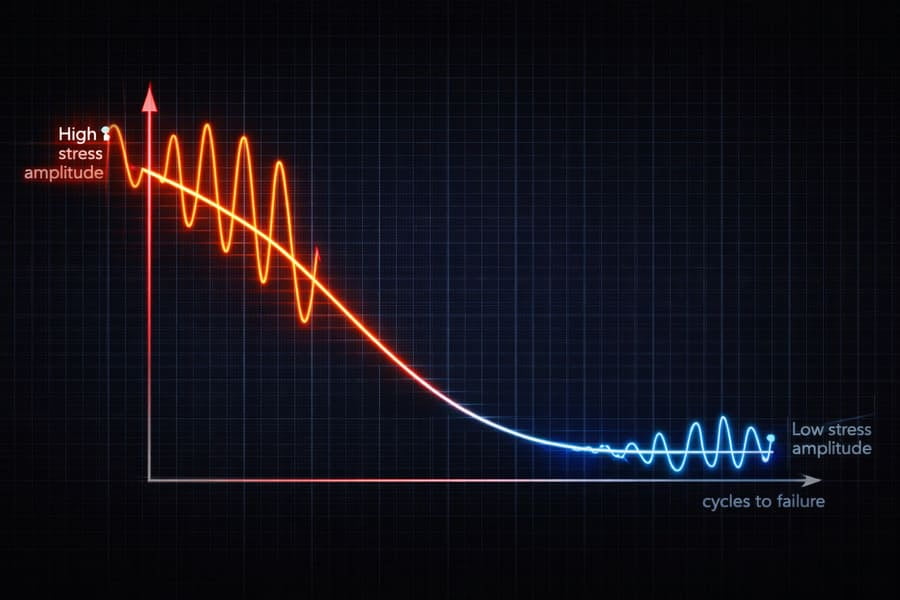
Let's go back to the paperclip analogy. The "stress range8" is how far you bend it each time. The "number of cycles" is how many times you bend it.
- High Stress, Low Cycles: If you bend the paperclip a large amount each time, it will break very quickly, perhaps in just 10 or 20 bends. For a wheel, this is like operating a consistently overloaded machine on very rough terrain. The stress range8 is high, so it fails after fewer hours.
- Low Stress, High Cycles: If you only bend the paperclip a tiny amount, you could do it thousands of times before it breaks. This is like a wheel on a light-duty machine that operates on smooth pavement. The stress range8 is low, so it lasts for a very long time.
Most OTR wheels live somewhere in between. They experience a mix of high-stress events (hitting a pothole) and low-stress events (rolling on a flat surface). Every single one of these cycles, big or small, consumes a piece of the wheel's total lifespan.
Is a High Load Rating a Guarantee of Long Service Life?
You compare two OTR wheels. One has a rated load of 8,000 kg, and the other 10,000 kg. It seems obvious that the 10,000 kg wheel is better and will last longer, right?
Not necessarily. A static load rating3 is a poor predictor of real service life because it ignores the dynamics of fatigue. It tells you what weight the wheel can hold, but not for how long it can withstand the repeated loading and unloading of daily work.
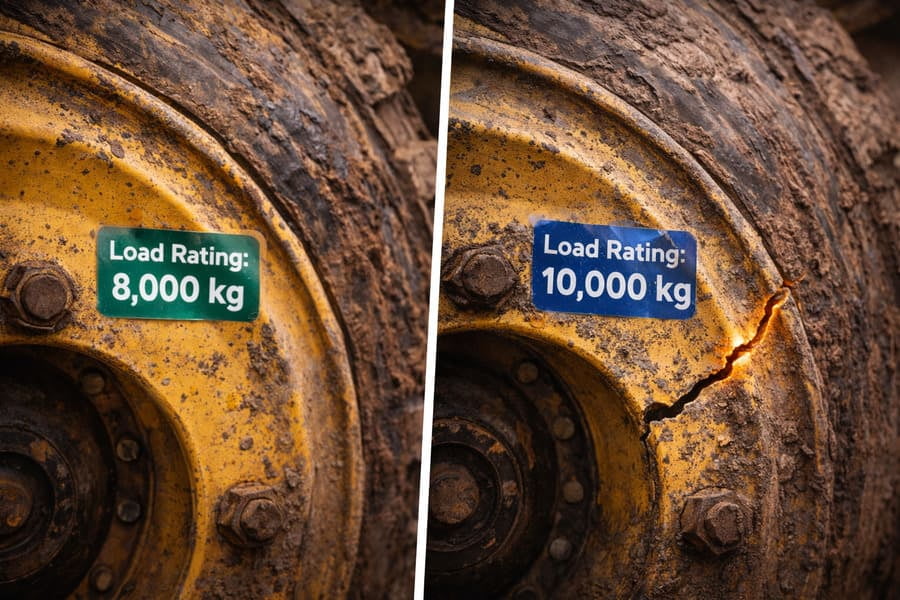
The rated load is a static number, calculated under ideal, non-moving conditions. It's like judging a runner's marathon potential based on how much weight they can lift while standing still. It's a relevant piece of information, but it doesn't tell you anything about their endurance4. A wheel's service life, or its "endurance4," is all about fatigue resistance9. A well-designed wheel might have a slightly lower static load rating3 but be engineered with better geometry, welds, and material quality10 to resist fatigue. This wheel could easily outlast a wheel with a higher load rating3 but poor fatigue characteristics. For example, sharp corners in the design or low-quality welds can create "stress risers11" where fatigue cracks start easily, regardless of the overall load rating3. Focusing only on the rated load is a common mistake that leads procurement managers12 to select wheels that are strong on paper but fail quickly in the real world.
Conclusion
The true measure of an OTR wheel’s value is not its static strength, but its endurance4. Understanding fatigue life1 is the key to reducing risk and ensuring long-term reliability for your customers.
Understanding fatigue life is crucial for assessing the durability of materials and components, ensuring long-term reliability. ↩
Explore how stress cycles contribute to material fatigue, helping you make informed decisions in engineering and procurement. ↩
Learn about load ratings and their significance in selecting the right wheels for your applications. ↩
Understanding endurance helps in selecting materials that can withstand repeated stress over time. ↩
Learn about the common causes of OTR wheel failures to improve your procurement strategies and reduce warranty claims. ↩
Gain insights into ductile failure and its implications for material selection and design in engineering applications. ↩
Discover the impact of cyclic stress on materials, which is essential for understanding fatigue and durability. ↩
Understanding stress range is vital for predicting the lifespan of components under varying loads. ↩
Explore methods to enhance fatigue resistance, ensuring longer-lasting and more reliable components. ↩
Explore the relationship between material quality and fatigue life to make better procurement decisions. ↩
Learn about stress risers and their role in initiating fatigue cracks, crucial for design considerations. ↩
Gain insights into the challenges procurement managers encounter, helping you improve your selection process. ↩