
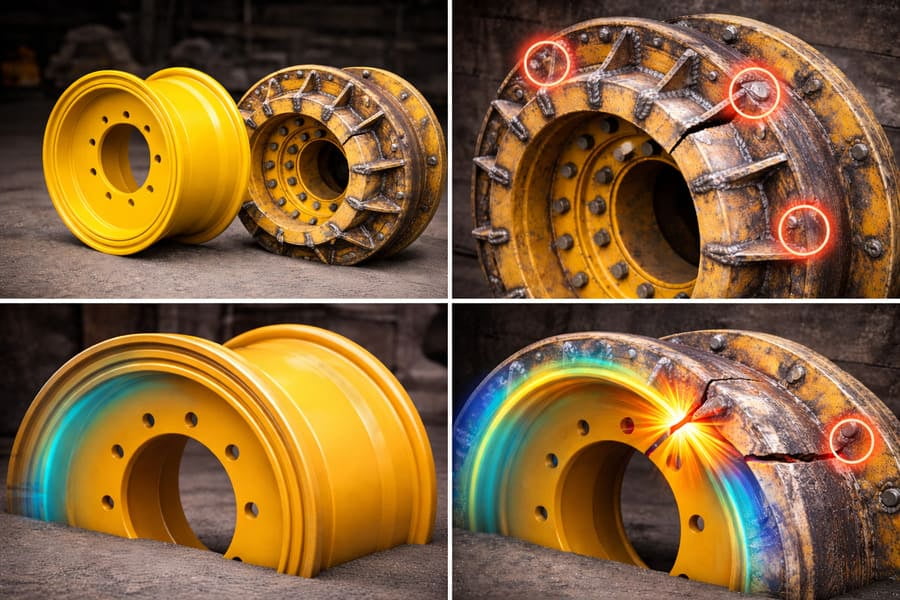
You see a heavily reinforced OTR wheel, covered in extra gussets and thick weld beads. It looks tough, an upgrade. But then it fails faster than the standard, simpler version.
More welding1 can make OTR wheels less reliable because each weld creates a brittle2 Heat-Affected Zone (HAZ)3, disrupts the intended stress path, and introduces stiffness mismatch4es. Instead of strengthening the wheel, this complexity creates multiple new points where cracks can begin.
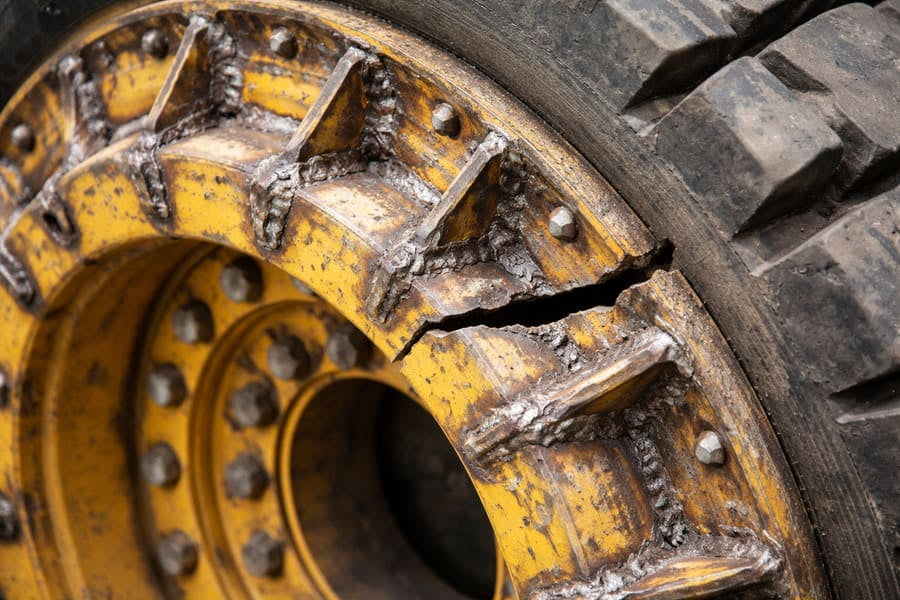
I remember a client years ago who ran a fleet in a quarry. He was convinced that adding more steel plates and welds to his wheels would solve his cracking problems. We advised against it, but he insisted. We built them to his spec. Six months later, his wheels were failing again, but this time in completely new and unpredictable places. He learned a hard lesson that we in the engineering world5 already know: in wheel design, more is not always more. The goal isn't to make a wheel that doesn't flex; it's to make a wheel that flexes correctly.
How Can Adding Welds Break a Wheel's Strength?
You see an OTR wheel with extra welds and supports6, and it seems indestructible. But then a crack appears in a strange spot, nowhere near the main point of load. You're left wondering why.
More welds don't distribute stress; they shatter it into fragments. Instead of flowing through one smooth, engineered path, the load crashes against each new weld. This creates many small, localized stress zones, each one a potential starting point for a fatigue crack.
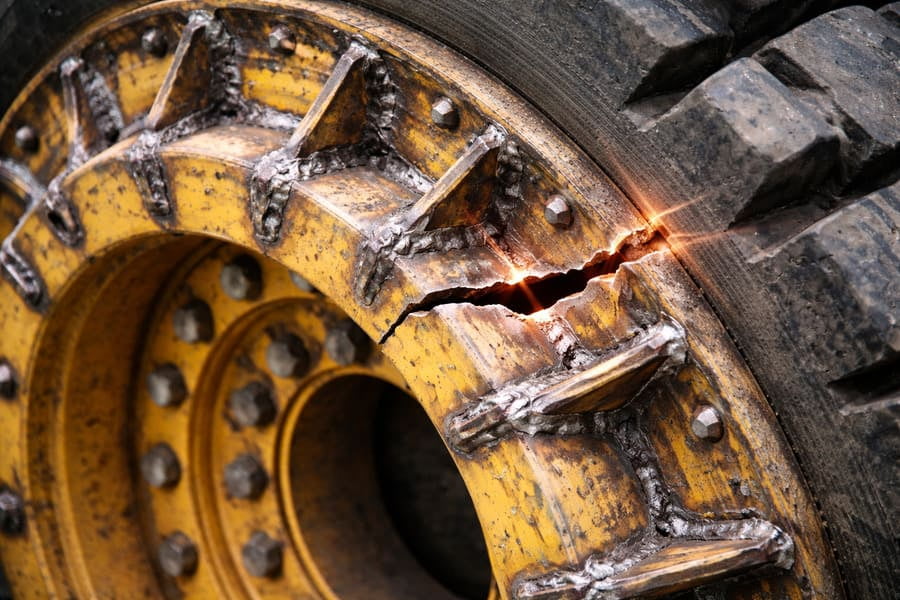
The best way I can explain this is to think of stress as a river flowing through the wheel's structure. A good design creates a wide, deep, and smooth river channel. The force flows predictably from the tire to the hub with no issues. Now, imagine you start adding welds and gussets. Each one is like a large rock or a small dam dropped into the river. The water doesn't flow smoothly anymore. It creates turbulence, eddies, and high-pressure spots around each obstruction. In a wheel, this turbulence is called stress concentration7. You haven't made the "river" stronger; you've just created dozens of chaotic, high-energy spots that will eventually erode the riverbank—or, in this case, crack the steel.
The Single Path vs. The Fragmented Path
A clean design manages stress. A complex design8 creates it.
| Design Philosophy | Stress Flow | Result |
|---|---|---|
| Minimalist | A single, uninterrupted, predictable path. | Stress is managed and dissipated as intended. |
| Over-welded | Multiple, fragmented, chaotic paths. | Stress concentrates in unpredictable local zones. |
| Outcome | Long fatigue life and predictable performance. | Short fatigue life and unexpected failures. |
What Are "Heat-Affected Zones" and Why Do They Matter?
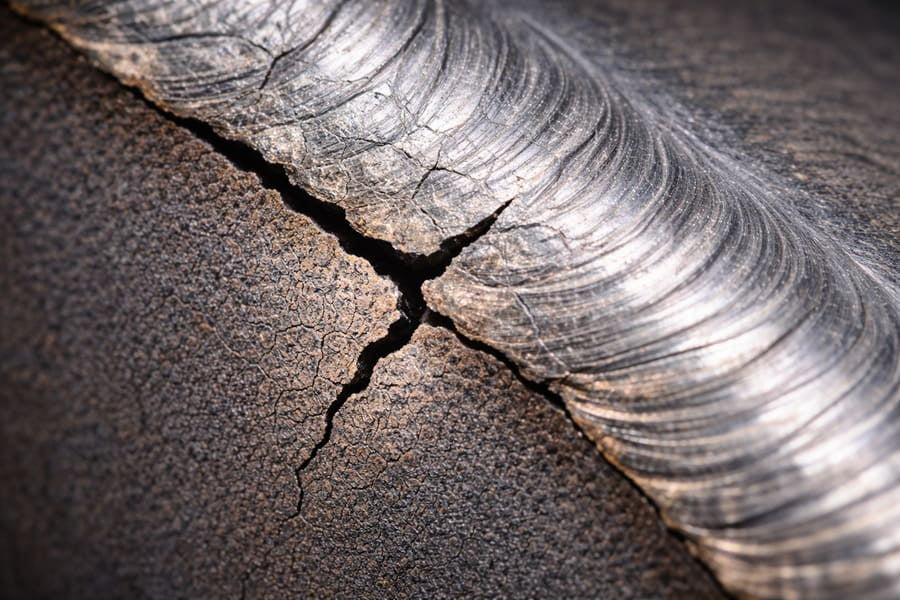
The crack on a failed wheel is right next to a perfect-looking weld bead. The weld itself is fine, but the steel beside it failed. This seems counterintuitive.
The Heat-Affected Zone (HAZ)3 is the metal next to a weld that gets fundamentally changed by the heat. It becomes harder and more brittle2. When you add more welds, these brittle2 zones can overlap, creating a large, fragile area that's highly susceptible to cracking.
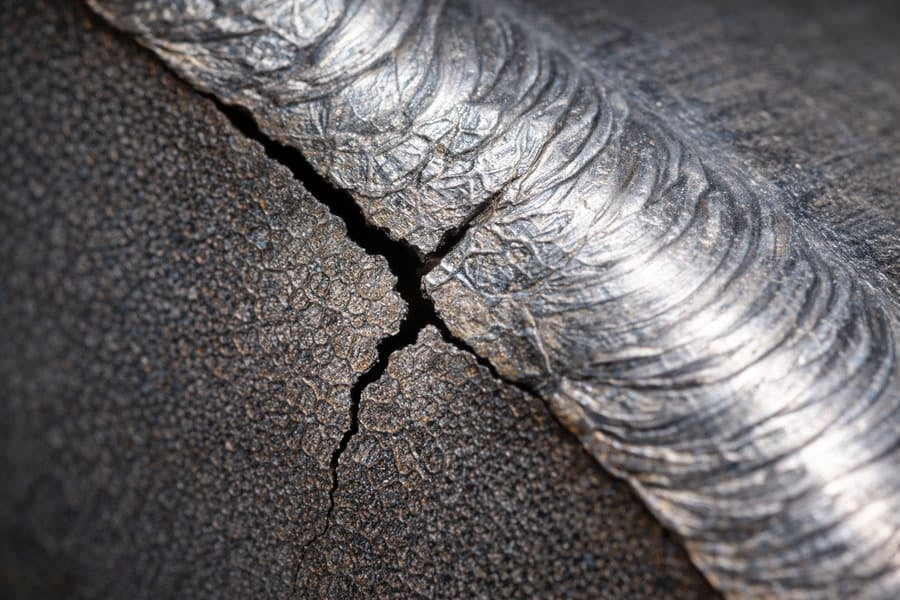
Think about the steel in your wheel. In its original state, it's engineered for a balance of strength and ductility—the ability to flex without breaking. The intense, localized heat from welding1 ruins that balance. The HAZ doesn't melt, but it gets hot enough to change its microscopic crystal structure. This new structure is very hard but has lost its flex. It's like turning a piece of tough leather into a fragile piece of glass. One small HAZ on a critical weld is manageable through good design. But when you start adding welds all over the place, these "glass-like" zones start to connect. You create a hidden network of brittle2ness throughout the wheel, just waiting for the right impact or vibration to shatter.
The Hidden Damage of Heat
The danger lies in what you can't see.
- Parent Metal: Strong and ductile. Designed to flex and absorb energy.
- Weld Metal: Fused material, very strong but can be rigid.
- HAZ: The weakest link. Hard, brittle2, and loses its ability to flex. This is where fatigue cracks9 love to start.
The more you weld, the more HAZ you create.
If More Welding Doesn't Add Strength, What Does It Add?
Your customer insists on an extra "safety" plate welded onto the wheel disc. You do the work, but the wheel fails right at the edge of the new plate. The "fix" became the problem.
More welding1 adds stiffness, not necessarily strength. This creates an abrupt "stiffness mismatch4" where a very rigid section meets the original, more flexible part of the wheel. All operational stress naturally concentrates at this sharp transition, creating a new, perfectly predictable point of failure.
Imagine you have a flexible fishing rod. If you tape a short, rigid steel pipe to the middle of it and then bend the rod, where will it break? It will snap right at the edge of the pipe. You didn't make the rod stronger; you just told the bending force exactly where to concentrate its energy. Adding reinforcements to an OTR wheel does the same thing. The wheel disc is designed to flex slightly to absorb shocks. When you weld a thick, unmoving plate onto it, you create a hard line. Now, instead of the whole disc absorbing the load, that one edge where steel meets steel takes all the punishment. The original design's ability to dissipate energy is gone, replaced by a man-made stress riser.
The Difference Between Strength and Stiffness
They are not the same, and confusing them leads to failure.
| Concept | Definition | In-Wheel Application |
|---|---|---|
| Strength | The ability to resist a load without breaking. | The wheel can carry the machine's weight. |
| Stiffness | The ability to resist bending or flexing under a load. | How much the wheel deforms under cornering or shock. |
| The Problem | Adding stiffness in one area forces another area to flex more, concentrating stress. |
Doesn't More Complexity Mean a More Engineered Solution?
You're looking at two wheels. One is a simple, clean design. The other has intricate welds and supports6. It's easy to assume the more complex one must be better engineered and therefore safer.
Complexity is the enemy of reliability. Every extra weld is another potential point of origin for a fatigue crack, another manufacturing step that can have a hidden defect, and another variable that makes performance less predictable. A simple design has fewer failure paths.
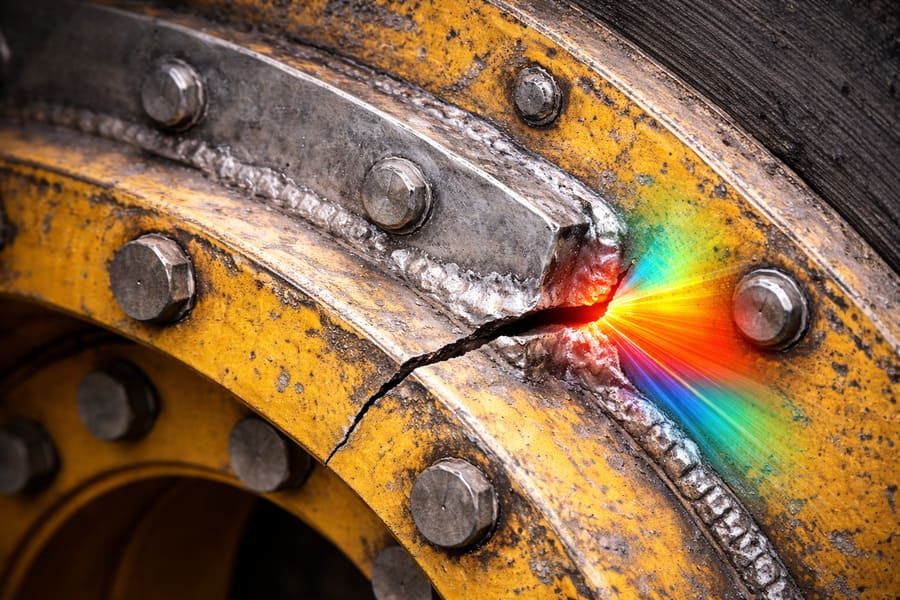
As an engineer, I can tell you that the most elegant solution is almost always the simplest one. A complicated design is often a sign that the core engineering problem hasn't been solved properly. Instead of creating a fundamentally sound structure, the designer is just adding patches to fix symptoms. Each "patch"—each extra weld or gusset—introduces new risks. It needs to be inspected, it creates another HAZ, and it changes the stress dynamics. A clean design, where the shape of the components themselves creates the strength, is inherently more reliable. There are fewer things that can go wrong because there are fewer things, period. The goal of good OTR wheel design10 isn't to add more parts; it's to make the fewest parts work perfectly together.
Conclusion
True reliability in OTR wheels comes from intelligent, simple design, not from adding more welds. More complexity often creates more problems, turning would-be reinforcements into the very source of failure.
Learn about the effects of welding on metal properties, crucial for ensuring structural integrity. ↩
Explore the factors that lead to brittleness in metals, crucial for material selection and design. ↩
Understanding HAZ is crucial for weld quality and durability, as it highlights how heat affects metal properties. ↩
Understanding stiffness mismatch helps in designing components that can withstand operational stresses. ↩
Stay updated on the latest engineering trends to enhance your knowledge and practices. ↩
Learn how welds and supports can impact the integrity of structures, essential for safe design. ↩
Explore how stress concentration impacts material performance and failure, essential for effective design. ↩
Understanding the pitfalls of complex designs can lead to more reliable and efficient engineering solutions. ↩
Discover the mechanisms behind fatigue cracks to better understand material failure and prevention. ↩
Gain insights into optimal OTR wheel design practices to enhance performance and reliability. ↩