
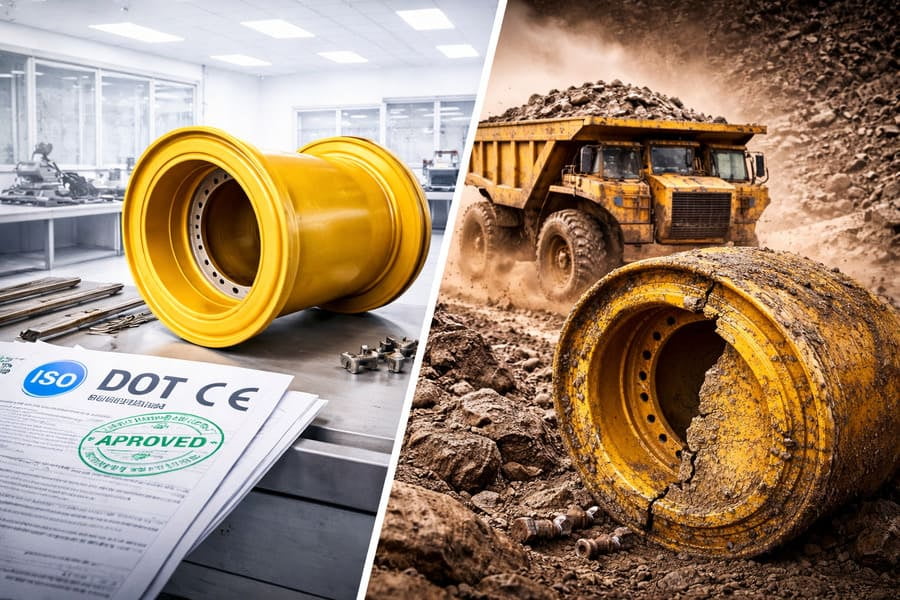
Your procurement process depends on standards like ISO and DOT for assurance. Yet, compliant wheels fail under real-world stress, causing costly downtime and eroding trust.
OTR wheel standards1 describe a minimum legal and safety baseline2 tested under controlled, predictable laboratory conditions. They confirm a wheel meets a standardized set of criteria but do not predict its performance or durability under the unique, severe, and variable stresses of real-world operation.
For over a decade, I've worked with procurement managers who place immense faith in certifications. And they should—these standards are non-negotiable for market access3 and basic safety. We pride ourselves on our ISO, DOT, and REACH compliance. However, I've also seen the frustration when a fully certified wheel cracks under the strain of a harvest season or on a rugged mining site. The key is understanding that the piece of paper with the certification stamp and the real-world performance4 of the steel are two different stories. The standard is the introduction; the real story is written in dirt, mud, and heavy loads.
Do Standards Replicate the Real World?
You purchase wheels that have passed rigorous cornering and radial fatigue tests5, expecting them to be invincible. But the field environment is far harsher than any lab, and failures persist.
No, standards are designed to describe an average, predictable world. They use controlled loads and cycles to create a repeatable test, but they cannot account for the sudden shocks, uneven surfaces, and extreme overloading that are normal in heavy-duty operations.
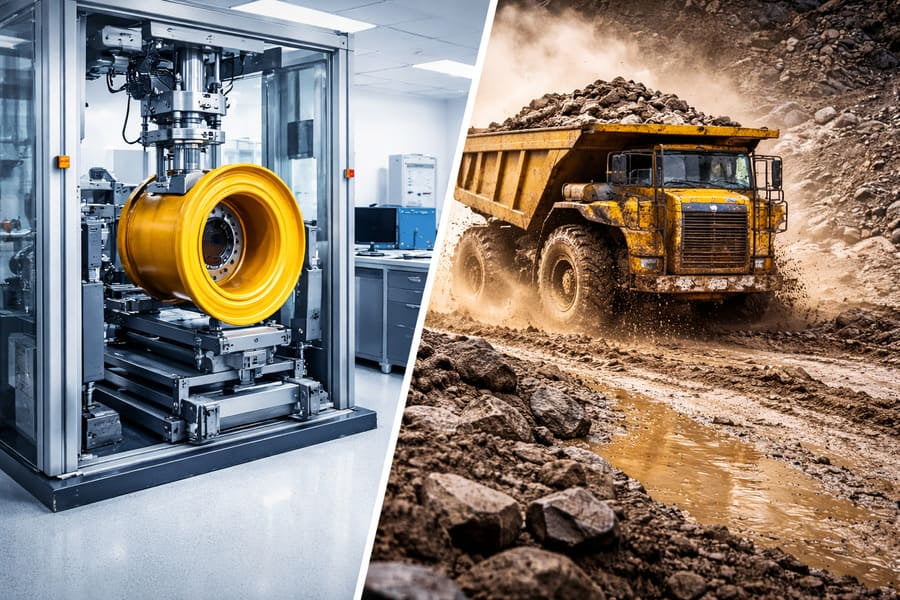
Think about the standard radial fatigue test. A wheel is put on a machine and subjected to a constant, specified load for a set number of rotations. It's clean, consistent, and perfectly controlled. Now, picture your customer's reality: a combine harvester hitting an unseen rock, a loader dropping a heavy bucket too quickly, or a tractor navigating deep, muddy ruts that twist and strain the wheel assembly. These are the moments that cause failure. They introduce complex, multi-axial forces and impact loads that are orders of magnitude higher than the smooth, predictable forces in a lab test. The standard proves the wheel can survive an ideal commute; it says nothing about its ability to survive a sudden street fight. The standard isn't wrong; it's just not telling the whole story of your operational life.
How Far Outside the Standard Do Real Operations Get?
Your team assumes that if a OTR wheel passes a test at 100% of its rated load, it should handle field conditions. But you're still witnessing bent OTR rims and cracked discs on relatively new equipment.
Most critical stress events in a wheel's life happen far beyond what standards simulate. Real-world operations are defined by moments of peak load—impacts, side-loading, and overloads—that are simply not part of the standardized testing protocol.

A standard might test a wheel to survive millions of cycles at its maximum rated load. This sounds impressive, but it misses the point. A OTR wheel rarely fails from the gentle accumulation of rated loads. It fails from the thousands of brief, violent events that exceed that rating.
| Test Condition vs. Real World | Standard Test Protocol | Real-World Event |
|---|---|---|
| Loading | Constant, predictable force | Sudden impact (pothole, rock) |
| Surface | Smooth drum | Uneven, soft, or rocky ground |
| Forces | Purely radial or cornering | Combined twisting & impact forces |
| Environment | Clean, temperature-controlled | Mud, corrosion, extreme heat/cold |
A pothole can generate an impact force three to five times the wheel's static load rating. A sharp turn on soft soil can introduce massive lateral stresses that the cornering fatigue test barely touches. The standard confirms the OTR wheel has a solid baseline of strength, but it's the design's ability to tolerate these off-the-chart peak loads that determines its actual survival.
Is a "Compliant" OTR Wheel a "Durable" OTR Wheel?
You've built a supply chain6 based on certified products, believing compliance is the ultimate mark of quality. But the warranty claims7 for field failures tell you a different story.
Absolutely not. Compliance means the wheel passed a specific, controlled test on a specific day. Durability is the ability to survive an uncontrolled, chaotic environment for years. Passing a test proves legality and entry-level quality, not long-term resilience.
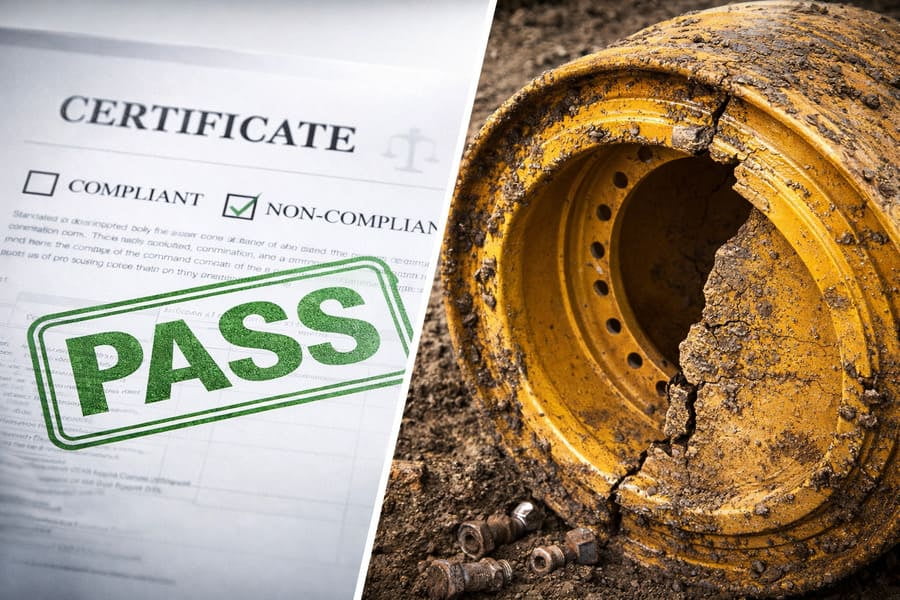
Achieving a DOT or ISO certification is a critical gateway. It allows a product to be sold legally. Think of it as a driver's license. It proves you can pass a basic driving test: you can park, signal, and follow the rules in a controlled environment. Does that license prove you're a great driver who can handle a blizzard, avoid a multi-car pile-up, or navigate a treacherous mountain road? No. It just proves you met the minimum requirement to be on the road. Similarly, a wheel standard proves the product met the minimum engineering requirement. Durability, on the other hand, is earned in the field. It is the product of robust design, quality materials, and manufacturing consistency8 that go far beyond the simple pass/fail criteria of a standard test.
What Problem Do Standards Actually Solve?
If standards don't guarantee durability, what is their true purpose for a procurement manager? It can feel like you're chasing paperwork that has little connection to reality.
Standards solve the problem of market access3 and legal permission. They provide a common, universally accepted language to confirm a product is not fundamentally unsafe or defective, allowing it to be bought and sold with a baseline level of confidence.

The primary role of a standard is to create a level playing field. It ensures that no manufacturer can sell a dangerously subpar product. It gives you, the buyer, a tool to disqualify suppliers who cannot even meet the most basic requirements. It's a risk-management tool9 for the supply chain6. However, it's not a performance-guarantee tool for the end-user. The standard allows a product to exist and be traded legally. It gives you permission to buy it. But it does not, and cannot, guarantee its survival in your customer's unique and demanding application. That guarantee comes from a deeper partnership with a supplier who understands your reality and engineers products to exceed the standard, not just meet it.
Conclusion
Standards are the starting line, not the finish line. They give you permission to compete, but they don't guarantee you'll win the race for durability and customer trust.
Understanding OTR wheel standards is crucial for ensuring safety and compliance in procurement processes. ↩
Exploring safety baselines helps ensure products meet essential safety requirements for consumers. ↩
Understanding how standards impact market access can help manufacturers navigate regulatory landscapes. ↩
Exploring real-world performance helps understand the limitations of lab tests and the importance of durability. ↩
Radial fatigue tests are critical for assessing wheel durability, making this topic worth investigating further. ↩
Exploring supply chain dynamics can reveal how quality is maintained and risks are managed in procurement. ↩
Warranty claims provide insights into product performance and durability, highlighting potential issues. ↩
Manufacturing consistency is crucial for ensuring long-term product durability, making it a key area to explore. ↩
Understanding the role of standards as risk-management tools can enhance procurement strategies. ↩