
You inspect your heavy machinery, looking for signs of wear like worn tires or hydraulic leaks. But a catastrophic wheel failure can happen without any of the usual warning signs.
OTR wheel failures1 are sudden and catastrophic2 because, unlike tires, they don't provide progressive warnings. Safety cannot be managed by inspection alone; it must be built into the wheel's design and manufacturing process from the very beginning.
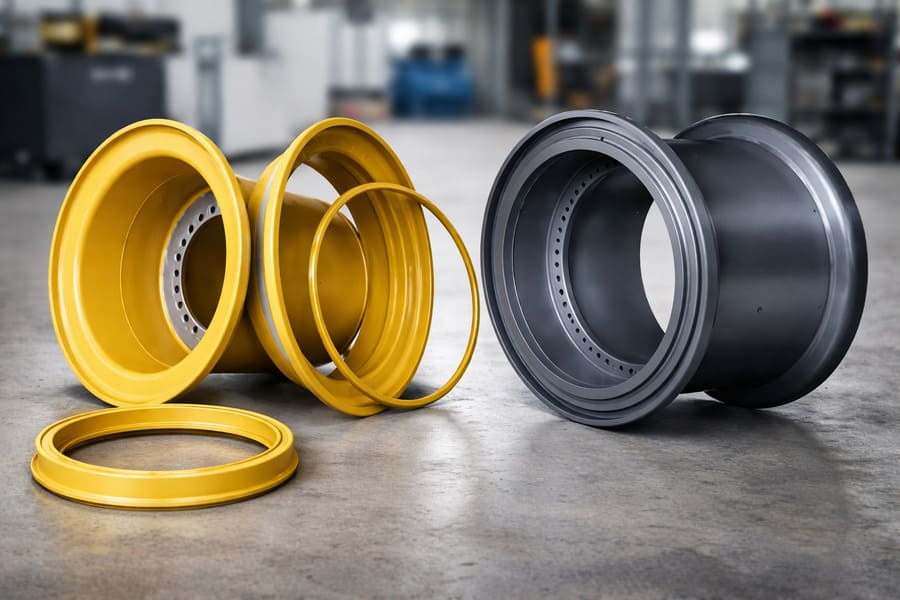
Over my 12+ years in this business, the most dangerous misconception I've encountered is that a steel OTR wheel is just a simple, strong piece of metal. A fleet manager once told me, "It's a solid chunk of steel, what could go wrong so fast?" A few months later, one of his loaders experienced a sudden wheel collapse. The operator was fine, but the incident damaged the axle and shut down a critical part of his site. He learned that day that a wheel doesn't wear out like a tire; it fails like a switch being flipped. This is why we must shift our thinking from reacting to failures to preventing them before the steel is even forged.
Why Don't OTR Wheels Give You Warning Signs Before They Break?
You're used to seeing signs of wear on equipment. A tire goes bald, a hose bulges. But you've seen OTR wheels that looked fine one day and were catastrophically broken the next.
Unlike tires, which are composites that wear down progressively, an OTR wheel is a monolithic steel structure. Failure occurs when a fatigue crack3 reaches a critical point, leading to an immediate and complete structural collapse without gradual warning.
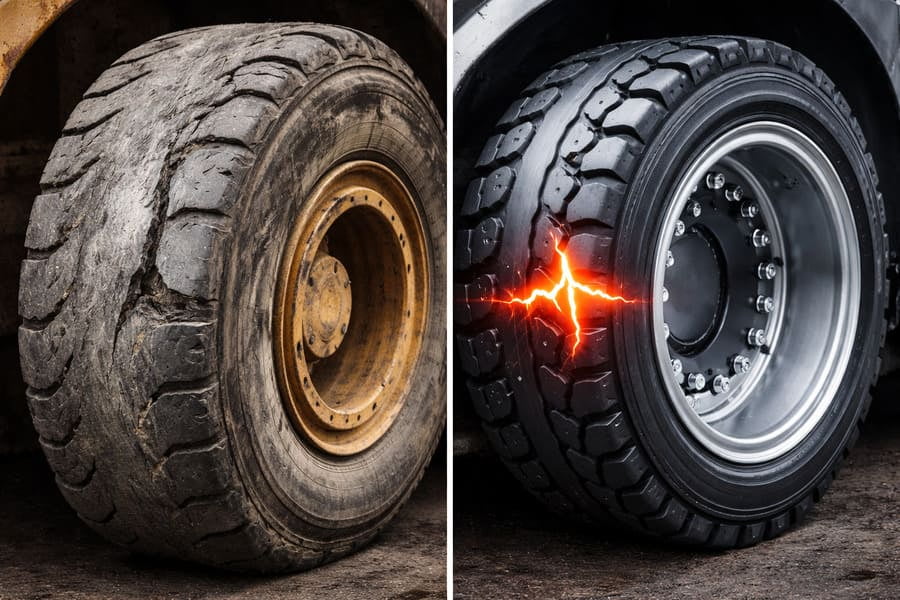
Think about a OTR tire. It's made of rubber, belts, and fabrics. As it ages, you can see the tread depth decrease, you might notice cracking in the sidewall, or feel a slow leak. These are all warnings that the tire is nearing the end of its life. An OTR wheel is completely different. It's a unified steel component designed to withstand enormous forces for millions of cycles. It doesn't "wear down" in the same way. Instead, microscopic fatigue crack3s can start and grow internally where you can't see them. The wheel performs perfectly until one of those cracks reaches a critical size. At that moment, the failure is instantaneous and total. It's not a slow decline; it's a sudden event. This is why you can't rely on simple visual inspections to predict a wheel failure.
Why Is a Tiny Crack on an OTR Wheel So Dangerous?
You spot a small, hairline crack on a wheel disc or weld during an inspection. It seems minor, and the temptation is to "keep an eye on it" to avoid costly downtime.
A crack of any size is an immediate, critical safety issue. It signals that the OTR wheel's internal structure has already failed. Continuing to use it means you are operating with zero safety margin4, risking a complete and sudden collapse at any moment.
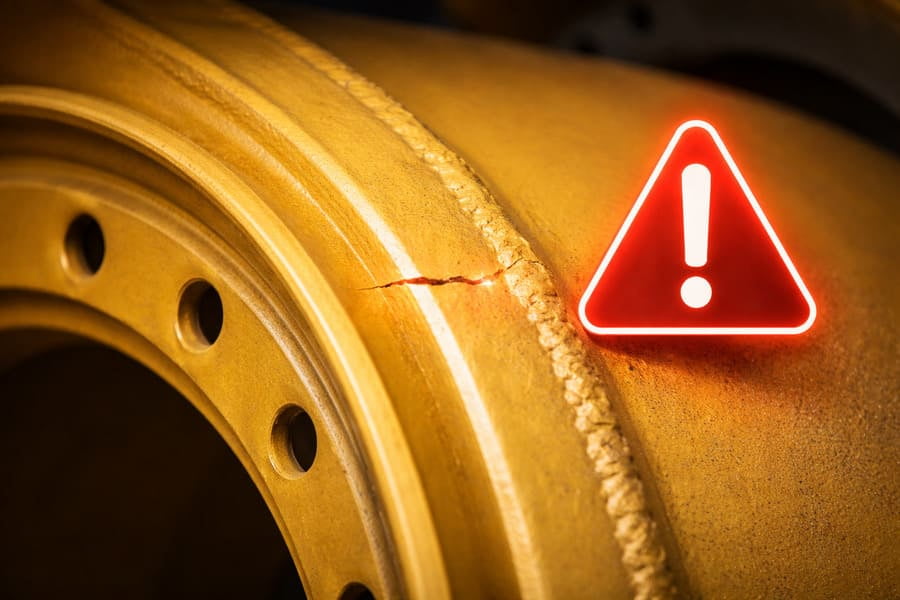
When I see a picture of a cracked OTR wheel, my first thought isn't about repair; it's about the immense risk that machine is under. A crack isn't a surface scratch. It's the visible evidence that the steel has fractured under fatigue. The moment a crack appears, the wheel has lost its designed structural integrity. It is no longer capable of safely carrying the machine's weight and handling operational stresses. Thinking you can "monitor" a crack is like knowing one of a bridge's main support cables has snapped and hoping the rest will hold. The risk escalates from a possibility to a probability. Any severe impact or heavy load could cause the crack to propagate instantly, leading to a total wheel separation. This is a non-negotiable safety red line.
Do OTR Wheels Have a Built-In Safety Margin After Cracking?
In some engineering systems, there are backups. If one part fails, another takes over. You might assume a massive steel wheel has some kind of reserve strength even after it's damaged.
No, there is no built-in redundancy in an OTR wheel. It is a single-point-of-failure5 component. Once its primary structure is compromised by a crack, there is no backup system to prevent a total collapse. The safety margin4 disappears instantly.

Let's talk about redundancy. A large airplane has multiple engines. If one fails, the others can still keep the plane flying safely. That is a redundant system. An OTR wheel is the opposite; it is a "single-point-of-failure5" system. It is designed as one solid unit to bear the entire load assigned to its corner of the machine. There is no secondary disc or backup rim that kicks in if the main one cracks. The entire safety and performance of the OTR wheel depend on its structure remaining 100% intact. The moment that structure is breached by a fatigue crack3, the system has failed. There is no "limp mode" or reserve capacity. This is what makes a cracked wheel so fundamentally different from other components that might show graceful degradation. It's either fully functional or it's an active, high-risk hazard.
How Can You Guarantee OTR Wheel Safety Before It's Even Made?
If failures are sudden and have no safety net, reacting to cracks is too late. How then can you, as a procurement or brand manager, effectively manage this risk?
Safety must be designed into the wheel in advance. This means controlling risk at the source through meticulous engineering6, certified materials7, and a rigorous manufacturing quality control8 process that is validated by international standards like ISO 90019.
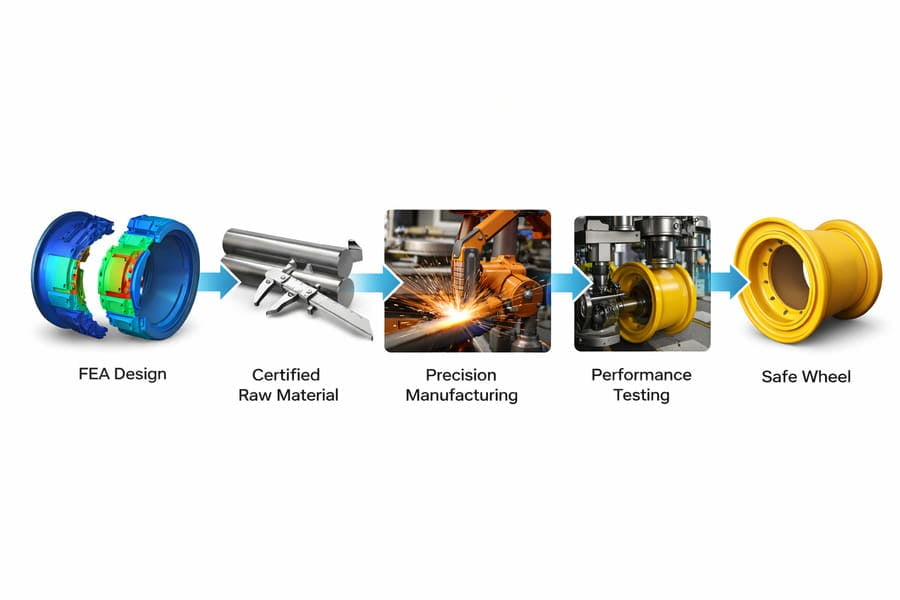
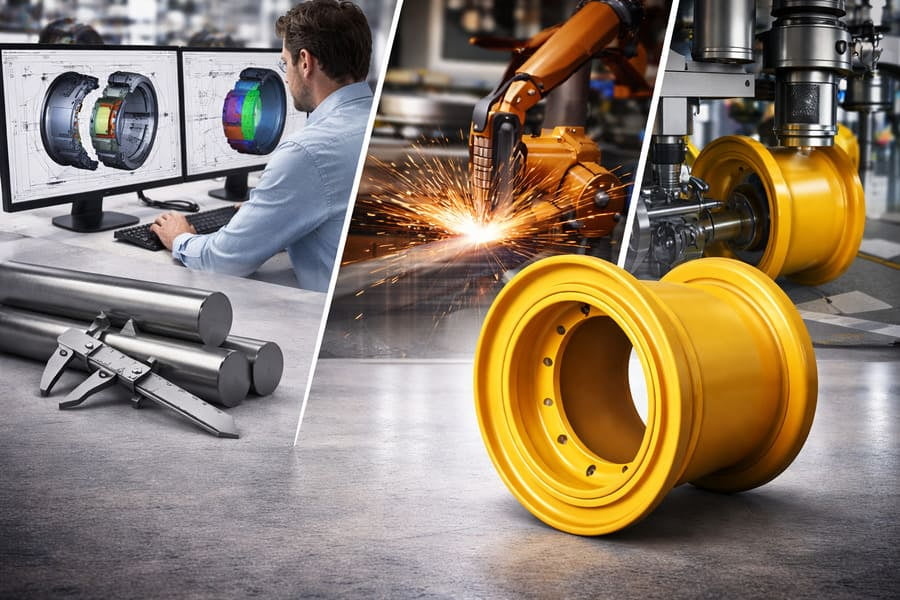
This is the most important part of my job as a supplier. Since we cannot react to failure, we must prevent it. The entire focus must be on the pre-production and production stages. It starts with design, using tools like Finite Element Analysis (FEA)10 to simulate stress and eliminate weak points before a single piece of steel is cut. It continues with raw materials; we conduct stringent tests to ensure the steel meets our specifications for strength and ductility. Then, during manufacturing on our 10 professional production lines, every step from forming to welding is precisely controlled. Finally, we perform multiple performance tests on finished wheels to validate their fatigue life. This is what it means to build safety in. When you choose a partner like Gescomaxy, you aren't just buying a wheel. You are buying the assurance that comes from a proven, proactive quality system11 designed to anticipate and prevent failure from ever starting.
Conclusion
OTR wheel safety12 isn't about inspection; it's about prevention. Since failures are sudden and absolute, reliability must be engineered into the design and manufacturing process from the very start.
Understanding the causes of OTR wheel failures can help you implement better safety measures and prevent catastrophic incidents. ↩
Exploring the reasons behind sudden failures can enhance your knowledge of machinery safety and maintenance. ↩
Understanding fatigue cracks is crucial for preventing sudden machinery failures and ensuring operational safety. ↩
Learning about safety margins can help you understand how to design and maintain safer machinery. ↩
This concept is vital for understanding risks in machinery design and can guide better engineering practices. ↩
Discovering the importance of meticulous engineering can help you appreciate the quality and safety of machinery. ↩
Exploring the significance of certified materials can enhance your understanding of quality assurance in production. ↩
Understanding quality control processes can help you ensure the safety and reliability of machinery. ↩
Learning about ISO 9001 can help you understand quality management systems and their role in safety. ↩
Learning about FEA can provide insights into advanced engineering techniques for improving safety. ↩
Exploring proactive quality systems can help you understand how to prevent failures before they occur. ↩
Understanding wheel safety practices can help you maintain equipment and prevent accidents. ↩