
Your perfectly specified OTR wheels1 are failing in the field. This constant downtime and cost erodes trust in your equipment and leaves you questioning your entire procurement strategy2.
Operating environments decide failure through unpredictable stresses—uneven ground, sharp impacts, and operator habits3. These real-world factors create loads that far exceed the controlled conditions assumed during the OTR wheel's design and testing, leading to premature fatigue4 and failure where none was expected.
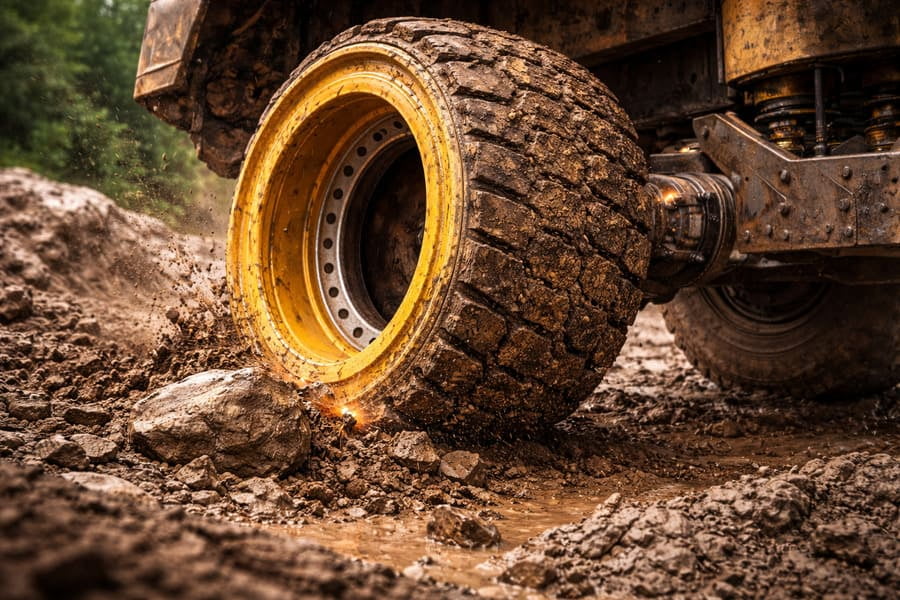
Over my 13 years exporting OTR tires and wheels, I’ve seen this story play out time and again. A procurement manager, like you, does everything right. They source a wheel that meets all the material specs, passes all the lab tests, and has all the right certifications. Yet, the calls about cracked discs and bent rims keep coming. The disconnect happens because a wheel's life isn't lived in a clean, predictable laboratory. Its story is written in the mud, rocks, and ruts of a real working farm. The design is just the first chapter; the environment writes the rest.
Why Do Identical Wheels Fail at Different Rates?
You deploy a fleet with identical OTR wheels1, yet some fail in months while others last for years. This inconsistency makes it impossible to predict maintenance costs and creates operational chaos5.
Identical wheels fail differently because no two operating environments6 are truly identical. Constant variations in ground conditions, load distribution7, and speed create unique and non-uniform stress patterns8 that a standardized design cannot fully account for, leading to unpredictable service life9.
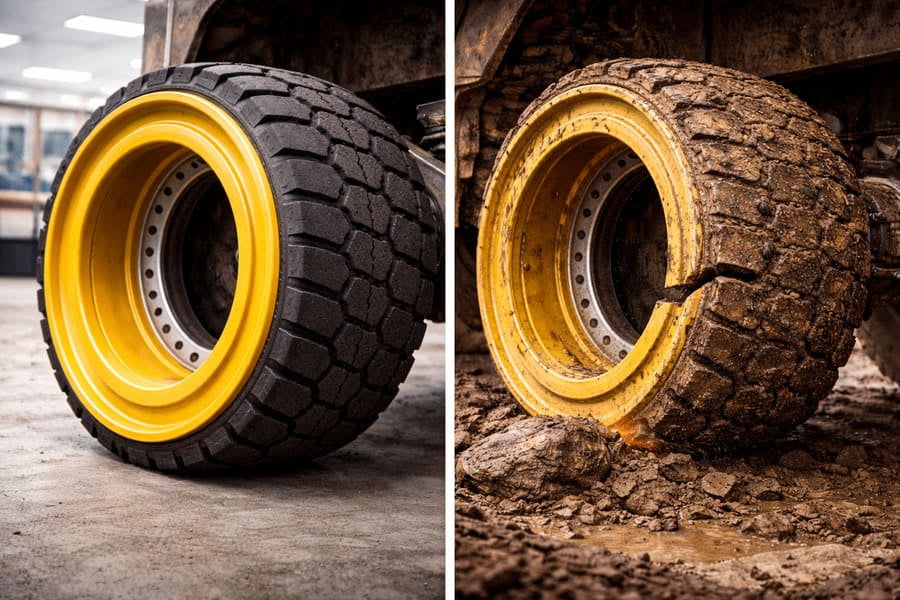
The core issue is non-uniformity. A design specification assumes a relatively consistent world. In reality, an OTR wheel's job is pure chaos. One moment, a tractor is on flat, hard-packed dirt, and the next, its left wheel sinks into a soft, muddy patch while the right rides high on a ridge. This instantly creates a twisting force that the design's simple load rating never anticipated.
The Myth of the "Average" Workday
We talk about average loads and speeds, but a wheel's life is defined by the exceptions, not the averages.
- Ground Interaction: The surface changes constantly. A OTR wheel might encounter hard clay, loose gravel, and soft mud all within a few hundred meters. Each surface interacts with the wheel differently, changing the load path and stress points.
- Load Fluctuation: The weight on a wheel is never static. Think of a harvester—its grain tank goes from empty to full, shifting the center of gravity and dramatically increasing the load in a matter of hours.
- Speed and Turns: A sharp turn at low speed on soft ground can put more lateral stress on a wheel than driving straight at high speed on pavement.
The wheel that fails is the one whose unique journey included the perfect storm of these variables. The one that survives simply had an easier life, even if it was on the same farm.
How Does the Operator Influence OTR Wheel Failure?
You've provided your customers with top-tier equipment, but you still get warranty claims10. You suspect it's not just the machine; it’s how the machine is being used.
Operators amplify wheel stress through their habits. Aggressive acceleration, hard braking, and sharp turns systematically create peak loads and side forces that were underestimated or completely ignored in the original design calculations, accelerating fatigue and causing premature failure.
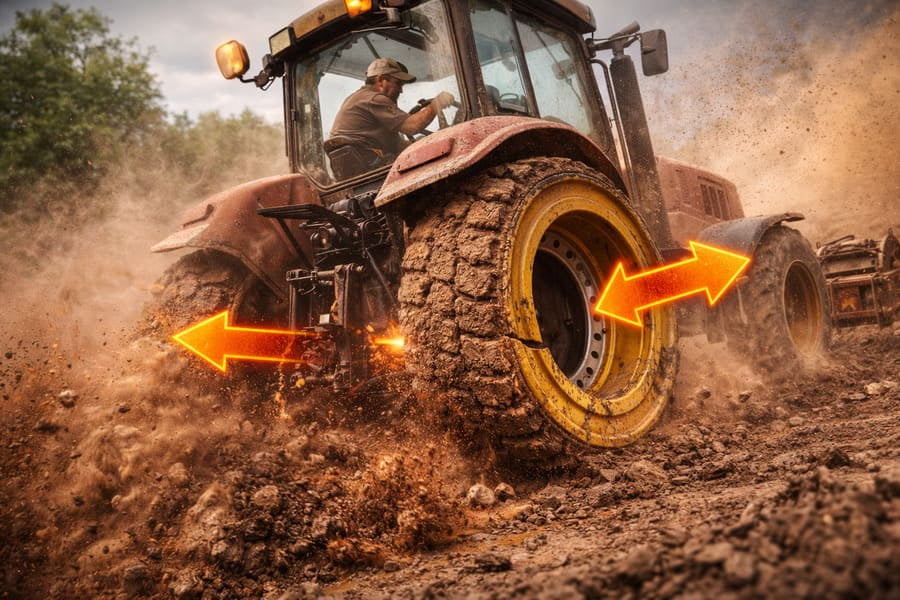
A machine is only as gentle as its operator. In our experience, the human element is one of the biggest and most overlooked factors in equipment failure. A wheel designed to handle a theoretical load can be pushed far beyond its limits by an operator trying to finish a job before a storm rolls in. This is the human amplification effect. It’s where theoretical engineering meets real-world urgency.
| Operator Action | Designed Load Path | Amplified Real-World Load |
|---|---|---|
| Gentle Start | Smooth application of torque. | Low stress on the disc and bolt holes. |
| Aggressive Start | Sudden, high-torque impact. | Massive stress on bolt holes and welds. |
| Wide Turn | Gradual application of side load. | Within the design's cornering fatigue limits. |
| Sharp, Fast Turn | Extreme lateral force and twisting. | Exceeds design limits, stressing the rim flanges. |
| Smooth Stop | Evenly distributed deceleration force. | Minimal shock to the assembly. |
| Hard Brake | Intense forward-pitching force. | Concentrates stress on the front of the bolt circle. |
An operator isn't trying to break the equipment. They are trying to be productive. But that productivity often involves pushing the machine in ways that amplify forces beyond their designed intent. That "little extra push" is what bridges the gap between a long service life9 and a sudden field failure.
Can a Single Event Really Destroy a OTR Wheel?
A wheel that has performed flawlessly for months suddenly fails after hitting one bad pothole. It seems impossible that a single moment could undo a year of solid performance.
Yes. A single extreme event, like a severe impact or a massive overload, can consume a huge portion of a OTR wheel's total fatigue life instantly. It can create microscopic cracks that then grow with every subsequent rotation until the wheel fails completely.
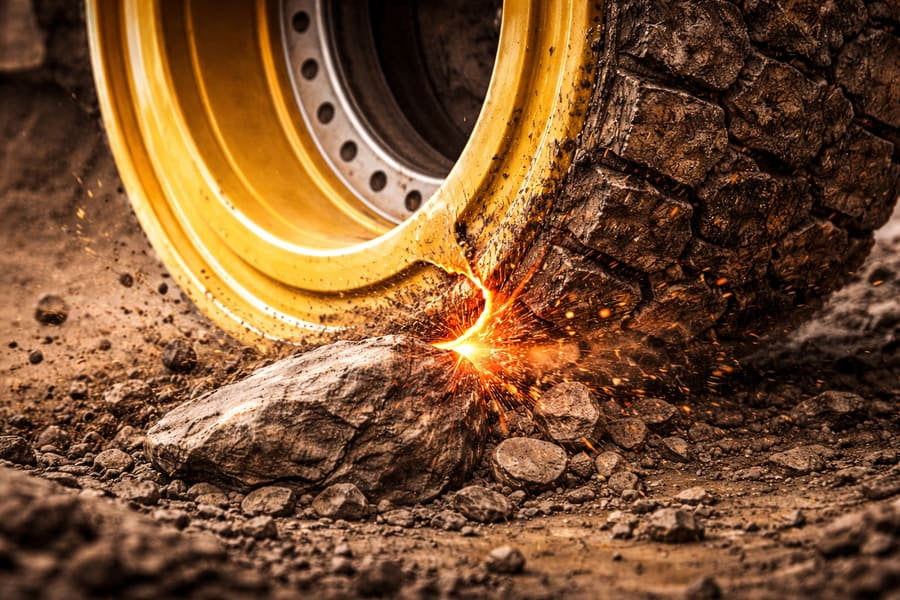
Metal fatigue is like bending a paperclip. You can bend it back and forth gently hundreds of times. But if you bend it sharply just once, you create a weak point. The paperclip is now compromised, and it will take far fewer gentle bends to finally break it. OTR wheels1 work the same way. Their "fatigue life" is the total amount of stress they can endure before breaking. This life is consumed with every rotation, but not evenly. A normal day might use up a tiny fraction of its life. An extreme event, however, can be like that sharp bend in the paperclip. Hitting a large rock or dropping into a deep rut can create an impact load11 that is many times the OTR wheel's static rating. This single shock can initiate a micro-crack. From that moment on, the wheel is living on borrowed time. The crack is invisible, but with every normal rotation, it grows a little bit, until one day, under a perfectly normal load, the wheel fails. The final break wasn't the cause; it was the inevitable conclusion of that one extreme event.
Why Do Wheels That Seem Perfect for the Job Still Fail?
You've matched the OTR wheel's load rating and specs perfectly to the vehicle. Logically, it should last. But reality proves otherwise, and you're left searching for an explanation.
Failure happens when the real-world operating environment drifts away from the original design assumptions. As the mismatch between the theoretical job and the actual job grows, failure is no longer a question of "if," but a simple function of "when."

Every engineered product is a collection of assumptions. The designer assumes a certain maximum load, a typical operating speed, a specific type of terrain, and a certain operator behavior. A OTR wheel is deemed "fit for purpose" if those assumptions closely match the intended application. But what happens when they don't? What if the soil is wetter and heavier than assumed? What if the operator is more aggressive than assumed? What if the tractor is pulling a new, heavier implement that wasn't part of the original plan? Each of these represents a drift from the initial design parameters.
The Inevitability of Mismatch
- Initial Design: Based on a "snapshot" of the intended use.
- Environmental Drift: The customer uses the equipment on steeper hills or in rockier soil.
- Operational Drift: The operator works longer hours or pushes the machine harder to meet deadlines.
- Equipment Drift: The machine is modified with heavier attachments or tires.
As this gap between the design assumptions and the field reality widens, stress accumulates in ways the OTR wheel was never meant to handle. The safety factors12 built into the design begin to erode. At some point, the accumulated stress finds the weakest point, and the wheel fails. The wheel didn't have a defect; its environment simply evolved beyond the boundaries of its design.
Conclusion
A wheel's design is only a hypothesis. The operating environment is the experiment that proves or disproves it. True reliability comes from closing the gap between the two.
Explore this resource to learn how to enhance the lifespan and performance of OTR wheels in challenging environments. ↩
This link offers insights into optimizing procurement strategies to ensure better equipment performance and reliability. ↩
Explore how operator behavior can significantly affect machinery performance and maintenance needs. ↩
Discover the underlying causes of premature fatigue and how to mitigate them for better equipment longevity. ↩
Discover strategies to streamline operations and reduce chaos in equipment management. ↩
Understanding these factors can help you select the right equipment for your specific conditions. ↩
This resource explains the importance of load distribution in maintaining equipment efficiency and safety. ↩
Understanding stress patterns can help you predict and prevent machinery failures. ↩
Learn about the key factors that influence the service life of OTR wheels to make informed purchasing decisions. ↩
This link provides insights into common warranty claims and how to prevent them. ↩
Understanding impact load is crucial for preventing equipment failure and ensuring safety. ↩
Learn about safety factors and their importance in ensuring equipment reliability and performance. ↩