

The irrigation season feels like a constant storm of unexpected service calls and frantic inventory searches. This chaos kills your profits, burns out your team, and damages your reputation.
You reduce risk by creating standardized systems1. This involves using clear selection criteria for new tires, a consistent framework for judging wear, and data-driven inventory planning2g](https://arxiv.org/html/2404.04097v1)%%%FOOTNOTE_REF_3%%%. This approach transforms reactive service into proactive and profitable risk management4.

I used to work with a dealer, let's call him Mark, who thought his best asset was a technician named Tom. Tom had this incredible gut feeling for when a tire was about to fail. The problem was, when Tom retired, Mark's business fell into chaos. His team couldn't agree on which tires to replace, customers were complaining about inconsistent advice, and his warehouse was full of the wrong sizes. Mark realized he wasn't running a tire business; he was just relying on one person's intuition. He needed a system, a playbook that anyone on his team could follow to make the right call, every single time.
Why is a "Quiet Season" Your Most Valuable Asset?
You're proud of your sales numbers, but your profit margins5 are shrinking. Every day brings another urgent call about a failing tire, pulling your technicians off profitable jobs.
A "quiet season6" is your most valuable asset because its success is measured by the absence of problems. It proves your tire selection and planning are working, maximizing profit by minimizing costly, reactive service calls and preserving customer trust7.

We're trained to measure what we do: sales made, irrigation tires installed, calls answered. But in the tire business, the most important metric is what doesn't happen. A quiet season6—one with few to no emergency calls—is the ultimate sign of a healthy dealership. Every time you have to dispatch a truck for an unexpected failure, you lose. You lose money on fuel and labor for an unplanned trip. You lose the opportunity to do scheduled, more profitable work. Most importantly, you lose a little bit of your customer's confidence. The goal shouldn't be to become great at emergency repairs8. The goal should be to build a system of tire selection and management so effective that emergencies become rare. That quietness is where your real profit is found.
How Do "Gray Zone" Irrigation Tires Silently Destroy Your Profits?
A customer calls. The tire isn't flat, but it looks "bad." Your technician isn't sure if it will last the season. Replacing it feels costly, but leaving it feels risky.
These "gray zone" cases destroy profits because they consume immense resources in judgment and second-guessing. A tire that hasn't failed catastrophically but is no longer reliable creates a risk-management problem, not a simple quality defect, leading to disputes and wasted time.
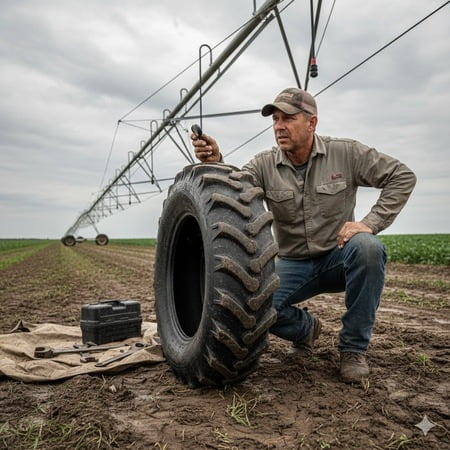
A clear failure is easy. The tire is flat, you replace it, and everyone moves on. The real poison for a dealership is the in-between cases. This is where warranty claims turn into arguments and customer relationships get strained. Is the cracking on the sidewall normal aging or a sign of imminent failure? Will that tread make it through the final two months of watering? Without a standardized framework9, every one of these decisions is a stressful, time-consuming debate. Your technician in the field makes one call, the manager at the office makes another, and the customer is caught in the middle. By creating a clear, visual guide10—a playbook—for what constitutes "safe to run," "monitor closely," or "replace now," you eliminate the debate. You turn a subjective judgment call into a simple, repeatable business process.
Standardizing "Gray Zone" Decisions
| Tire Condition | Ad-Hoc Judgment (High Risk) | Standardized Playbook (Low Risk) |
|---|---|---|
| Minor Sidewall Cracking | "Looks okay to me." - Technician A | "Condition Green: Safe to run, check again in 30 days." |
| 50% Tread Remaining | "Maybe it will last?" - Technician B | "Condition Yellow: Advise customer it may not last the full season. Offer replacement options." |
| Uneven Lug Wear | "It's not flat yet." - Technician C | "Condition Red: High risk of failure under load. Recommend immediate replacement." |
| Result | Inconsistent service, customer confusion, high risk of in-season failure. | Consistent advice, clear customer communication, managed risk. |
Why Does Experience Fail When Managing a Mixed Fleet?
Your best technician can service a Valley pivot with his eyes closed. But when he's faced with a new Reinke model on different soil, his old tricks don't work.
Experience with one system fails because managing a mixed fleet requires standardized judgment, not just ad-hoc experience. Different pivots, soil types, and loads demand a consistent evaluation framework that applies equally to all equipment, removing guesswork.

Relying on individual experience is like having a separate playbook for every single player on a team. It's chaos. A dealer's territory might include three different pivot brands, four distinct soil types, and countless variations in water and cornering system weight. The idea that one person's "feel" can correctly account for all these variables is a fantasy. This is why a standardized system is so critical. It forces your team to evaluate tires based on universal principles11 of load, wear, and risk, not just what they remember from the last job. It helps them ask the right questions: What is the real load on this specific tower? How does this clay soil increase stress compared to the sandy field across the road? This approach elevates your team from being "tire fitters" to become true risk advisors for your customers.
Do Your Field Teams Need More Data or Clearer Rules?
You've given your service team access to every tire spec sheet and technical manual. Yet, they still call you from the field, unsure of what to do.
Your service teams need decision playbooks12, not more specifications. In the field, the question isn't "Is this a good tire?" It's "Can this tire safely keep running for the next 60 days?" A playbook gives them clear rules to answer that question confidently.

A spec sheet tells you a irrigation tire's maximum load. It doesn't tell you what to do when a tire with 40% tread life is going into the most critical watering month of the year. Your team is paralyzed by data because it doesn't answer their real-world question. This is where a simple decision playbook changes everything. It's a tool, often with pictures, that guides them through a simple process: "If the cracking looks like Photo A, the tire is safe. If it looks like Photo B, advise the customer to monitor it. If it looks like Photo C, it must be replaced." This isn't "dumbing down" the work; it's making it smarter. It empowers your technicians to make fast, consistent, and defensible decisions. It reduces their stress, builds customer trust7, and protects your business from the liability of a bad call.
Conclusion
Stop relying on gut feelings and start building a system. Standardized selection, judgment, and inventory planning3 will give you the one thing you really want: a quiet, profitable irrigation season.
Explore how standardized systems can streamline operations, reduce chaos, and enhance profitability in your business. ↩
Learn how data-driven inventory planning can optimize stock levels, reduce waste, and increase profits. ↩
Learn how effective inventory planning can reduce costs and improve profitability. ↩
Discover how proactive risk management can turn reactive service into profitable business practices. ↩
Learn strategies to enhance profit margins by reducing reactive service calls and optimizing operations. ↩
Discover why a quiet season, marked by fewer emergencies, is crucial for maintaining customer trust and maximizing profits. ↩
Understand the importance of reducing emergency calls to maintain and build customer trust. ↩
Understand the financial and reputational benefits of minimizing emergency repairs in business operations. ↩
Find out how a standardized framework can eliminate guesswork and ensure consistent decision-making. ↩
Find out how visual guides can simplify complex decisions and improve consistency in tire management. ↩
Explore the universal principles that can guide consistent evaluation across different equipment types. ↩
Learn how decision playbooks can empower field teams to make confident and consistent decisions. ↩