
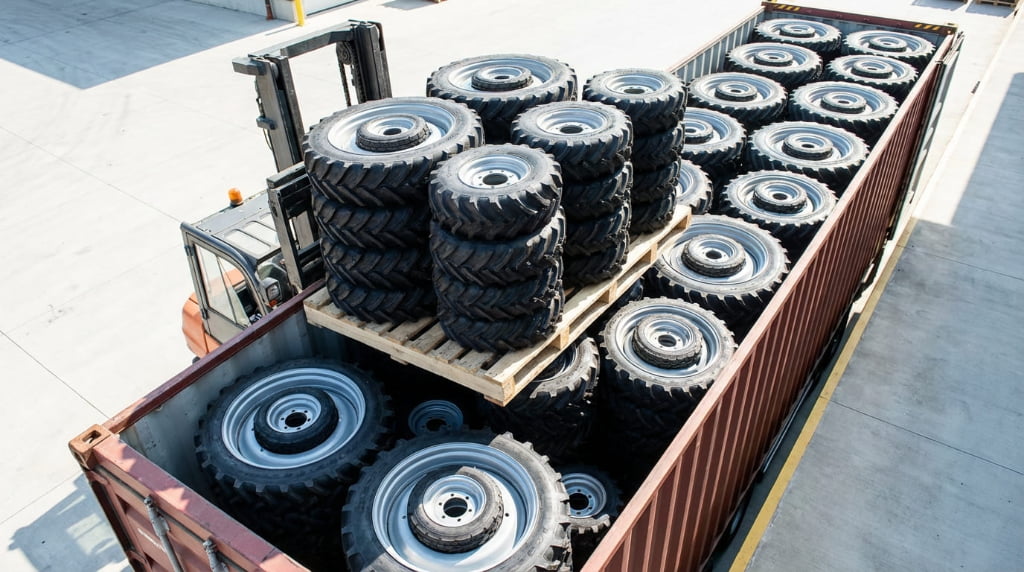
Your container shipping costs1 are soaring. You’re frustrated because you know a lot of that space is just empty air inside your separate tire and rim shipment, inflating your per-unit cost.
You save money by having us pre-assemble tires and rims2, which transforms two bulky items into one compact unit. We also use nesting strategies3, fitting smaller components inside larger ones, to maximize container fill rate and dramatically cut your per-unit freight cost4.
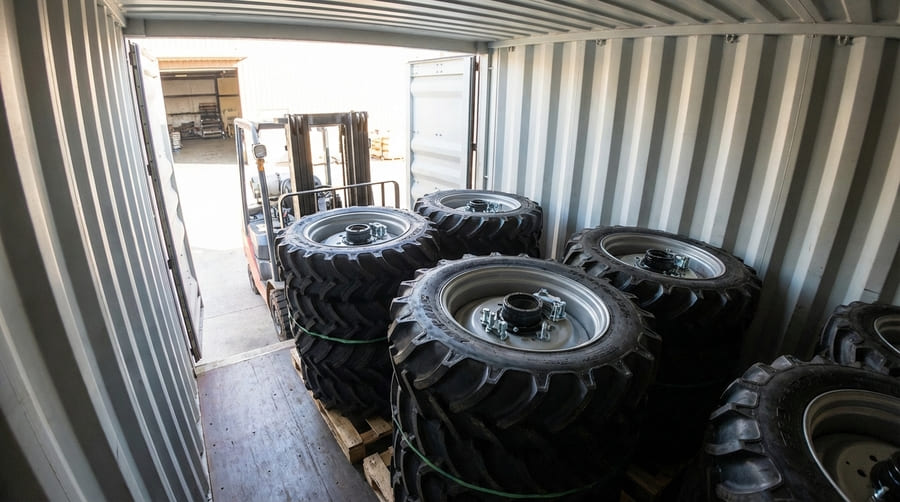
As a procurement manager, your job is to find efficiencies. In my 13 years of exporting agricultural tires5, the single biggest "aha!" moment for my clients is when we talk about shipping. I've seen countless companies spend a fortune shipping tires and rims separately6. They're paying freight on the empty, unfillable space inside every single tire. It’s like buying a whole shipping container and leaving a third of it empty on purpose. We found a way to solve this, not just by providing great products, but by fundamentally changing how they are shipped. Let's look at how we can stop you from paying to ship air.
How Does Pre-Assembly Eliminate Wasted Shipping Volume?
You’re buying tires and rims separately, but that means you’re shipping a huge, hollow void with every tire. This wasted space costs you money and adds local assembly costs7 later.
Pre-assembly works by mounting the tire onto the rim before shipping. This transforms two bulky items with lots of internal empty space into one solid unit, significantly reducing the total cubic meter volume and letting us pack the container far more densely.
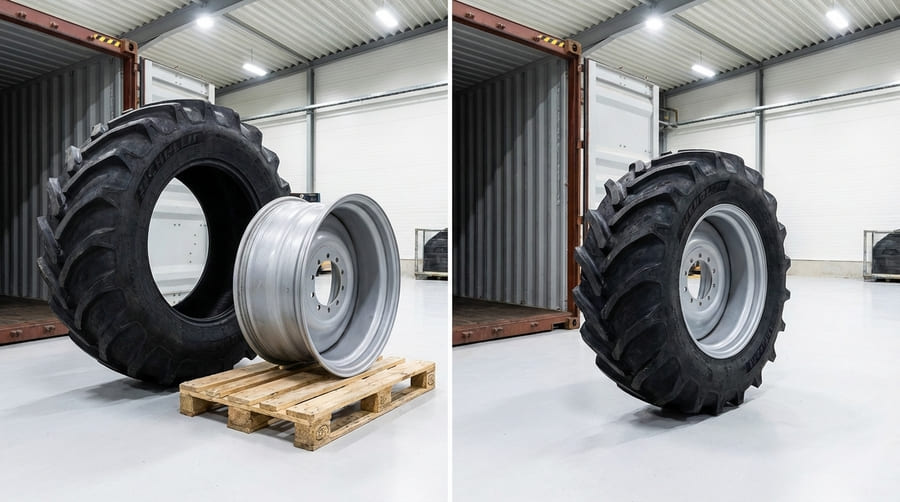
Let’s break this down. A large agricultural tire is essentially a big, hollow ring. A steel rim is a smaller, heavy ring. When shipped separately, they are awkward shapes that don't stack cleanly. The space inside the tire is completely wasted. By mounting the tire onto the rim at our facility, we create a single, more manageable unit—a complete wheel assembly8. This immediately eliminates the "air" you were paying to ship inside the tire. It also makes loading much more efficient, as assembled wheels can often be packed more tightly than their separate components. This service doesn't just save you on freight; it also removes the hassle and cost of arranging for assembly at the destination. You receive a product that’s ready to be installed, streamlining your entire operation.
The True Cost of Separate Components
| Shipping Method | Container Space Usage | Hidden Costs | Supply Chain Impact |
|---|---|---|---|
| Tires & Rims Separate | Low efficiency, much wasted "air" | High freight cost per unit; Local assembly labor & time | Complex; requires post-delivery logistics |
| Assembled Wheels | High efficiency, minimal wasted space | Lower freight cost per unit; No local assembly needed | Streamlined; units are ready for use |
How Does Nesting Further Maximize Container Space?
Even with assemblies, you worry there's still wasted space that could be used. You want to be absolutely sure you’re getting the maximum value out of every dollar spent on freight.
Nesting is an advanced strategy where we place smaller rims inside larger rims, and smaller tires inside larger tires, before loading. This technique fills the natural voids within the products themselves, pushing container fill rates to their absolute maximum and lowering your costs even further.
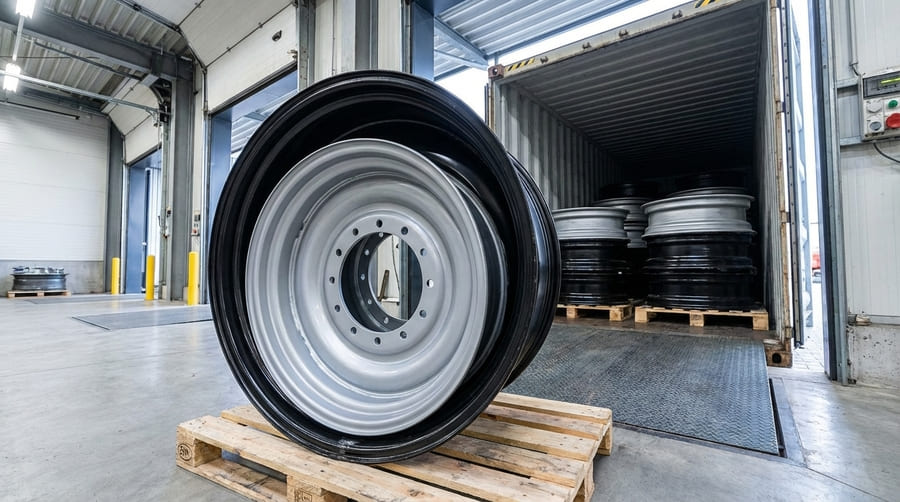
Nesting is the next level of shipping optimization9, and it's something I get really excited about because the savings are so clear. Imagine you have an order for multiple sizes of rims. Instead of stacking them individually, we can place a 24-inch rim inside a 38-inch rim. Instantly, the space inside the larger rim is no longer wasted. We apply the same logic to tires where it's technically feasible. This strategy requires careful planning and knowledge of the products' dimensions, but the result is a shipment that is packed with incredible density. For clients who purchase a range of sizes, nesting can be a game-changer. It turns what would have been empty pockets of air into valuable, product-filled space, ensuring you are only paying to ship your actual goods.
Can You Show Me a Real-World Cost Comparison?
You've heard the theories, but you need to see the numbers. How much money can you actually save by switching from shipping components to shipping assembled and nested wheels?
A sample calculation shows that by using assembly and nesting, you can fit significantly more wheel sets in a single container. This can reduce the per-set logistics cost by 30-40% or even more, representing thousands of dollars in direct savings on a single shipment.
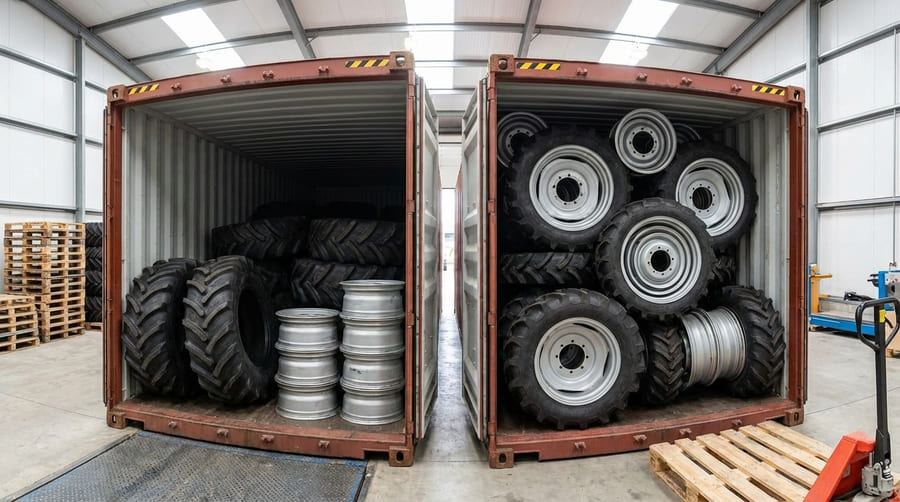
Let's run a simplified example. Imagine you need 120 sets of a popular agricultural wheel size.
-
Method 1: Shipping Separately
- 120 tires and 120 rims are bulky and create a lot of wasted air. Due to the inefficient packing, you might only fit 60 sets (60 tires + 60 rims) into one 40-foot container.
- To ship all 120 sets, you would need two containers. If the freight for one container is $4,000, your total shipping cost is $8,000.
- Your per-set shipping cost is $8,000 / 120 = $66.67 per set.
-
Method 2: Assembled & Nested Shipping
- We assemble the wheels and use nesting where possible. The packing is now far more dense. We can now fit all 120 sets into a single container.
- Your total shipping cost is just $4,000.
- Your per-set shipping cost is $4,000 / 120 = $33.33 per set.
In this scenario, you saved $4,000 in total and cut your per-unit logistics cost in half. This is a direct boost to your profit margin.
Conclusion
Stop paying to ship air. By switching to pre-assembled and nested wheel shipments, you can dramatically increase container efficiency, slash your per-unit freight cost4s, and simplify your supply chain.
Understanding the factors influencing shipping costs can help you make informed decisions and save money. ↩
Discover how pre-assembly can significantly reduce shipping costs and improve efficiency. ↩
Learn about nesting strategies to maximize container space and reduce freight costs. ↩
Explore strategies to effectively lower your per-unit freight costs. ↩
Explore best practices for shipping agricultural tires to maximize efficiency and reduce costs. ↩
Explore the hidden costs and inefficiencies of shipping tires and rims separately. ↩
Learn how local assembly costs can add to your overall shipping expenses. ↩
Find out how complete wheel assemblies can streamline your shipping process. ↩
Discover best practices for optimizing your shipping process and reducing costs. ↩