
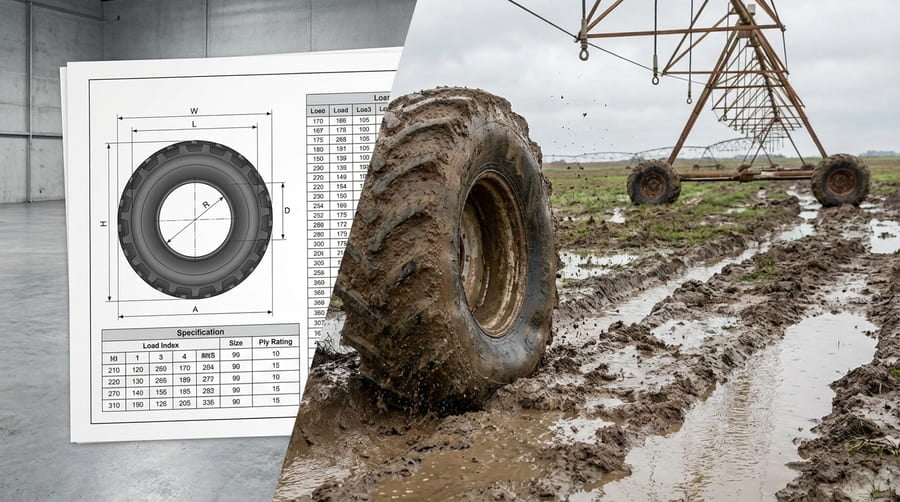
You've done your homework. You matched the irrigation tire's load index1 and dimensions perfectly to the pivot's requirements. But then it fails in a muddy rut, and the spec sheet offers no explanation.
A irrigation tire's specifications confirm its basic capabilities, like load and size, for standard operation. However, the real-world field conditions2—mud, ruts, and slopes—introduce complex stresses that spec sheets don't cover. These unlisted stresses3 are what truly determine the risk of failure.
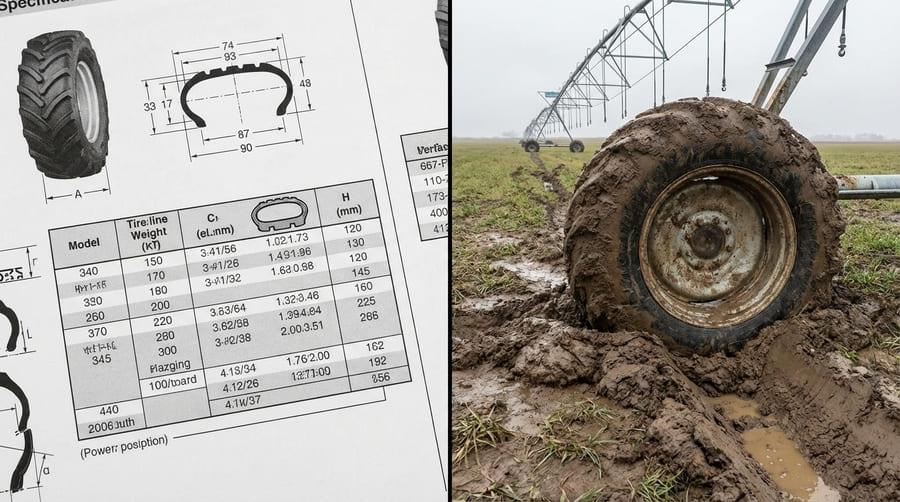
I’ve been in this business for 13 years, and early on, I learned a hard lesson: a spec sheet is a starting point, not a guarantee. I remember working with a large corporate farm that was meticulous about their procurement. They bought a batch of irrigation tires that were, on paper, a perfect match for their pivots. Six months later, I got an angry call. They were seeing repeated failures, but only on the pivots located in their lower fields. The tires in the upper, drier fields were fine. The spec sheet was identical for all of them, but the ground conditions4 were not. The mud and uneven terrain in those lower fields were introducing forces the irrigation tires were never rated for. That day, we stopped talking about specs and started talking about the environment.
What Hidden Stresses Do Spec Sheets Completely Ignore?
You're looking at a datasheet full of numbers for load, speed, and pressure. It feels like you have all the information you need, but you have a nagging feeling something is missing.
Standard specifications almost never account for dynamic, real-world stresses5 like deep mud, uneven ruts, or side-hill operation. These environmental factors create complex loads that push a tire past its design limits, even if it seems correctly specified on paper.
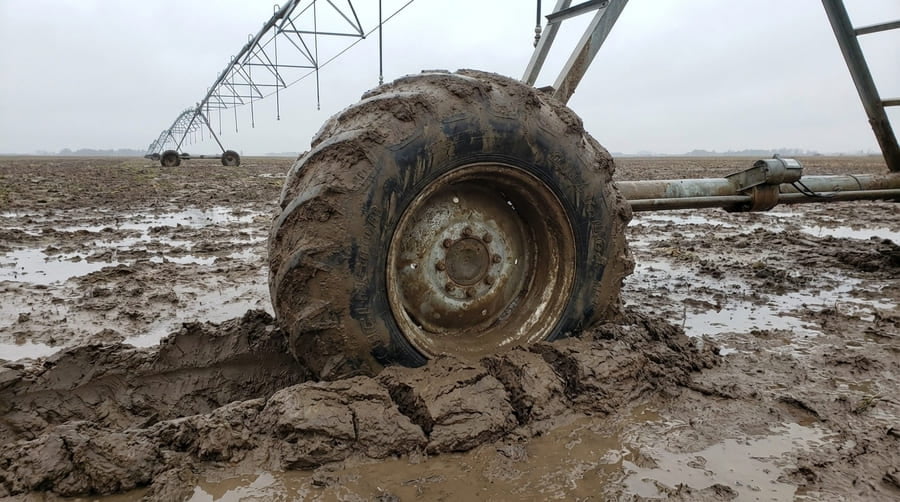
Think of a spec sheet as a lab test. It tells you how the tire performs in a perfect, controlled environment. But a farm is anything but controlled. The load rating, for instance, assumes the weight is distributed evenly on a flat surface. It doesn't account for the intense sideways pressure (lateral force6) exerted on a irrigation tire's sidewall as it claws its way out of a muddy rut. It doesn't factor in the constant twisting force (torsion7) on a tire when a tower gets slightly misaligned and drags it sideways. And it certainly doesn't measure the unique strain of operating on a slope, where gravity is constantly pulling the entire structure downhill. These are the forces that cause beads to unseat, sidewalls to buckle, and plies to separate. They are the true test of a tire's durability, and they are nowhere to be found on the spec sheet.
Unlisted Stresses vs. Standard Specs
| Standard Specification | Unlisted Real-World Stress | Consequence of Ignoring It |
|---|---|---|
| Load Index (kg/lbs) | Torsional load from ruts & misalignment. | Sidewall damage, ply separation. |
| Ply Rating | Lateral force from climbing out of ruts. | Bead unseating, carcass failure. |
| Overall Diameter | Soil compaction and sinking in mud. | Increased rolling resistance8, gearbox strain. |
| Static Loaded Radius | Operating on a continuous slope. | Uneven wear, structural fatigue on one side. |
Why Does the Same Irrigation Tire Fail on One Farm but Succeed on Another?
You sold the same tires to two different farms. One customer loves them, but the other is experiencing constant issues. You're left wondering if it's a quality control problem.
Identical irrigation tire specifications do not guarantee identical performance. The ground conditions4—from soil type to terrain—dramatically alter the forces acting on the tire. A tire that thrives on firm, flat ground can fail quickly in soft, uneven soil.
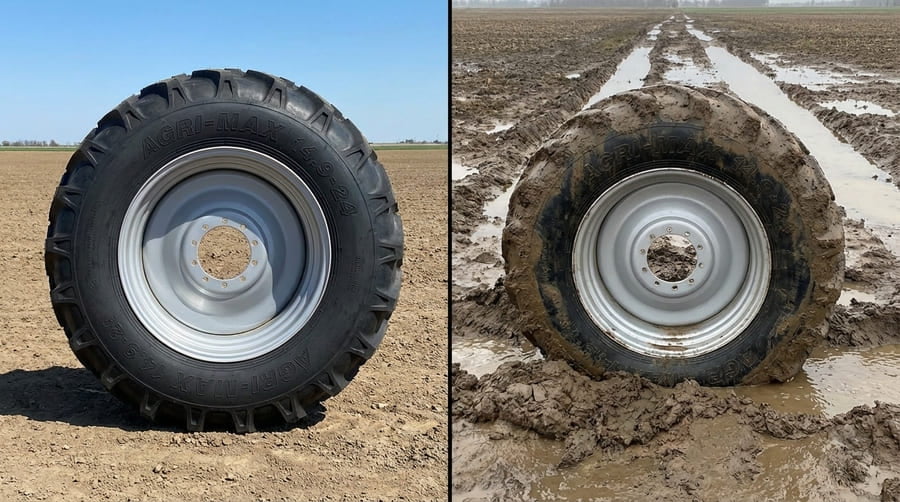
This is a scenario I see all the time. A dealer finds a tire that works great for 90% of their customers and assumes it's a universal solution. But it's the other 10% that can damage your reputation. A tire's performance is a direct result of its interaction with the ground. On hard-packed, dry soil, the load is distributed evenly across the tread. The tire performs exactly as the spec sheet predicts. Now, take that same tire and put it in a field with soft, loamy soil after a heavy rain. The irrigation tire sinks, creating deep ruts. To move, it not only has to support the pivot's weight but also constantly climb the wall of the rut it just created. This adds enormous strain and changes the performance equation entirely. The load is no longer simple vertical pressure; it's a complex combination of vertical load and horizontal resistance. The tire that was perfectly adequate on the first farm is now severely under-equipped for the second.
Where Do Most Irrigation Tire Failures Actually Begin?
Your team inspects the main tread and sidewalls, and everything looks fine. Yet, a failure still occurs, seemingly out of nowhere. You're looking in the wrong place for the initial problem.
Most breakdowns don't start during normal, average operation. They begin at overlooked "boundary conditions9"—the extreme moments like a wheel getting stuck, a tower climbing a steep incline, or a tire being dragged sideways. These edge cases cause the initial damage.
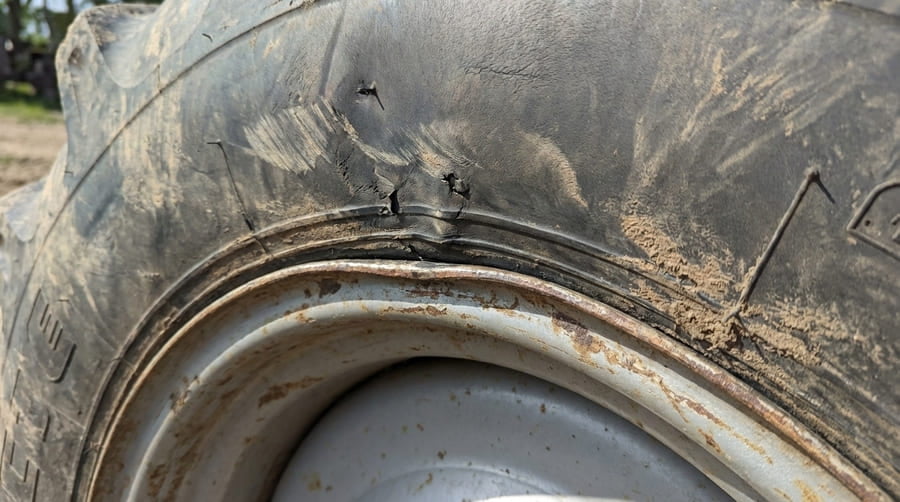
We tend to think of failure as a gradual process of wear and tear. But for irrigation tires, it's more often a story of specific events. The most vulnerable moments are at the extremes. For example, a pivot tower gets stuck in a deep rut. The drive motor keeps trying to turn the wheel, but the tire is locked in place. This creates an immense torsional force10://en.wikipedia.org/wiki/Glossary_of_mechanical_engineering)7al force that twists the irrigation tire on the rim, which can damage the bead—the steel bundle that holds the irrigation tire to the galvanized wheel. The damage might be invisible at first, but the bead seal11 is now compromised. A week later, it starts a slow leak. A month later, it fails. The final blowout seems random, but the cause was that one specific "boundary condition" event. Focusing only on the general condition of the tire means you miss the evidence of these critical moments, which are the real starting point of most structural failures.
Conclusion
Look beyond the spec sheet. Real-world risk is defined by mud, ruts, and slopes. Understanding the field conditions is the only way to choose a tire that will not just fit, but survive.
Understanding the load index helps ensure the tire can handle the weight demands of your specific irrigation system. ↩
Exploring this will help you understand how different terrains and conditions impact tire performance and longevity. ↩
Learning about unlisted stresses can help you anticipate potential tire failures not covered by standard specifications. ↩
Exploring this can help you choose the right tire for specific field conditions, ensuring better performance. ↩
Understanding these stresses can help you choose the right tire for challenging environments. ↩
Knowing about lateral force can help prevent sidewall damage and improve tire durability. ↩
Understanding torsion can help you identify potential causes of tire failure due to twisting forces. ↩
Understanding rolling resistance can help you improve fuel efficiency and reduce wear on tires. ↩
Understanding boundary conditions can help you identify critical moments that lead to tire failure. ↩
Learning about torsional force can help you prevent damage during extreme conditions. ↩
Understanding the bead seal's role can help you prevent leaks and ensure tire integrity. ↩