
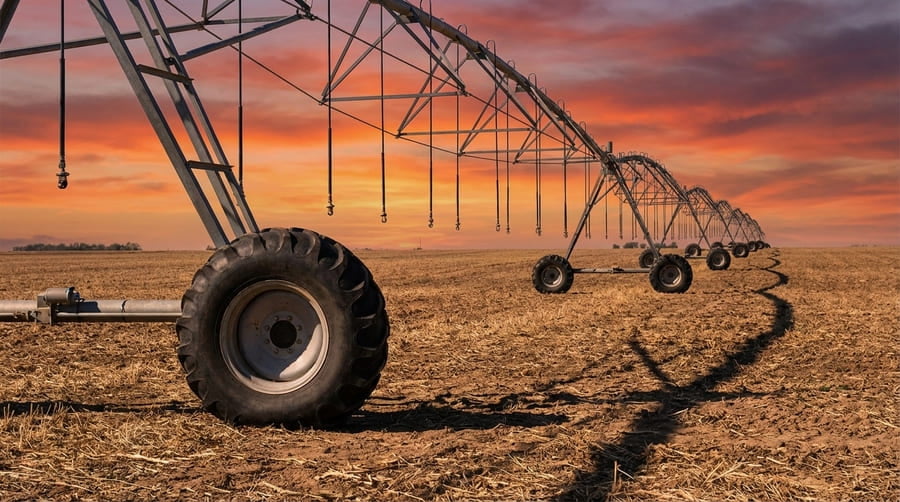
You see one irrigation tire on your center pivot wearing down faster than all the others. Your first thought is to blame the tire itself. This is a costly mistake that ignores the real problem.
Irrigation tires1 are the first to show system imbalance2 because their primary role is stability, not traction. As flexible load-bearers3, they absorb and visually display mechanical stresses4 from the entire structure, acting as an early warning system5 before more rigid, expensive components fail.
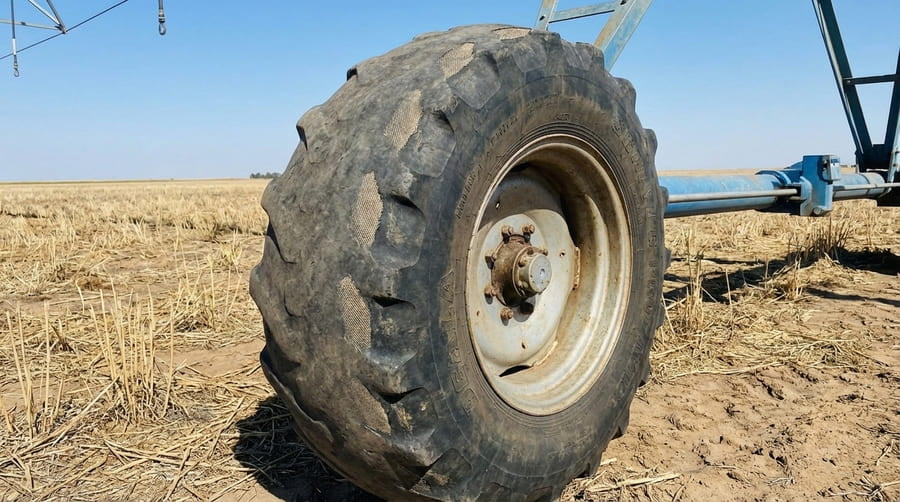
I remember a client in Nebraska who was frustrated. He had a tower where the inside irrigation tire would wear out twice as fast as the outside one. He'd replaced it three times, each time convinced he'd just gotten a "bad tire." I flew out to his farm, and we walked the pivot's path. It turned out, a minor rut on the inside track6 caused that specific tower to tilt slightly on every rotation. The motor, gearbox, and steel structure showed no signs of stress, but the flexible tire was absorbing that slight, constant imbalance, causing it to scrub and wear abnormally. The tire wasn't the problem; it was the only part of the system honest enough to tell us there was one.
Is a irrigation tire's main job traction or something else entirely?
When we think of tires, we think of grip and pulling power. We see it on tractors and trucks every day. So when a pivot tire wears out, we naturally assume it's a performance failure.
An irrigation tire's primary function is not to pull, but to support the entire system. It acts as a flexible foundation, providing load support, damping vibrations, and maintaining stability over uneven ground.
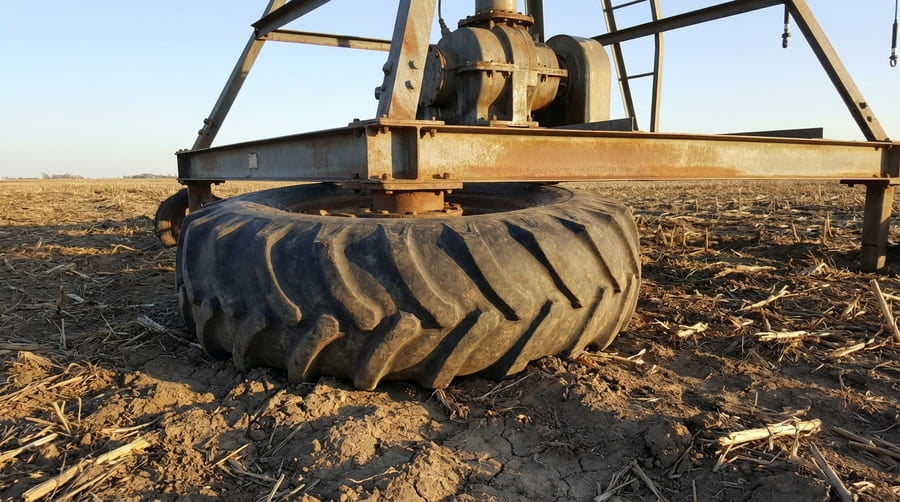
Unlike a tractor tire designed to transfer engine torque into the ground, an irrigation tire is mostly just along for the ride. The electric motors and gearboxes provide the minimal propulsion needed. The tire's real job is much more passive, but also more critical for system health. It has to support thousands of pounds of static weight7 from the pipes, water, and tower structure. It must also act like a shock absorber8, flexing and compressing to dampen vibrations as the tower rumbles over clumps of dirt and small ruts. This unique role as a flexible, load-bearing cushion makes it incredibly sensitive to how forces are distributed from the rest of the pivot structure. It's not built for aggression; it's built for endurance and stability.
Tractor Tire vs. Irrigation Tire: A Tale of Two Jobs
Understanding the difference in their core function is key.
| Feature | Tractor Tire (Traction) | Irrigation Tire (Stability) |
|---|---|---|
| Primary Function | Transferring engine power to the ground | Supporting system weight and maintaining balance |
| Key Design Focus | Aggressive tread lugs for maximum grip | Strong sidewalls and high load capacity |
| Main Force Handled | Horizontal torque and shear forces | Constant vertical and fluctuating lateral forces |
| Failure Indicator | Loss of grip (spinning) or tread wear | Deformation, uneven wear, or structural damage |
Why does a small system imbalance2 create a big irrigation tire problem?
You might think a slight misalignment or a bit of extra weight on one side is no big deal. But for a irrigation tire, these small issues are amplified into major stress, leading to premature failure.
When a pivot system is mechanically unbalanced, the tires are the first to show it. As the most flexible component in the load path, they absorb and visibly express these uneven forces before rigid parts can.
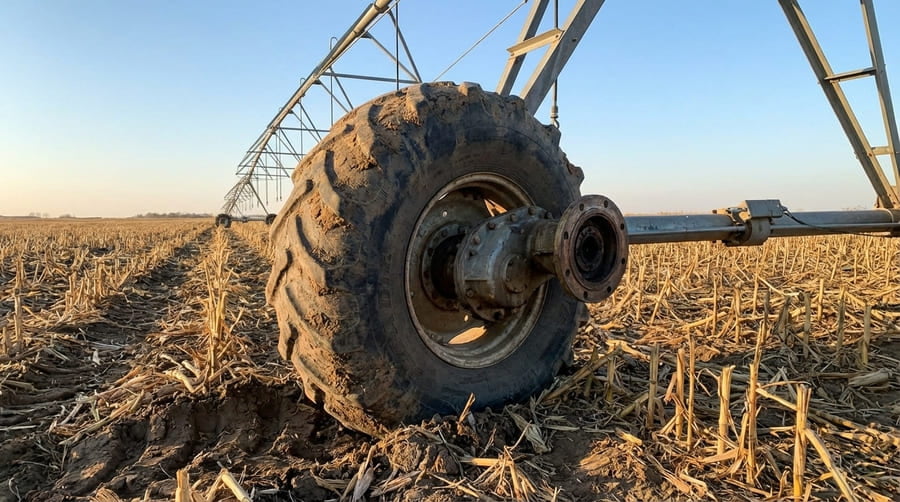
Imagine carrying a heavy backpack with both straps perfectly adjusted. The weight is distributed evenly. Now, imagine one strap is much longer than the other. Your body is unbalanced, and all the weight digs into one shoulder. That shoulder is your irrigation tire. A center pivot is a long, articulated steel structure. A slight misalignment in a tower, a wheel rut, or a gearbox issue changes the geometry of the entire system. The rigid steel beams and pipes don't flex easily, so they transfer that imbalance down to the one component designed to flex: the tire. This results in forces the irrigation tire was never designed to handle. Instead of a straight, vertical load, it now experiences constant lateral scrubbing or uneven pressure, which is why irregular wear patterns appear. The tire isn't failing; it's screaming for help on behalf of the entire system.
Can a tire's wear pattern tell you what's wrong with your system?
You see cupping on one irrigation tire and shoulder wear on another. These aren't random defects. They are a visual language that tells a story about a specific problem somewhere else in the pivot.
A tire's irregular wear pattern is a direct, visual map of a system-level mechanical problem9. By learning to read these patterns, you can diagnose issues with alignment, load, or tracking before they cause catastrophic failure.
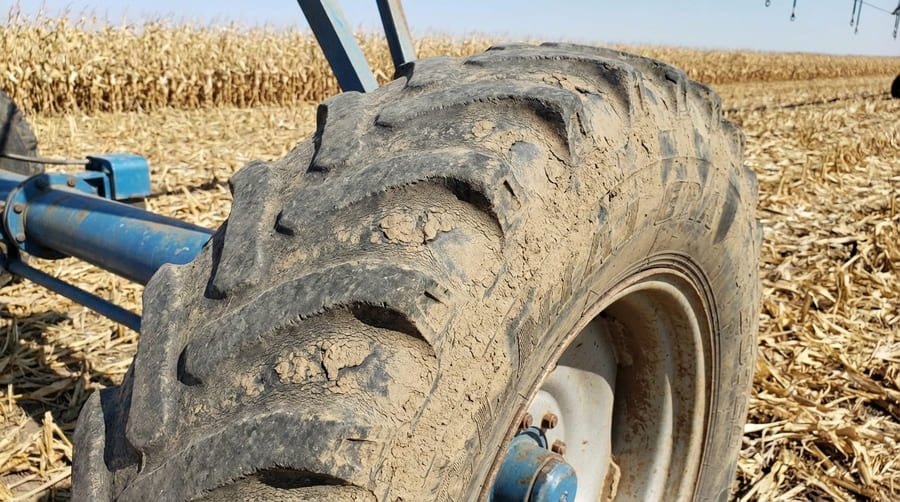
Tire wear is a form of data. It's the physical result of the forces acting upon it. A properly inflated and aligned tire carrying a balanced load will wear slowly and evenly. Any deviation from this creates a distinct pattern. For instance, heavy wear on both shoulders often points to chronic under-inflation10, forcing the tire to carry weight on its weaker sidewalls. Conversely, wear down the center can indicate over-inflation11. But more complex patterns tell a deeper story about the system itself. Consistent wear on just one shoulder of a tire often points to a wheel alignment12 or tower lean issue. This "toe-in" or "toe-out" condition scrubs the tire sideways with every rotation. By treating the wear pattern not as the problem, but as the symptom, you can trace the issue back to its root cause.
Reading the Signs: What Your Tires Are Telling You
| Wear Pattern | What it Looks Like | Likely System Problem |
|---|---|---|
| One-Sided Shoulder Wear | One edge of the tread is smooth/worn | Wheel misalignment (toe-in/toe-out13) or tower lean |
| Cupping / Scalloping | Uneven, scooped-out patches | Worn-out drivetrain components, wheel imbalance |
| Center Rib Wear | The center of the tread wears fastest | Chronic over-inflation11 (often a user error) |
| Both Shoulders Wear | Both edges of the tread wear fastest | Chronic under-inflation10 (often a user error) |
Conclusion
Stop blaming your tires. Start listening to them. An irrigation tire showing a problem is not a failure; it is a valuable, early warning that protects your entire irrigation system from costly damage.
Understanding the role of irrigation tires can help you maintain your system effectively and prevent costly failures. ↩
Learn how system imbalance can lead to premature tire wear and how to address it for better performance. ↩
Discover the importance of flexible load-bearers in maintaining stability and preventing damage. ↩
Understanding mechanical stresses can help you diagnose issues before they escalate into major problems. ↩
Explore how irrigation tires can signal problems in your system before they lead to costly repairs. ↩
Learn how even minor ruts can cause significant wear on irrigation tires and how to fix them. ↩
Discover how static weight affects tire performance and what you can do to optimize it. ↩
Understanding the shock-absorbing role of irrigation tires can enhance your system's longevity. ↩
Discover how to use tire wear as a diagnostic tool for your entire irrigation system. ↩
Learn about the risks of under-inflation and how to ensure your tires are properly inflated. ↩
Explore how over-inflation can lead to tire damage and how to maintain proper pressure. ↩
Understanding wheel alignment can help you prevent uneven tire wear and extend tire life. ↩
Understanding toe-in/toe-out can help you maintain proper alignment and prevent tire wear. ↩