
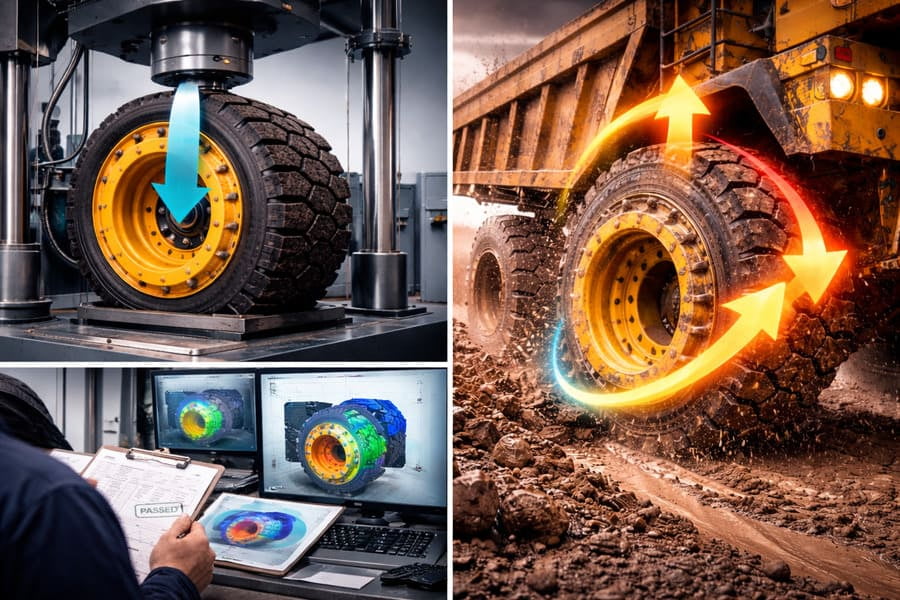
Your new OTR wheels1 passed every certification, with test reports to prove it. But in the field, you're still seeing cracks and failures. You start to wonder if the tests mean anything.
The real risk for OTR wheels1 lives in the gap between standardized tests2 and real-world chaos. Lab tests apply clean, single-direction forces, but actual operation involves a messy, simultaneous combination of turning, braking, and impact loads3 that standards don't simulate.
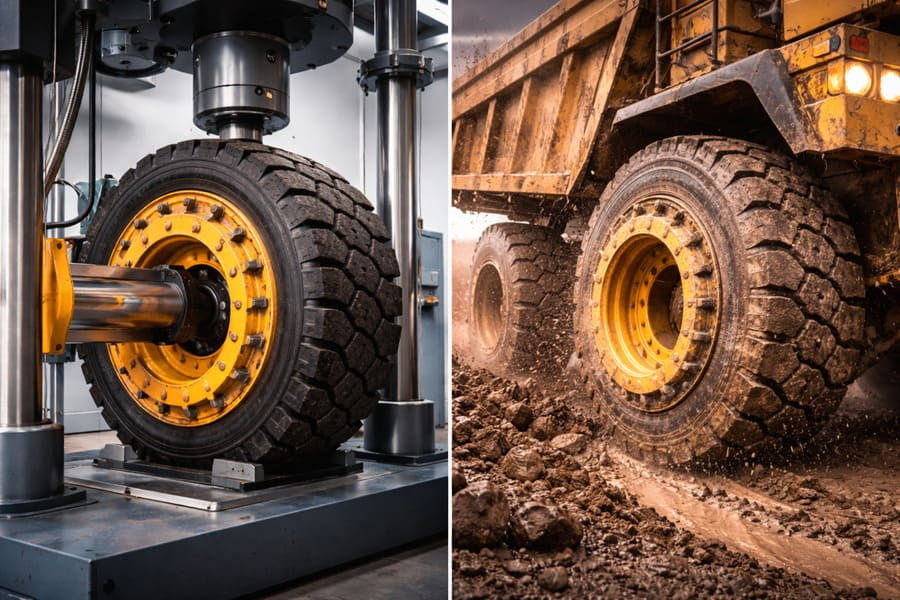
This reminds me of a time we were developing a OTR wheel for a new line of articulated dump trucks. The wheel passed the standard radial fatigue4 and cornering fatigue5 tests with flying colors. We could have stopped there and gotten it certified. But our own internal simulations showed a potential stress point when the truck was turning sharply while going over uneven ground. We added a new, combined-load test6 to our own process to replicate this. It’s that gap—the space between the official test and the muddy reality—where failures happen and where a manufacturer's true experience shows.
Why Do Certified OTR Wheels Still Fail in the Field?
You invested in wheels that meet all the industry standards, expecting reliability. Yet, they fail prematurely, causing downtime and costs, making you question the value of certification.
Certified OTR wheels1 can fail because standards test for isolated forces, like pure cornering or pure radial load. In the real world, these forces hit the wheel all at once, creating complex stress combinations that are far more damaging than any single test.
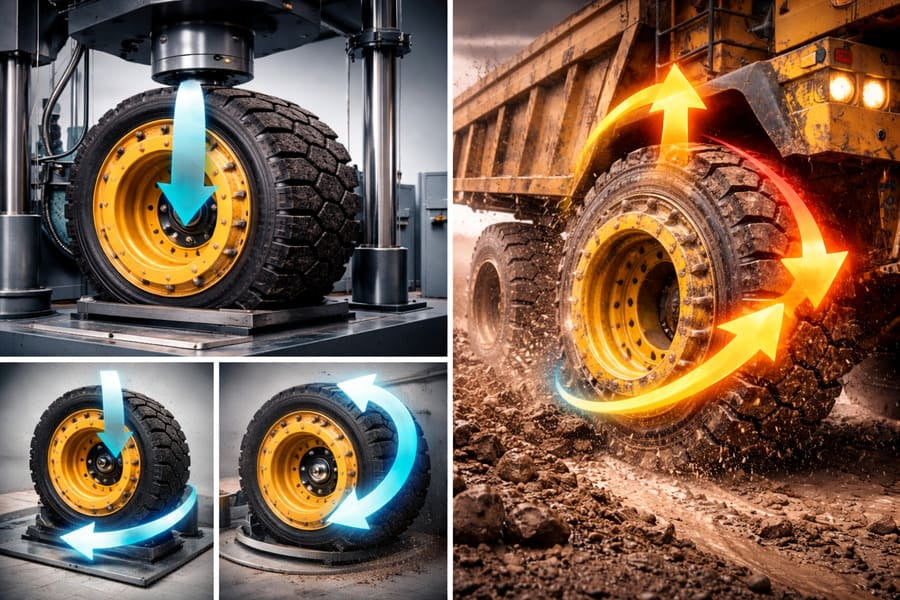
Think about driving a car. The standard tests are like checking if the car can turn left, and separately, if it can go over a speed bump. But what happens when you turn left while hitting a pothole? The forces combine and multiply. It's the same for an OTR wheel. A mining truck might be carrying a full load (radial stress), turning a sharp corner (cornering stress), and hitting a rock (impact stress) all in the same second. The standard test checks each of these things one by one, in a clean, controlled environment. It never checks them all together. This combination is what finds the true weak point in a wheel's design.
The Test vs. The Field: A Different Reality
| Factor | Standard Lab Test | Real-World Operation |
|---|---|---|
| Load Type | Controlled, predictable, one at a time. | Messy, unpredictable, multiple at once. |
| Direction | Purely radial or purely lateral (cornering). | Forces come from every angle simultaneously. |
| Environment | Climate-controlled lab, clean surfaces. | Mud, rocks, water, extreme temperatures. |
| Goal | To prove it meets a minimum baseline. | To survive its entire operational life. |
Are Standard OTR Wheel Tests Useless Then?
You see that standard tests don't replicate reality and wonder if you should ignore them. But without them, how can you compare products or trust a supplier's quality claims?
No, standard tests are not useless. They are essential for establishing a baseline of quality and manufacturing consistency. They confirm the wheel's basic structural integrity and material quality, but they should be seen as the starting point for reliability, not the final guarantee.
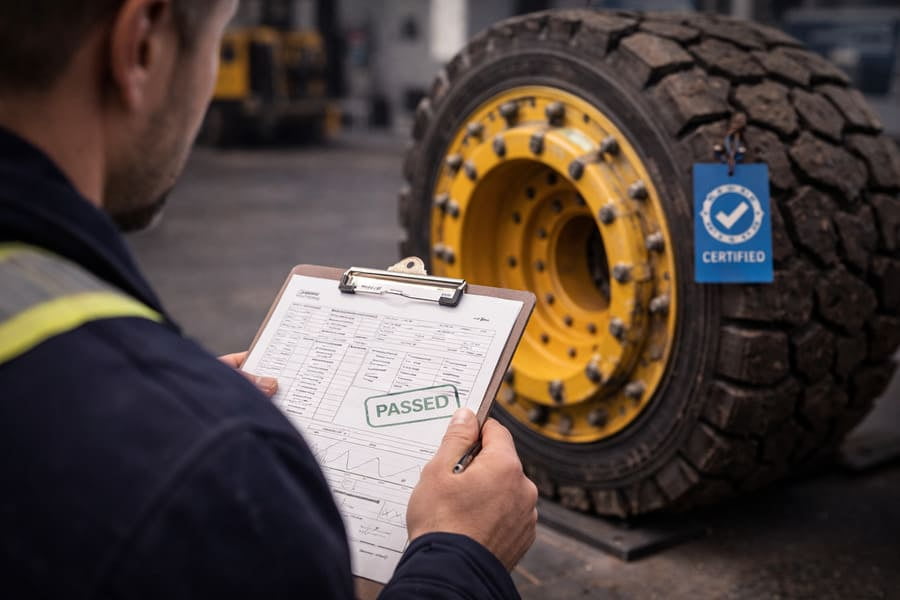
Standard tests, like those from SAE or TRA, are like a high school diploma. They prove you have a fundamental level of knowledge and competence. You wouldn't hire a doctor who didn't graduate high school, right? These tests ensure the manufacturer is using proper materials and sound welding techniques. They provide a vital benchmark. Without them, you have no way of knowing if a wheel is even fundamentally safe. The key is to see them for what they are: a foundation. A good manufacturer builds on that foundation. We use computer simulations7 (FEA) to model complex, combined-load scenarios, and we develop our own internal physical tests that are far harsher than the industry standard. The standard test is the first step, not the last.
The Purpose of Each Stage
- Standard Tests (SAE, TRA, etc.): These are for Quality Control. They ensure every OTR wheel off the line meets a consistent, minimum safety and strength standard. They are repeatable and comparable.
- Advanced Simulation (FEA): This is for Design Validation. We use it to find potential weak spots under complex, multi-axis load conditions that standard tests can't replicate.
- Real-World Data & Custom Tests: This is for Performance Proof. Feedback from the field and our own custom tests prove the design works in the messy, unpredictable environments our clients operate in.
Conclusion
Standard tests provide a crucial quality baseline, but the real risk lies in combined, real-world forces. True reliability comes from a design philosophy that tests for reality, not just the standard.
Explore this resource to understand how OTR wheels can be tested effectively for real-world applications. ↩
This link will provide insights into the limitations of standardized tests and their relevance to actual performance. ↩
Understand the effects of impact loads on OTR wheels and why they are critical for real-world applications. ↩
Discover the impact of radial fatigue on OTR wheels and why it matters for their longevity. ↩
This resource will explain cornering fatigue and its implications for OTR wheel design and testing. ↩
Learn about the significance of combined-load tests in ensuring the durability of OTR wheels in challenging environments. ↩
Explore how advanced simulations can enhance the testing process for OTR wheels beyond standard methods. ↩