
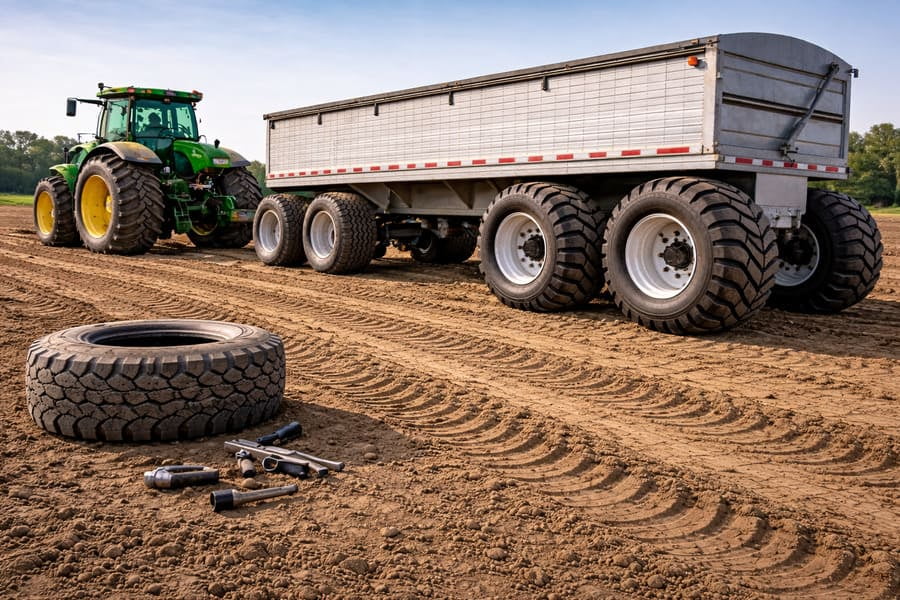
You've invested heavily in protecting your soil. Your state-of-the-art tractor runs on advanced low-pressure tires, but the transport trailer it pulls still leaves deep, compacted ruts across your field.
You can retrofit a standard trailer by replacing its high-pressure truck tires with a complete flotation system1. This involves using custom-built agricultural wheels2 designed with a truck hub bolt pattern and carefully calculated offset, allowing wide flotation tires3 to fit without interfering with the trailer frame4.
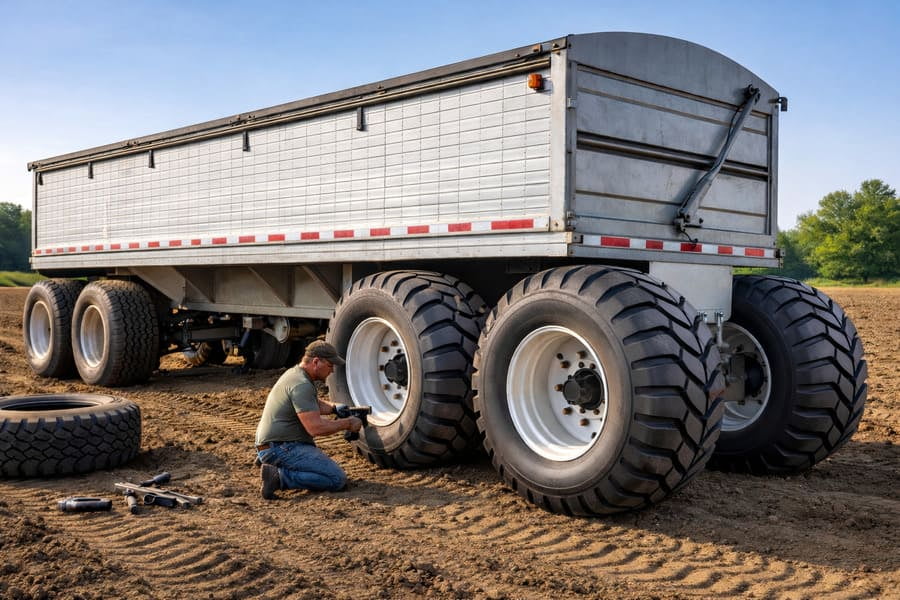
Last spring, I visited a client who runs a large organic farm. He showed me his new tractor, a beautiful machine with massive IF tires. He was proud of his investment in soil health. But then he pointed to the grain trailer behind it. "See that?" he said. "The tractor floats over the ground, but the trailer sinks in like a knife. Every pass I make, I'm undoing my own hard work." He was right. The problem wasn't his tractor; it was the transport equipment that hadn't caught up with modern farming practices. That's when we knew we had to offer a simple, complete solution.
Why Do Standard Trailer Tires Undermine Your Soil Health Efforts?
You spend a premium on soil-friendly tractor technology, only to watch your trailer's narrow tires carve deep tracks into the ground. It's frustrating to see your investment in soil structure5 being compromised with every haul.
Standard trailer tires are often repurposed truck tires. They operate at high pressures and have a small, narrow contact patch. This concentrates the entire weight of the trailer onto a tiny area, causing severe soil compaction6 and crop damage.
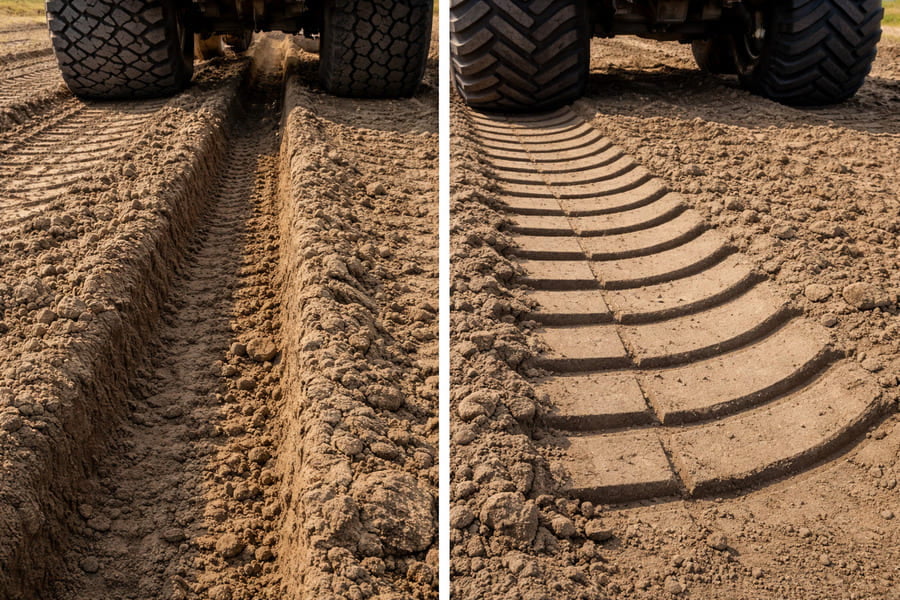
The science is simple: pressure equals force divided by area7. A heavily loaded trailer has a lot of force (weight). When that force is put on a narrow truck tire8 with a small footprint, the pressure exerted on the soil is immense. This pressure squeezes out the air and water from the soil, destroying its structure. Compacted soil prevents roots from growing, blocks water infiltration, and ultimately reduces your yield. Flotation tires do the opposite. Their wide profile and flexible sidewalls create a much larger footprint. This spreads the same weight over a greater area, dramatically reducing the ground pressure and allowing the tire to "float" over the surface instead of digging into it. It's the missing link in a truly low-impact farming operation.
Footprint and Compaction: The Tale of Two Tires
| Tire Type | Typical Air Pressure | Ground Contact Area | Resulting Impact |
|---|---|---|---|
| Standard Truck Tire | High (90-110 PSI) | Small and narrow | Deep ruts, high soil compaction6, root damage. |
| Agricultural Flotation Tire | Low (20-40 PSI) | Large and wide | Minimal soil impression, low compaction, protects soil structure5. |
How Do You Convert a Truck Hub for Wide Flotation Tires?
So, you're convinced you need flotation tires on your trailer. But your trailer has standard 8-stud or 10-stud truck hubs. How can you possibly fit a wide agricultural wheel onto it?
The conversion is achieved with a specially manufactured wheel. This wheel combines a wide agricultural rim (e.g., for a 500/50-17 tire) with a center disc that is custom-drilled to match your trailer's existing truck hub bolt pattern.
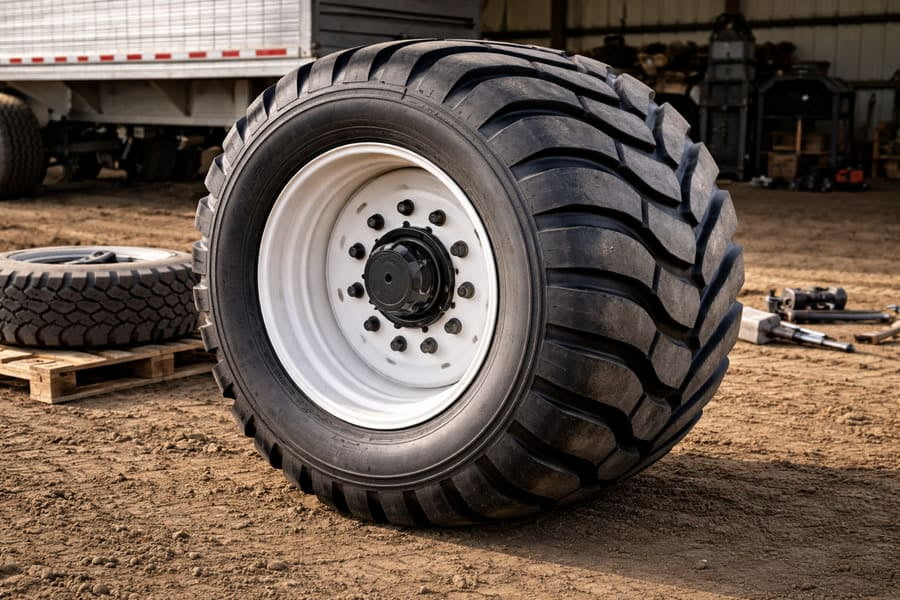
You don't need to change your trailer's axles or hubs. The solution lies entirely in the wheel itself. Think of it as a hybrid. We take a wide, agricultural-sized rim, like a 17-inch or 22.5-inch diameter rim designed for flotation tires, and we weld it to a heavy-duty center disc9. This is not just any disc. We manufacture this disc with the exact bolt pattern of your trailer's truck hub, whether it's a common 10-stud on 285.75mm PCD or something else. This allows the new, wide wheel to bolt directly onto your existing equipment. So, you can unbolt your old 20-inch truck wheels and bolt on a new set of wheels mounted with 550/45-22.5 flotation tires in the same afternoon. It's a direct-fit solution that bridges the gap between on-road transport hardware and on-farm soil protection needs.
Why is Wheel Offset the Most Critical Measurement in a Retrofit?
You've got the right hybrid wheel and flotation tire, but when you bolt it on, it hits the trailer's frame or suspension components. What went wrong? The conversion failed because of incorrect wheel offset10.
Offset is the distance from the wheel's mounting surface to its centerline. For a wide flotation tire, the offset must be precisely calculated to push the tire outwards, providing enough clearance to avoid any contact with the trailer's chassis.
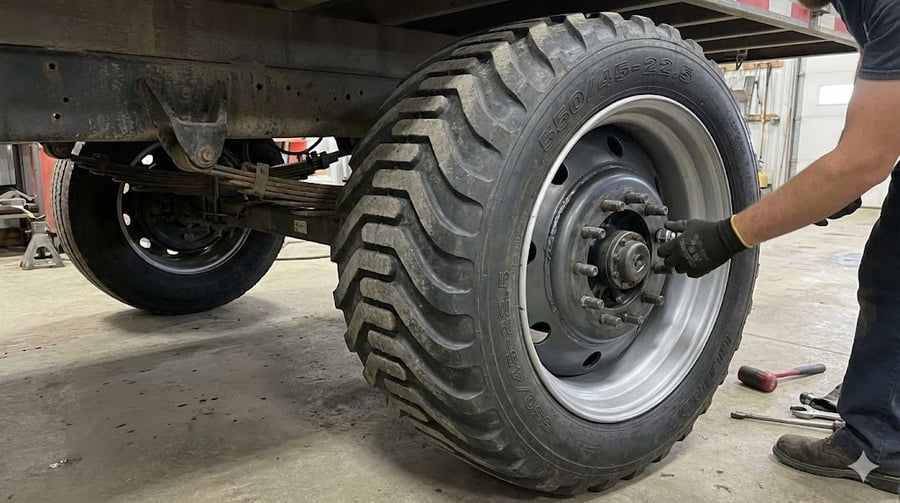
When you replace a narrow truck tire8 with a flotation tire that is twice as wide, you have to manage that extra width. If you use a wheel with zero offset (where the mounting hub is aligned with the center of the rim), the extra width will be added equally to the inside and outside. In most cases, this will cause the inner sidewall of the new, wide tire to rub against the trailer frame4. To prevent this, we use a negative offset. This means we build the wheel so that the mounting surface is closer to the inside edge of the rim. This effectively pushes the entire wheel and tire assembly further out from the trailer body, creating the critical space needed for the tire to operate without interference, even during tight turns or over uneven ground. Getting this measurement right is the key to a successful and safe retrofit.
As part of our service, we help you measure your existing setup to calculate the perfect offset for your specific trailer and chosen tire size. We offer a complete retrofit kit11 that includes the tires, the custom-built rims12 with the correct offset, and even matching stub axles if a full axle replacement is desired.
Conclusion
Retrofitting your trailers with a flotation tire system is the final step to achieving complete soil protection. It closes the gap left by standard truck tires, ensuring every machine on your farm works to preserve your most valuable asset: your soil.
Explore how flotation systems can enhance soil health and reduce compaction in farming. ↩
Learn about the advantages of using agricultural wheels for better soil management. ↩
Find out how wide flotation tires can enhance your farming efficiency and soil protection. ↩
Understand the relationship between trailer frame design and tire functionality. ↩
Discover the importance of maintaining soil structure for optimal agricultural productivity. ↩
Understand the factors leading to soil compaction and how to mitigate them. ↩
Delve into the physics of pressure and its implications for soil health in farming. ↩
Discover the negative impacts of narrow truck tires on soil health and crop yield. ↩
Learn about the role of heavy-duty center discs in enhancing tire durability and performance. ↩
Learn why wheel offset is crucial for successful tire retrofitting and avoiding equipment damage. ↩
Find out what components are essential in a tire retrofit kit for improving trailer performance. ↩
Explore the benefits of custom-built rims for optimizing tire performance on trailers. ↩