
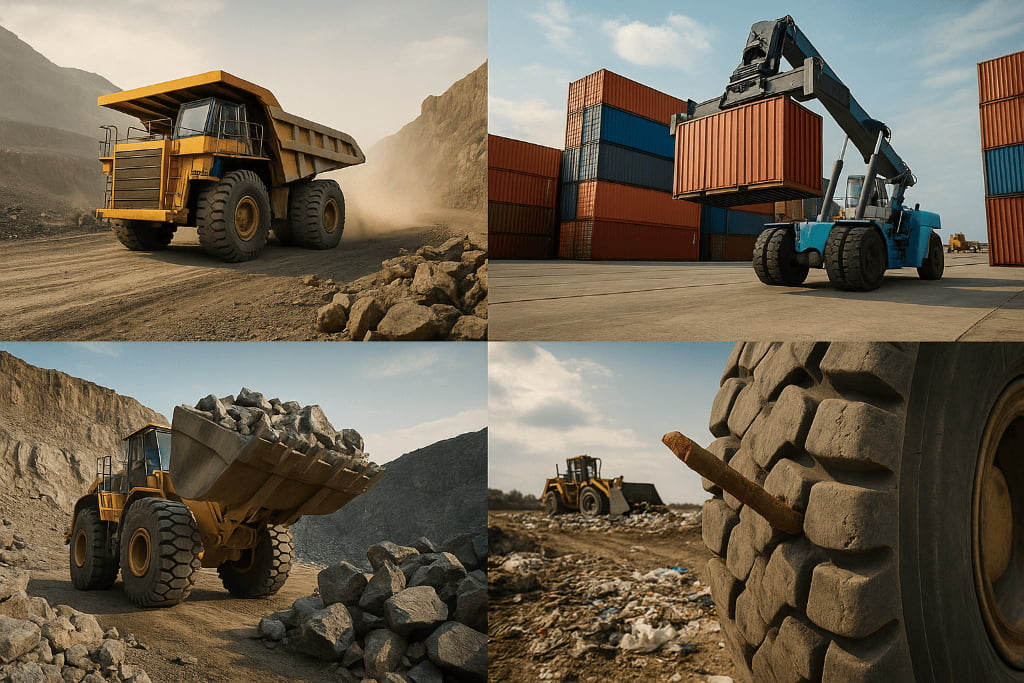
You bought a top-rated, "heavy-duty" OTR tire for your fleet. Yet, it wears out fast at your port, while another one gets shredded in your quarry, causing costly downtime.
The right OTR tire is chosen by matching its specific structural design—sidewall thickness1, rubber compound2, belt package3, and tread pattern4—to the primary failure risk5 of the application, such as impact for mining, heat for ports, or punctures for landfills.

I once had a client managing a quarry who bought a batch of tires that were highly rated for port operations. He figured, "Heavy-duty is heavy-duty, right?" Within weeks, he was calling me about severe tread chunking6 and cut failures7. The tires were designed to resist heat on smooth port surfaces, not to fight against the sharp, jagged rocks of his quarry. He learned a hard lesson: in the OTR world, the "enemy" is different in every environment, and you have to choose your armor specifically for the fight you're in.
Why Can't One "Heavy-Duty" OTR Tire Do It All?
It's tempting to simplify inventory with a single, general-purpose OTR tire. But this cost-saving attempt often backfires, leading to premature failures and a higher total cost of ownership.
A "one-size-fits-all" approach fails because each application attacks a tire differently. A tire built for heat resistance8 in a port lacks the cut protection for a quarry. A tire with thick sidewalls for mining is too rigid for high-speed port use.

Think of it like choosing shoes. You wouldn't wear steel-toed work boots to run a marathon, and you wouldn't wear running shoes on a construction site. Both are "footwear," but they are built for entirely different stresses. OTR tires are the same. A mining tire is designed to survive brutal, short-cycle impacts from rocks. Its thick rubber and reinforced sidewalls9 are perfect for that job but would generate catastrophic heat if used in a port, where vehicles run long distances at higher speeds. The port tire's heat-resistant compound is great for endurance but is too soft to withstand the constant chipping and cutting in a quarry. Using the wrong structure doesn't just reduce tire life; it creates a serious operational and safety risk.
Matching the Tire to the Threat
Each environment has a primary "enemy" that dictates the ideal tire structure.
| Application | Primary Threat | Required Tire Feature |
|---|---|---|
| Mining | Impact & Cutting | Thick Sidewalls & Cut-Resistant Compound |
| Ports | Heat Buildup | Heat-Resistant Compound & Strong Casing |
| Quarries | Sharp Rocks & Chunking | Chip-Resistant Compound & Deep Tread |
| Landfills | Punctures | Steel Belts & Puncture-Proof Casing |
What Makes Mining Tires Unique for Handling Extreme Loads and Impacts?
Your mining trucks carry immense loads over rough terrain, where every rock is a potential tire killer. A standard tire casing would buckle or be cut open under such constant, brutal force.
Mining tires are engineered with extremely thick sidewalls, reinforced belt package3s, and specialized cut-resistant rubber compound2s. This construction provides the structural integrity needed to withstand the combined forces of massive loads and sharp rock impacts without catastrophic failure.

When I inspect a dedicated mining tire, the first thing I notice is the sheer mass of rubber and steel in it. It’s built like a tank. The sidewalls are often twice as thick as a standard OTR tire to prevent being cut or crushed against rock faces. The rubber compound2 isn't designed for speed; it's formulated with special polymers that resist gouging and chipping from sharp granite or ore. Deeper inside, the steel belt package3 is layered and reinforced to distribute the immense weight of a fully loaded haul truck and to stop impacts from penetrating the casing. Often, you'll see deep L5 or L5S tread pattern4s, which act as a shield of rubber to protect the casing itself. It's a structure completely focused on one thing: survival in a high-impact, high-load environment.
Key Structural Elements for Mining Tires
- Thick, Reinforced Sidewalls: Protects against cuts and impacts from rocks during turns and loading.
- Cut-Resistant Compounds: Specially formulated rubber that resists chipping, tearing, and chunking.
- Robust Belt Package: Multiple layers of high-tensile steel belts10 to support extreme loads and resist punctures from sharp objects.
- Deep Tread Patterns (L5/L5S): Provides maximum protection for the tire casing and extends wearable tread life.
How Do Port and Quarry Applications Demand Different Protections?
Your port reach stackers run constantly, while your quarry loaders navigate a minefield of sharp rocks. Both are tough jobs, but using the same tire for both would lead to disaster.
Port tires need heat-resistant compounds and strong casings to handle continuous high-speed runs and heavy turning. Quarry tires need chip-resistant compound11s and extra-deep tread12 to defend against constant cutting and tread chunking6 from sharp aggregate.
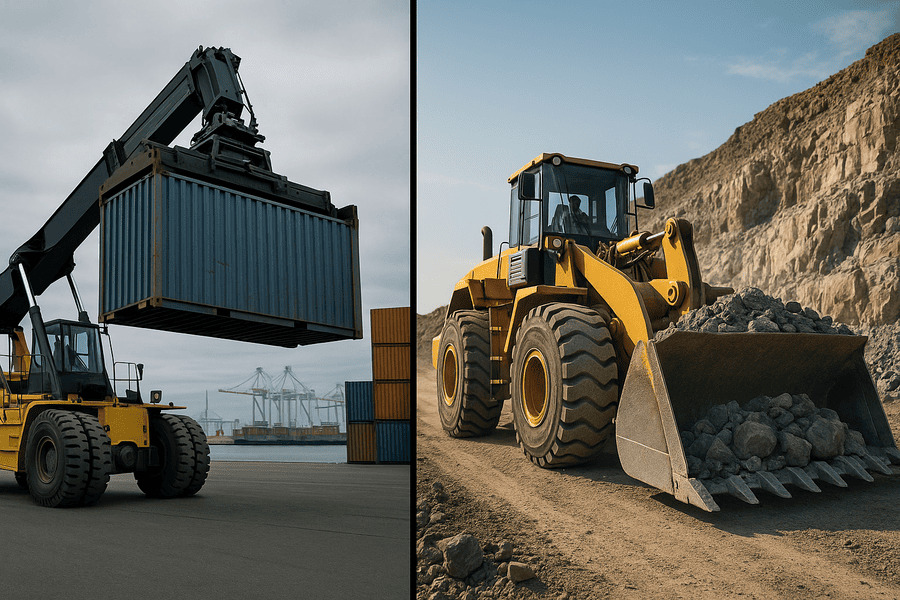
The difference is all about heat versus cuts. In a container terminal, the biggest enemy is heat. A reach stacker might travel miles a day at relatively high speeds, carrying heavy containers. This continuous movement generates enormous internal heat, which can cause the tire's components to separate. So, port tires use special rubber compound2s that don't build up heat and have a strong bead to handle the stress of tight turns under load. A quarry is the complete opposite. Speeds are low, but the ground is covered in sharp, abrasive rock. Here, the enemy is physical damage. A quarry tire is designed with an extremely chip-and-cut-resistant compound and often features an extra-deep tread12 (like an L5) to put as much rubber as possible between the rock and the casing. Using a port tire in a quarry would be like bringing a knife to a gunfight—it's simply not built for that kind of abuse.
Port vs. Quarry Tire Breakdown
| Feature | Port Tire (Heat is the Enemy) | Quarry Tire (Cuts are the Enemy) |
|---|---|---|
| Compound | Heat-resistant, low rolling resistance | Cut-and-chip resistant |
| Tread Depth | Standard (e.g., L3) | Deep or Extra-Deep (L4/L5) |
| Sidewall | Strong but flexible for stability | Thick and reinforced for impact |
| Focus | Endurance and speed | Durability and protection |
What Special Armor Do Tires Need for Landfills?
In a landfill or waste transfer station, the ground is a nightmare of hidden threats. It's not just dirt and rock; it's a mix of nails, rebar, broken glass, and sharp metal scraps.
Tires for landfill applications13 require a puncture-proof design. This is achieved through reinforced steel belts10, a puncture-resistant casing, and extra-thick sidewalls to protect against nails, scrap metal, and other sharp debris that can instantly destroy a standard tire.

When we design a tire for a landfill client, we assume it will be attacked by the worst possible objects every single day. The primary defense is a heavily reinforced casing, often with multiple layers of steel belts10 directly under the tread. This acts like a suit of armor to stop sharp objects from reaching the air chamber. The rubber compound2 itself is formulated for tear resistance, and the tread pattern4 is typically solid and deep to minimize the chance of something getting wedged in. Furthermore, the sidewalls are made exceptionally thick and durable. In waste sites, vehicles often scrape along concrete walls or debris piles, and a standard sidewall would be torn open in no time. For these applications, survivability is everything. The tire isn't designed for speed or comfort; it's a slow-moving shield designed to keep the machine running in an environment that eats other tires for breakfast.
Landfill Tire Defensive Layers
- Puncture-Resistant Casing: Built to prevent penetration from sharp objects like nails and rebar.
- Multiple Steel Belts: A shield of steel under the tread to deflect puncturing forces.
- Thick, Durable Sidewalls: Protects against scraping and side-impact punctures.
- Solid, Deep Tread: Minimizes voids where debris can get trapped and provides a thick layer of wearable rubber.
Conclusion
Choosing the right OTR tire isn't about finding the toughest one; it's about matching the tire's specific structure to the specific threats of your worksite. This strategic choice saves money and keeps operations running smoothly.
Understand the significance of sidewall thickness in enhancing tire durability and performance. ↩
Explore different rubber compounds and their roles in tire performance across various applications. ↩
Learn about the importance of belt packages in providing structural integrity and support for tires. ↩
Discover how different tread patterns influence traction and durability in various environments. ↩
Gain insights into the common failure risks associated with OTR tires in different applications. ↩
Learn about the factors leading to tread chunking and how to prevent it for better tire longevity. ↩
Discover effective strategies to avoid cut failures and extend the life of your OTR tires. ↩
Understand the concept of heat resistance in tires and its importance for high-speed applications. ↩
Learn about the role of reinforced sidewalls in preventing cuts and impacts in rugged terrains. ↩
Understand how steel belts contribute to tire strength and resistance against punctures. ↩
Explore the benefits of chip-resistant compounds in enhancing tire durability in harsh environments. ↩
Discover how deep tread patterns provide protection and extend the life of quarry tires. ↩
Explore the unique challenges tires face in landfill applications and how to address them. ↩