

You are stuck in a cycle of quoting lower and lower prices just to win a deal. You know this isn't sustainable, but you feel like you have no other choice to stay competitive.
Companies escape the price war1 by building a brand2, which is not about logos, but about creating trust3. This trust3 allows them to compete on value, quality4, and reliability, instead of just being the cheapest option in a race to the bottom.

Over my 12 years in this industry, I have seen countless companies burn out. They enter the market with aggressive, low-price strategies. They win a few orders and think they have found the secret. But a year later, they are gone. Why? Because a customer you win with a low price, you will lose to an even lower price. They never built a connection or a reason for the customer to stay. They were just a temporary line on a spreadsheet. The companies that last are different. They understand that the real competition isn't about who can be the cheapest today, but about who can be the most trust3ed tomorrow and the day after.
Why Is 'Winning' a Price War Actually a Sign of Failure?
You feel a brief victory when your low bid wins the contract. But this victory is quickly replaced by the pressure of thin margins and the knowledge that your competitor will just bid lower next time.
Because a price war1 is not a sign of competitiveness; it is a symptom of lacking it. True competitiveness comes from technology, consistency, and trust3. Relying on price alone means you have nothing else to offer your customers.

When a product has no brand, the conversation changes. The market stops asking, "Which one is better?" and only asks, "Which one is cheaper?" I've seen this happen again and again. A factory invests in a new production line but not in a brand. They produce a perfectly good product, but since it looks like ten others, they have to drop the price to move inventory. They are "buying orders," not building a business. This is a dangerous trap. It silently burns through your profits and your relevance in the market. Strong brands, on the other hand, don't have to lead with price. They lead with a promise of quality4 and reliability. Their competitiveness is built into their reputation5, which is a fortress that low prices cannot easily break down.
Price-Driven vs. Brand-Driven Business
| Aspect | Price-Driven Company | Brand-Driven Company |
|---|---|---|
| Primary Goal | Move units, win the bid | Build long-term customer trust6t](https://arxiv.org/pdf/2106.13347)%%%FOOTNOTE_REF_3%%% |
| Main Sales Tool | Discounts, low price | Reputation, proven value |
| Customer Loyalty | None; loyalty is to the price | High; loyalty is to the brand promise |
| Market Position | Fragile, easily replaced | Defensible, strong moat |
If a Brand Isn't Just a Logo, What Is It Actually Worth?
You hear about "brand equity7," but it sounds like a vague marketing term. You are focused on tangible results like sales numbers, and it is hard to see the direct financial return of building a brand2.
A brand is a compounding asset that builds delayed, but massive, returns. It reduces your customer acquisition cost8 to near zero over time because it drives repeat purchases, word-of-mouth referrals, and gives you pricing power9.
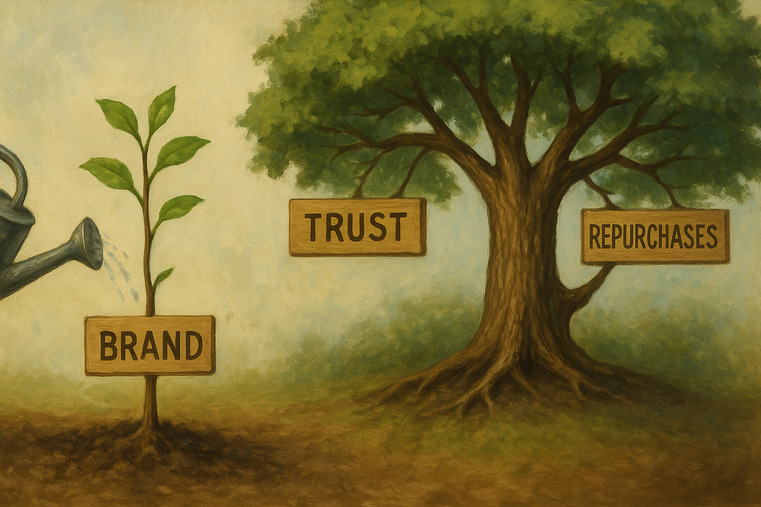
Think about this. Without a brand, every single sale is a new battle. You have to spend time and money to convince each customer from scratch. The cost to acquire that customer is high, and it resets to zero for the next one. Now, think about a brand. A brand is the ability to be repeatedly validated by the market. It is not about you saying you are good. It is about your customers deciding you are worth more. When a customer trust3s your brand, they come back without you having to persuade them again. They tell others about you. This is word-of-mouth, the most powerful marketing there is. You also gain pricing power9. A true brand exists when people are willing to pay 10%, 20%, or even 30% more for your product over a generic one. This brand equity7 compounds like interest, making your business stronger and more profitable each year.
How Can a Brand Protect You When the Market Turns Bad?
You worry about market volatility10. Raw material costs spike, shipping prices go crazy, and you fear your customers will leave you for a cheaper option the moment you have to raise your prices.
Because price cannot buy trust3, and only trust3 survives market cycles. When the market is chaotic, customers don't stick with the cheapest supplier; they stick with the most reliable and trust3ed partner who they know will not fail them.

I remember a few years ago when the price of natural rubber shot up by over 50% in just a few months. The market went into panic mode. The suppliers who had built their business entirely on being the cheapest had two choices: sell at a massive loss or break their contracts. Most of them simply disappeared. Their phones went unanswered. But the companies with strong brands handled it differently. They communicated openly with their clients. They explained the situation and implemented necessary price adjustments. Did they lose some customers? A few, yes. But the majority stayed. Why? Because their relationship was not based on price. It was based on years of consistent quality4, reliable delivery, and trust3. The customers knew that the brand would still deliver a high-quality4 product, even if it cost more. They were not just buying a tire; they were buying peace of mind. That is the ultimate protection a brand gives you.
Conclusion
To escape the price war1, you must shift your focus from winning the next order to building lasting trust3. A brand is the only true asset that appreciates over time.
Understanding the implications of a price war can help you strategize better and avoid common pitfalls. ↩
Explore how a strong brand can differentiate your business and foster customer loyalty. ↩
Understanding the role of trust can enhance your customer relationships and retention. ↩
Discover how prioritizing quality can lead to customer satisfaction and repeat business. ↩
Understanding the impact of reputation can help you build a more resilient business. ↩
Learn effective strategies for cultivating trust that leads to lasting customer relationships. ↩
Discover the value of brand equity and how it can lead to long-term financial success. ↩
Learn how reducing customer acquisition costs can significantly improve your business's profitability. ↩
Find out how strong brands can command higher prices and improve profit margins. ↩
Learn strategies to safeguard your business during unpredictable market conditions. ↩