
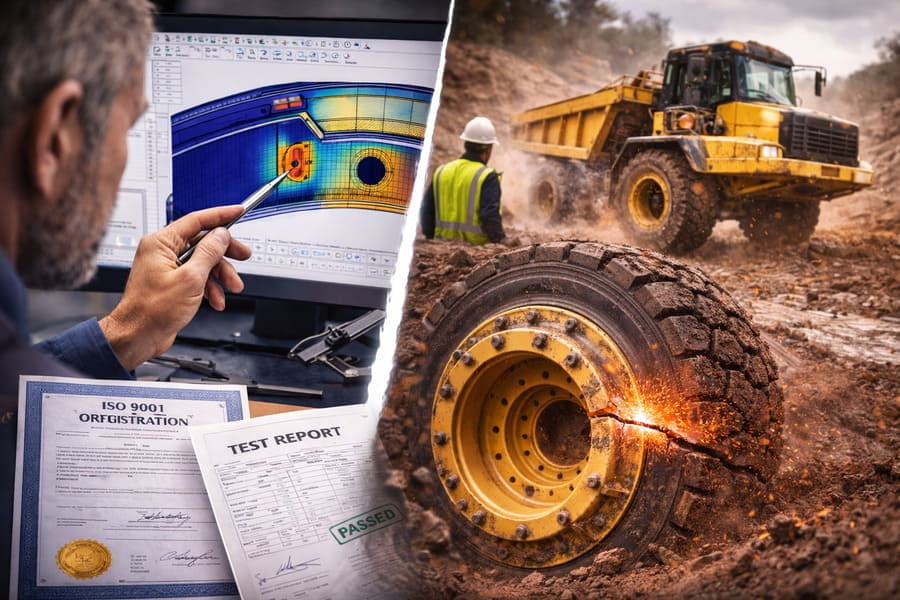
You selected a new OTR rim1 supplier, and their certificates2 are perfect. ISO 9001, lab test reports—everything is in order. Yet, you still worry about what happens once those rims hit the dirt.
Certificates prove a rim met a specific standard in a controlled lab on a specific day. They cannot prove it will be safe under the unpredictable, combined stresses and real-world conditions3 of your actual worksite, where the true risk lives.
This is something I explain to new clients all the time. They come to me with a checklist, and "certification" is at the top. It's important, of course. It's a baseline. But I tell them about a time a large quarry operation switched to a new, cheaper, but fully certified rim supplier. On paper, the rims were identical to their previous ones. But the new supplier's design had a slightly sharper angle on the gutter disc. It passed the standard tests, but in the field, that sharp angle created a stress point4. After six months of their trucks turning on uneven ground, cracks started appearing on OTR rim1s across their fleet. The certificate proved compliance; it didn't prove thoughtful design for the real world.
Why Does Risk Begin Where Certification Ends?
You have the test certificate in hand, confirming the OTR rim1 passed the required fatigue tests. You feel secure, but this feeling might be giving you a false sense of safety5.
The real risk begins the moment the OTR rim1 is put into service because certification is a backward-looking pass/fail test. It doesn't account for your specific application—your loads, speeds, and operating environment—which is where safety5 is actually determined.
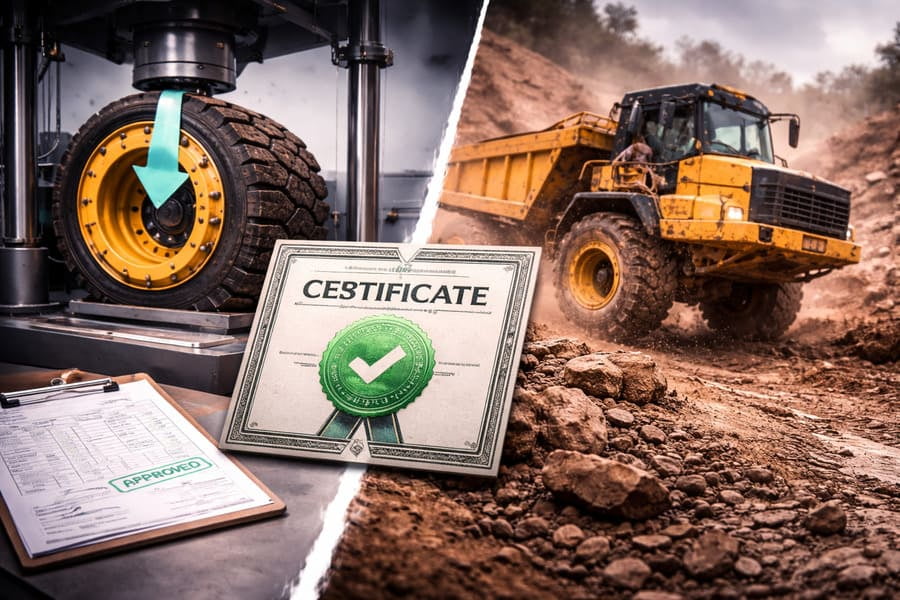
A certificate is like a driver's license test. It proves you can perform basic maneuvers in a controlled environment. It doesn't prove you can handle a blizzard on a mountain pass. For OTR rim1s, the standard tests (like cornering and radial fatigue) are the "driver's test." They are crucial for ensuring a basic level of quality. But they don't simulate a haul truck carrying an uneven load, turning on a 10% grade, and hitting a pothole at the same time. The certificate tells you the rim was compliant in the lab. It tells you nothing about how it will perform in the chaos of your worksite. That's where the separation happens, and the real risk begins.
The Certificate's Blind Spots
| What the Certificate Verifies | What Your Application Demands |
|---|---|
| Passes a standardized load test. | Withstands your unique, combined, and shock loads. |
| Made with compliant material. | Resists fatigue from your specific duty cycle. |
| Meets a dimensional standard. | Design is optimized to avoid stress risers in your use case. |
| Proves a historical fact. | Needs to deliver future performance. |
Why Is a Supplier's Judgment More Critical Than Their Paperwork?
You're comparing two suppliers. Both have all the right certificates2, but one is much cheaper. It's tempting to see them as equal, but are they really the same?
Certificates are just documents; they don't carry the weight of consequences. A good supplier's judgment is more critical because they make hundreds of small decisions in design and manufacturing, based on experience, that determine a rim's real-world safety5 and lifespan.

Paper can't absorb the shock of a failure. People do. The purchasing manager, the machine operator, the site foreman—they absorb the consequences. A certificate is a commodity; any factory can get one if they meet the minimum bar. But judgment is earned over years. It's the decision to add 2mm more steel in a high-stress area, even if the standard doesn't require it. It's the choice to use a smoother radius on a corner to distribute stress better. These decisions don't always show up on a spec sheet. As a manufacturer, we are not just making a product to pass a test. We are making a product that our client's brand and their operator's safety5 will depend on. That requires judgment that goes far beyond the paperwork.
Where Judgment Makes a Difference
- Design Philosophy: Designing for durability and real-world conditions3, not just to pass a test.
- Material Sourcing: Choosing suppliers known for consistency, not just the cheapest that meets spec.
- Manufacturing Process: Investing in better welding techniques and quality control that exceed the standard.
- Customer Feedback: Using field data from failures to improve future designs.
Conclusion
Certificates are a necessary starting point, but they don't guarantee safety5. True operational safety6y](https://arxiv.org/html/2506.20475)%%%FOOTNOTE_REF_5%%% comes from a manufacturer's experience, sound judgment, and a design philosophy7 that respects the reality of the field.
Explore this link to understand how to choose OTR rims that can withstand real-world conditions and ensure safety. ↩
Learn about the limitations of safety certificates and their relevance to actual equipment performance. ↩
This resource provides insights into how equipment performs under various real-world stresses. ↩
Discover the factors that lead to stress points in rim designs and how to avoid them. ↩
This link offers valuable information on maintaining safety in heavy equipment operations. ↩
Explore strategies that can help ensure operational safety in heavy machinery and equipment. ↩
Explore how a thoughtful design philosophy can enhance the durability and safety of heavy equipment. ↩