
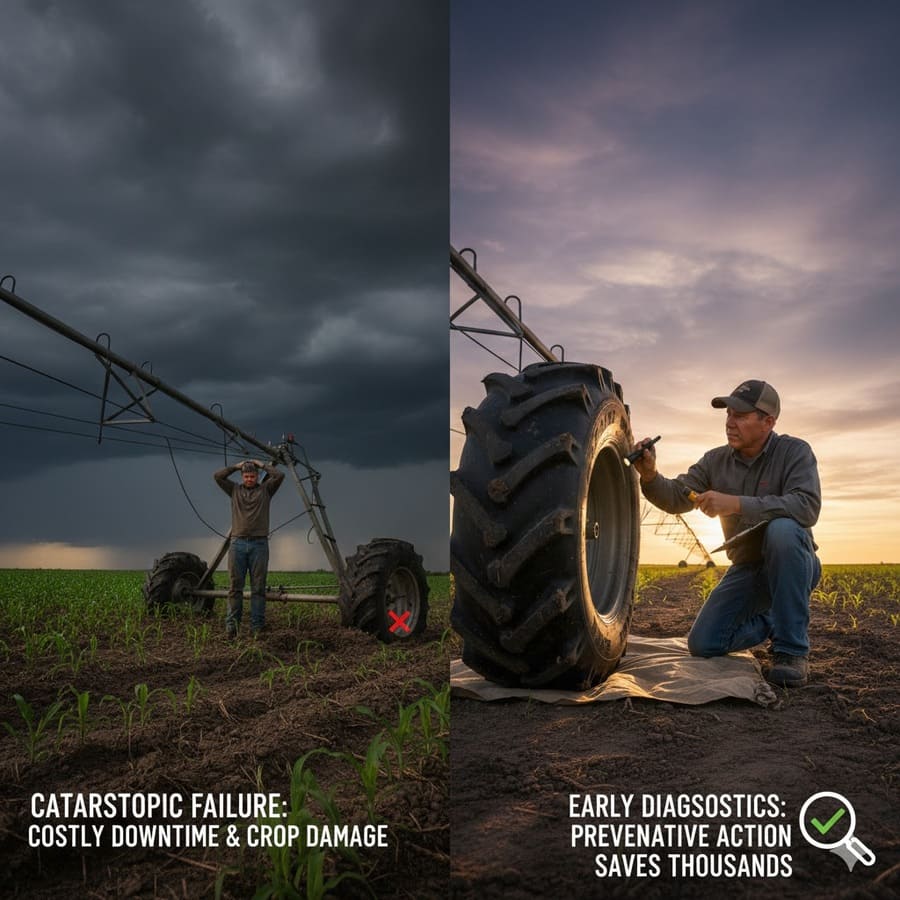
A catastrophic irrigation tire blowout on a pivot is every farmer's nightmare. It always happens at the worst possible time, causing costly downtime and crop damage. But what if you could see it coming?
The key is to spot the subtle, early signals of structural failure long before a blowout. These include localized bulging, persistent hopping, bead area leaks, and unusual wear patterns. Recognizing these signs transforms you from reactive to proactive, saving time, money, and crops.
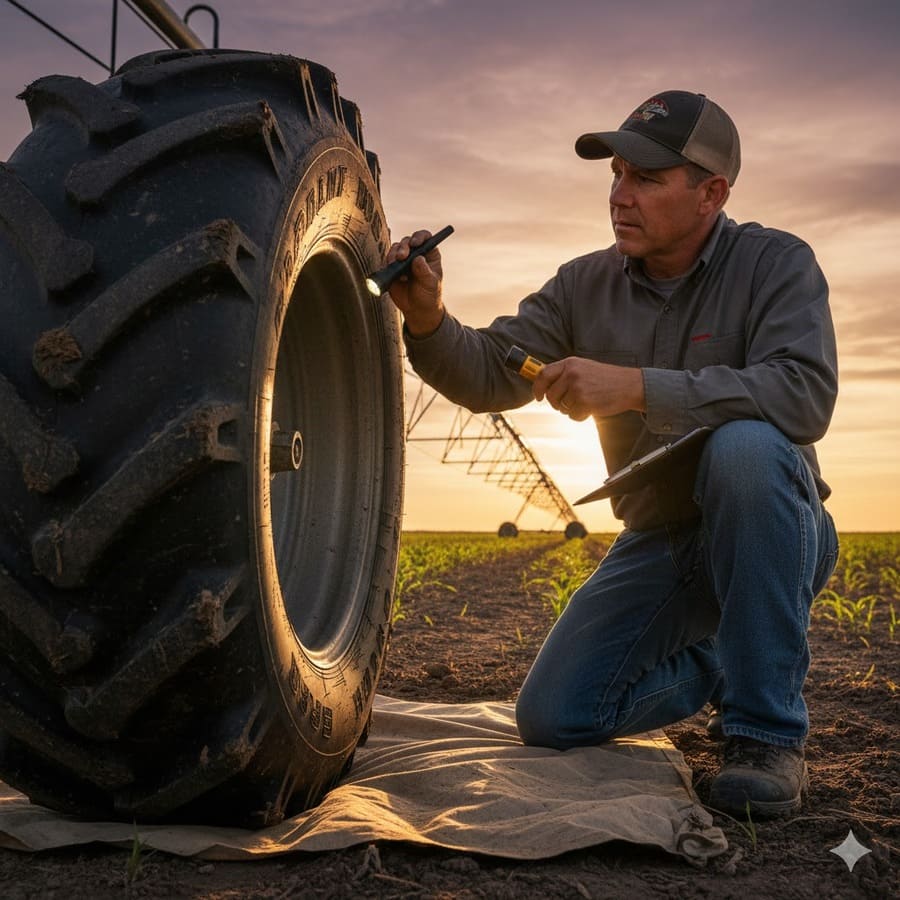
I once visited a large farm where the manager, a man named Carlos, was incredibly frustrated. He had a pivot that kept getting stuck, and one tower's irrigation tire looked "a little off," as he put it. It had a slight wobble. His team checked the gearbox and the bearings twice, finding nothing wrong. They blamed the tire brand, but I suspected something else. We took the tire off and found a soft, spongy area on the inner sidewall that wasn't visible when mounted. The internal structure was failing, causing the wobble. They were just days away from a blowout that would have taken out a section of their cornfield. That day, Carlos learned that the most important problems aren't always the most obvious ones.
Is That Small Bulge Just Cosmetic, or Is It a Real Warning Sign?
You're walking the pivot line and spot a small bubble on a tire's sidewall. It’s easy to ignore, but that nagging feeling says it could be something more serious.
A localized bulge or a soft spot is almost never just cosmetic. It's a critical early indicator that the internal layers of the tire are separating. Air is escaping from the inner liner and getting trapped, meaning the structure is compromised.
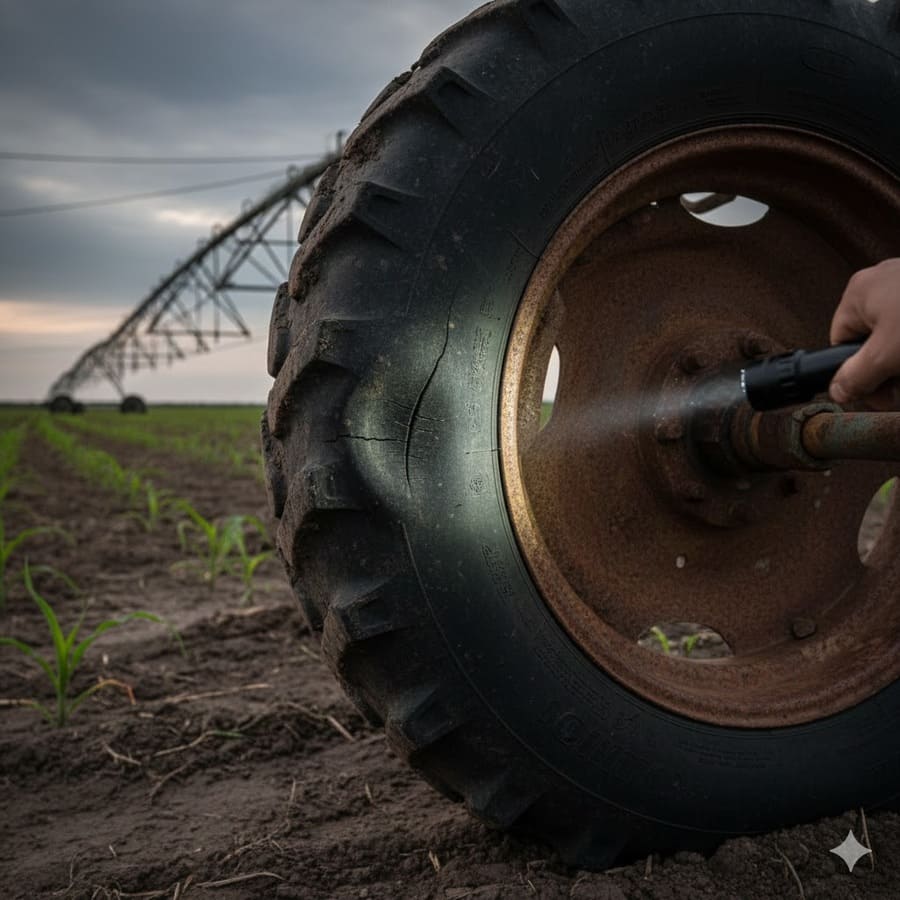
Think of a irrigation tire's structure like reinforced concrete. It has layers of rubber and fabric cords (like rebar) working together. A bulge is a sign that the rebar has broken. Air from the pressurized inner chamber has pushed through a weak spot in the cord body and is now sitting just under the outer layer of rubber. While it might hold for a while, every rotation and every bump in the field puts more stress on that already weakened area. It is no longer a question of if it will fail, but when. Ignoring it is a gamble, and the stakes are a full-season's reliability. A simple press with your hand can often tell you what you need to know: a cosmetic blemish feels solid, while a structural bulge will feel soft or give way under pressure.
Bulge Analysis: What to Look For
| Symptom | What It Means | Recommended Action |
|---|---|---|
| Small, Hard Bump | Often a cosmetic blemish from the manufacturing process. | Monitor, but usually safe. |
| Soft, Spongy Bubble | Air has breached the inner structure. The tire is failing. | Replace Immediately. |
| Wavy Sidewall | Can indicate underinflation or ply separation. | Check pressure; if wavy look persists, inspect for failure. |
Why Is Your Pivot Hopping Even After You've Checked the Mechanics?
Your pivot tower has a persistent vibration, but your team has already checked the drivetrain and bearings. You're wasting time and money chasing a mechanical ghost.
If you've ruled out mechanical causes, the hopping is likely coming from the tire's carcass. A irrigation tire that is out-of-round or has an internal inconsistency creates an imbalance that no amount of mechanical tuning can fix, pointing directly to a structural defect.

This is one of the most misdiagnosed issues in the field. A pivot is a mechanical system, so our first instinct is to blame the mechanics. But the irrigation tires are a critical part of that system's suspension and movement. A perfectly balanced tire provides a smooth, consistent roll. However, if there's a weak spot or a high spot in the tire's internal structure—perhaps from a manufacturing flaw or impact damage—the tire will deform unevenly with each rotation. This creates a "hop" or vibration that travels right up the tower. Your technicians can spend days checking alignment and gearboxes to no avail. The simplest test is often to swap the hopping tire with a known good one from another tower. If the problem moves with the tire, you've found your culprit: a tire with failing structural integrity.
Are Slow Leaks at the Bead a Nuisance or a Red Flag?
You have a irrigation tire that constantly needs a little air, and you notice some moisture and dirt collecting around the rim. It seems like a minor annoyance, but it could be an early warning.
Abnormal wear or persistent leakage around the bead area is a serious red flag. The bead is the irrigation tire's foundation. If it can't hold a perfect seal, it often indicates a structural problem with the bead bundle itself or damage from improper mounting.
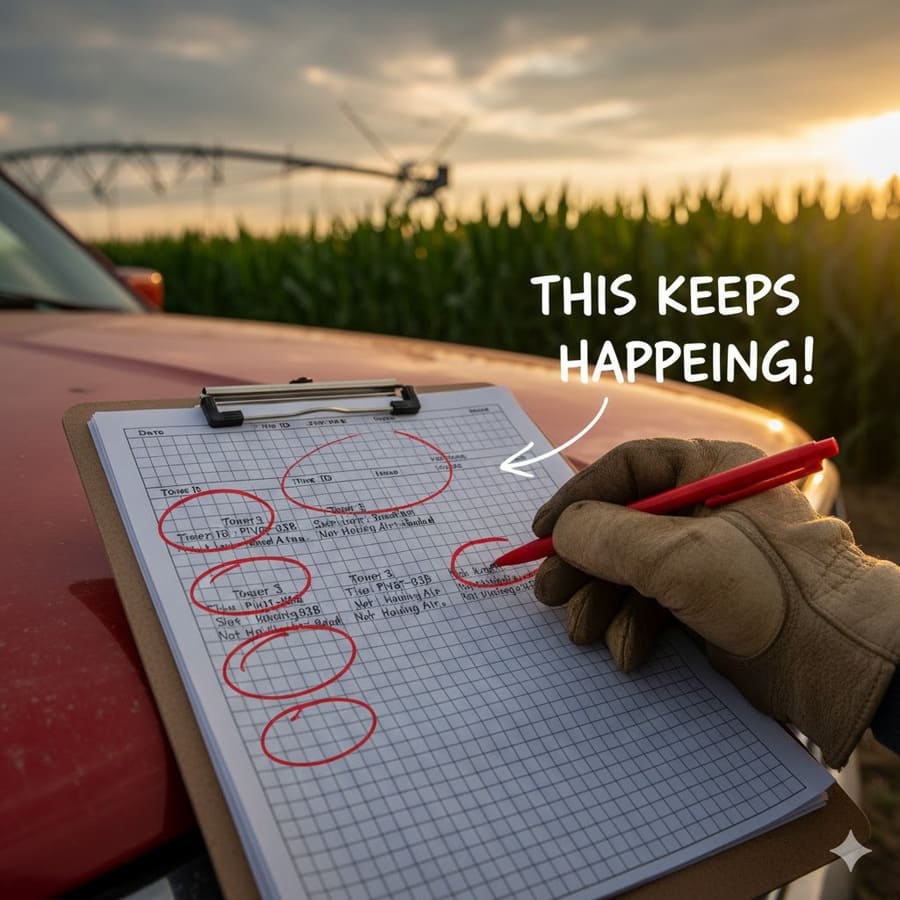
The bead is the bundle of high-tensile steel wires that holds the tire onto the wheel rim. Its job is to create a perfect, airtight seal and anchor the entire tire structure. When you see issues here, it's rarely a random event. A slow leak could mean the bead was stretched or damaged during installation, preventing a clean seal. You might also see chafing or cracking where the rubber meets the rim, which suggests the tire is flexing improperly under load. These aren't just simple leaks; they are signs that the tire's foundation is unstable. An unstable foundation puts uneven stress on the rest of the tire, particularly the sidewalls, accelerating its failure. Fixing a bead leak isn't just about stopping the loss of air; it's about investigating why the foundation of the tire is failing in the first place.
Is That Recurring Problem a Coincidence or a Clue?
You've had to service the same tire on the same tower three times this season for the same issue. You're starting to think it's not just bad luck.
In early diagnostics, repetition matters more than severity. A recurring abnormality in the same location is almost never a coincidence; it's a clear clue pointing to an underlying structural issue within the tire that a simple patch or air top-up will not fix.
A single flat tire can be caused by a random puncture. But a tire that repeatedly loses air, develops a wobble, or requires any kind of recurring service is telling you a story. It’s a story about a deeper, internal problem. Maybe there's a minuscule crack in the inner liner that only opens up under certain pressures, or a weak spot in the casing that flexes too much and causes the bead to unseat slightly. These small, repetitive failures are the irrigation tire's way of crying for help. Instead of treating the symptom again and again, it's time to diagnose the root cause. When you see a pattern of failure, no matter how small, your focus should shift from "repair" to "replace." The repetition itself is the signal that the tire's fundamental structural integrity is lost.
Conclusion
Don't wait for the blowout. Listen to the early warnings the irrigation tire is giving you. By spotting bulges, vibrations, and recurring issues, you can protect your equipment, your crops, and your profits.