
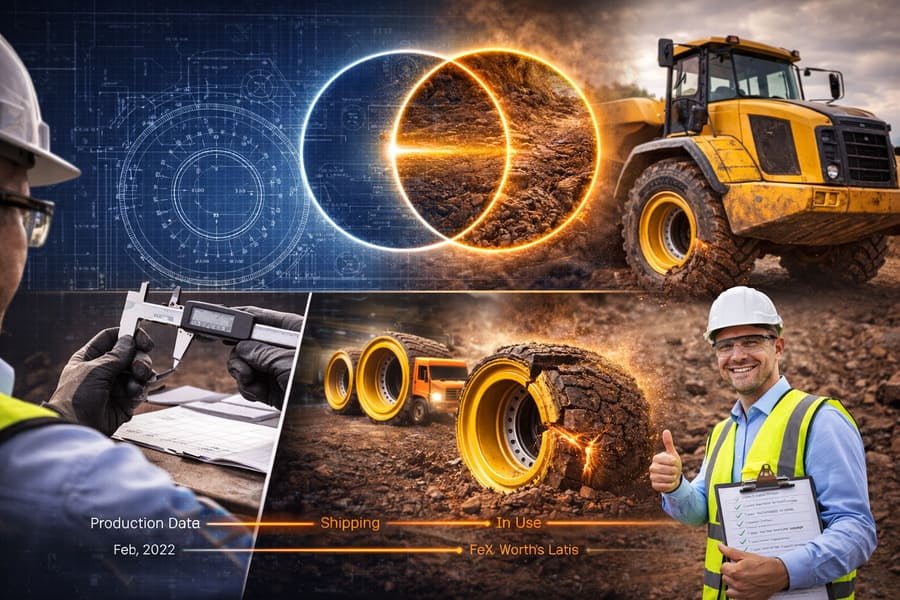
You trust the quality certifications and inspection reports that come with your OTR wheels1. Yet, you still get reports of field failures2, forcing you to question if these systems are truly protecting your brand.
Quality systems3 primarily control execution—ensuring a wheel is manufactured exactly to its design specifications4. They verify materials, dimensions, and weld integrity against a blueprint. However, they do not and cannot validate whether that blueprint is actually correct for the unpredictable stresses of the real world.
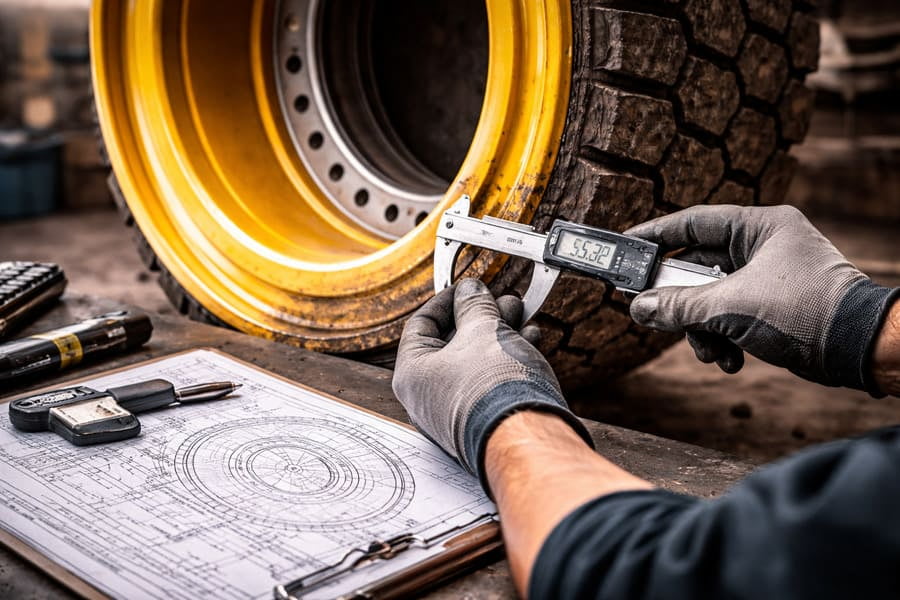
I've spent 13 years in the agricultural tire and wheel export business, and I've seen this disconnect firsthand. I once had a client, a large equipment brand manager, who was frustrated. He showed me stacks of quality documents5 for a batch of wheels—all perfect, all within tolerance. At the same time, he had a folder full of warranty claims6 for those exact wheels cracking. For a long time, we both focused on the factory, assuming there was a hidden manufacturing flaw7. The truth was much simpler: the factory had done a perfect job of building the wrong wheel. The quality system was working flawlessly, but it was enforcing a design that was not robust enough for the customer's actual application. That's when I realized our job wasn't just to supply wheels, but to close the gap between the blueprint and the field.
Can a Perfectly Made Wheel Still Be the Wrong Wheel?
You receive a shipment of wheels with flawless quality reports. Every dimension is perfect, every weld is clean. Yet, they begin to fail prematurely, leaving you questioning the value of inspection.
Absolutely. A "perfectly made" wheel is simply one that matches its design drawing. If that drawing is based on flawed assumptions about load, terrain, or operator behavior, the wheel is perfectly wrong. Quality control validates execution, not the wisdom of the original design intent8.
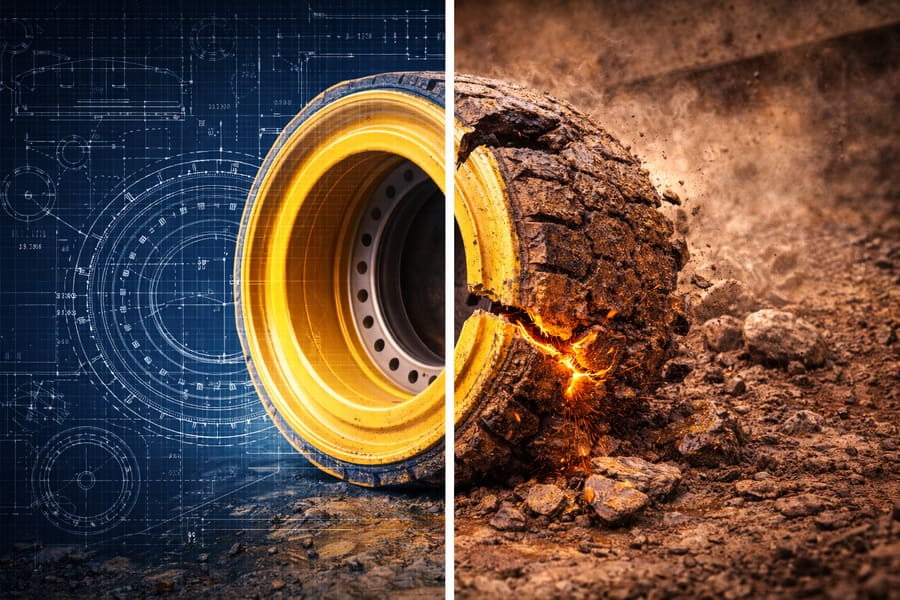
The core of the issue is the difference between what is specified and what is required. A quality system is a referee that ensures the rules of the drawing are followed. It has no power to question the rules themselves. As a procurement manager9, you rely on these systems, but you must understand their limits. The system can confirm the steel is the specified grade, but it can't know if that grade is sufficient for the extreme cold your machines will operate in. It can verify that a weld has penetrated to the specified depth, but it can't tell if that depth is enough to handle the twisting forces of uneven terrain. This is where partnership becomes critical. We don't just ask for a drawing; we ask about the environment.
| Quality Check | What It Verifies (Execution) | What It CANNOT Verify (Intent) |
|---|---|---|
| Rim Thickness | Conforms to drawing spec (e.g., 12mm ±0.3mm). | Is 12mm thick enough for rocky conditions? |
| Weld Integrity (NDT) | Weld is free of cracks and has full penetration. | Is the weld placement correct for high side-loads? |
| Bolt Hole PCD | Matches the specified Pitch Circle Diameter. | Can the bolt circle handle the operator's torque? |
A wheel isn't just a component; it's a solution to a problem. A quality system can only ensure the component is built correctly. It takes a deeper conversation to ensure it's the right solution.
Why Don't Inspections Catch Wheels Before They Fail?
You invest in suppliers with advanced inspection technology like Non-Destructive Testing (NDT)10. So why do fatigue cracks still appear in the field, seemingly out of nowhere?
Standard inspections are designed to find existing manufacturing defects like voids or cracks. They cannot see the microscopic damage of metal fatigue11 that accumulates slowly over time with every rotation under load. Inspection sees the past, not the future.
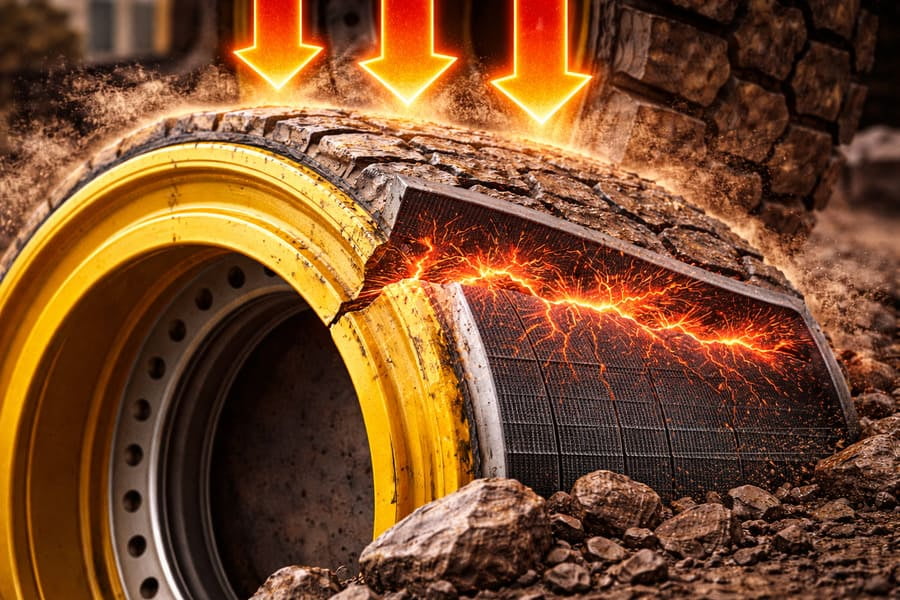
Think of metal fatigue11 like a credit card. Every cycle of stress—every bump, turn, and acceleration—is a small purchase. A wheel is designed with a certain "fatigue life12," which is like its credit limit. Non-Destructive Testing is like checking the card for fraudulent charges that have already posted. It can spot a big, obvious defect from the factory, like a bad weld. However, it is completely blind to the balance of small, legitimate charges that are slowly using up the credit limit. The wheel might look perfect after 100, 500, or even 1,000 hours of use. Internally, however, its fatigue life12 is being consumed. The final, visible crack is not the beginning of the problem; it's the moment the account is overdrawn. By then, it's far too late. The failure was inevitable, set in motion by the thousands of stress cycles that came before, none of which are visible to standard quality control13.
How Can a Problem Stay Hidden for So Long?
A customer reports a wheel failure today. You check your records and realize the wheel was manufactured over a year ago. How can a systemic issue remain undetected for that long?
There is a long delay between production and failure. A wheel must be manufactured, shipped, installed, and used for hundreds of hours before a fatigue-related flaw surfaces. By the time the first claim arrives, the factory has already produced thousands more identical units.
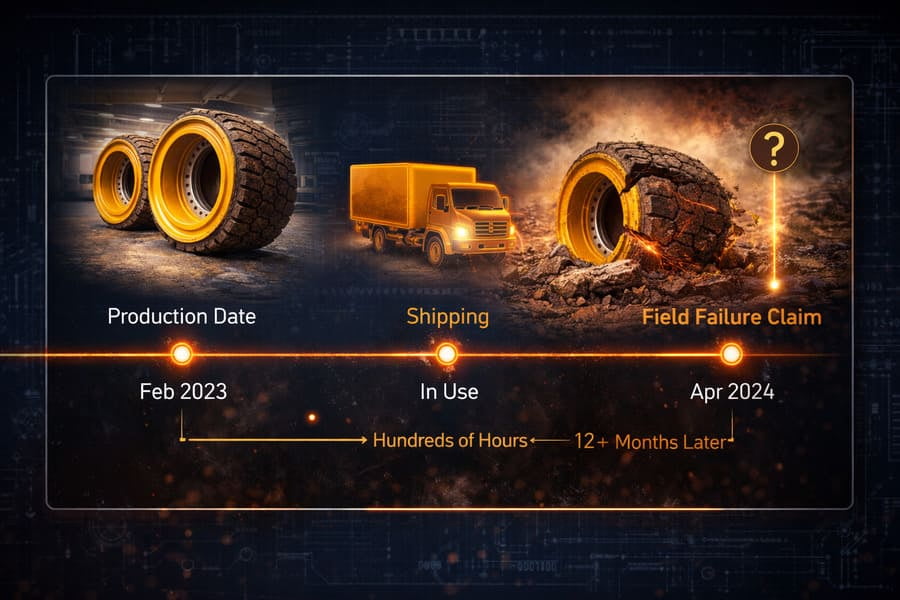
This delay is one of the biggest risks in the OTR wheel supply chain14. It creates a massive, hidden liability. Let's trace the journey of a single wheel with a subtle design flaw15—perhaps the disc is slightly too thin for a new, heavier tractor model.
- Month 1: The wheel is produced. It passes all quality checks because it perfectly matches the (flawed) drawing.
- Month 2: It's shipped across the ocean and sits in a distribution warehouse.
- Month 4: It's sold to a dealer and installed on a brand new piece of equipment.
- Month 7: The planting season begins. The wheel begins accumulating its first real stress cycles.
- Month 12: After hundreds of hours of hard use during planting and harvesting, the accumulated fatigue leads to a visible crack. The claim is filed.
In that entire year, the production line16 has been running, potentially producing thousands of wheels with the same latent vulnerability. The quality system never raised an alarm because, according to the official documents, nothing was wrong. The feedback loop is simply too long.
Can a Quality System Challenge a Bad Design?
You have a design that has worked for years, but now it's failing on newer, more powerful machines. Why isn't your supplier's quality department flagging this as an issue?
A quality system's function is to enforce compliance, not to question the design's validity. It ensures the design's assumptions are followed, but it cannot prove if those assumptions are correct for a new or changing application. It is a guard, not a detective.

Imagine you give a builder a blueprint for a garden shed and tell them to build it. The builder's quality control13 will ensure the walls are straight, the roof doesn't leak, and the door fits the frame. They do a perfect job. But then you try to park a giant combine harvester inside it. When it doesn't fit, you don't blame the builder's quality control13. Their job was to follow the plan. This is the exact role a quality system plays in a factory. It is fundamentally conservative. Its purpose is to prevent deviation from the established standard. It has no authority or capability to say, "Wait, I know the drawing says to use 10mm steel, but I see you're selling this to customers who operate in rocky terrain. We should really be using 12mm." That kind of critical, application-based thinking17 falls outside its scope. It ensures the assumptions within the design are executed faithfully; it can never challenge whether those assumptions are still valid in a changing world.
Conclusion
Quality systems3 are essential for ensuring manufacturing consistency. But they can't guarantee field performance. True reliability comes from aligning the design intent8 with the operational reality18, long before production ever begins.
Learn about OTR wheels and their critical role in heavy machinery, ensuring you make informed decisions for your equipment. ↩
This resource provides insights into common causes of field failures, helping you prevent similar issues in your operations. ↩
Explore this resource to understand how quality systems can enhance manufacturing processes and ensure product reliability. ↩
Learn about the significance of design specifications in manufacturing to ensure product performance and safety. ↩
Understanding quality documents is crucial for ensuring product compliance and reliability; this resource can guide you. ↩
Discover the typical causes of warranty claims to better manage risks and improve product quality. ↩
This resource offers strategies for identifying and rectifying manufacturing flaws, enhancing product quality. ↩
Understanding design intent is vital for aligning production with operational needs; this resource provides clarity. ↩
Explore the role of a procurement manager to enhance your understanding of supply chain management. ↩
Explore the role of NDT in ensuring product integrity without causing damage, a must-know for quality assurance. ↩
Understanding metal fatigue is essential for maintaining machinery; this resource explains its impact and prevention. ↩
Learn how to measure fatigue life to ensure the longevity and reliability of mechanical components. ↩
This resource outlines essential quality control components to help you maintain high manufacturing standards. ↩
This resource offers insights into effective supply chain management, crucial for operational success. ↩
This resource provides methods for identifying and correcting design flaws, ensuring product reliability. ↩
Learn strategies for optimizing production lines to improve efficiency and reduce costs. ↩
Understanding application-based thinking can enhance your design processes; this resource explains its importance. ↩
This resource discusses strategies for aligning design with operational reality, crucial for product success. ↩