
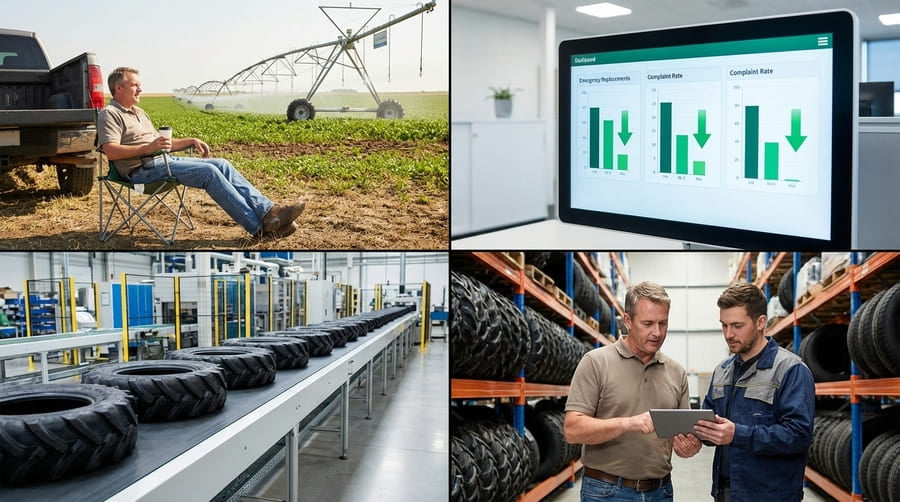
You sold tires with a great warranty, promising years of service. Yet, you're still spending your busiest months driving to fields for emergency replacements1, fielding calls from stressed-out farmers.
In dealer language, a “quiet season2” means minimal emergency calls, complaints, or warranty claims during the critical irrigation period. It is reliability defined by operational smoothness and a silent phone, not by a tire’s theoretical lifespan on a spec sheet.

When I first started exporting irrigation tires 13 years ago, I thought my job was to sell the longest-lasting product. I would talk about warranties and projected service life. But my most successful dealer partners taught me something crucial. They weren't impressed by a seven-year lifespan if a tire failed in year two, right in the middle of a drought. They cared about one thing above all else: not getting that panicked call in July. This completely changed how I look at our products. A truly "good" tire isn't just one that lasts; it's one that lets our partners have a predictable, quiet season2.
How Should You Actually Measure a Irrigation Tire’s Reliability?
You rely on the manufacturer's warranty and lifespan estimates. But when a irrigation tire fails prematurely, those numbers feel meaningless and your customer is still stuck with a downed pivot.
True reliability should be measured with real-world data3: the seasonal return rate4, complaint rate5, and the number of emergency replacements1. These metrics reflect in-field performance, which is far more valuable than a theoretical lifespan estimate.
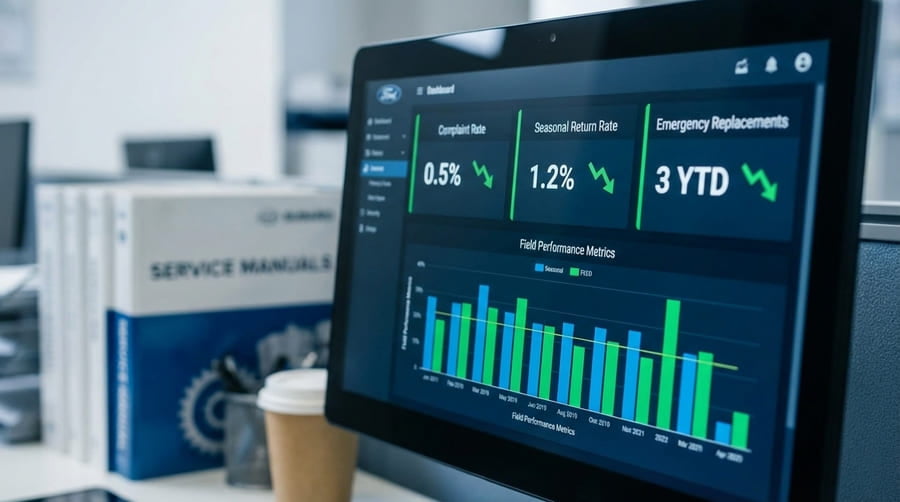
A warranty is a promise about the future, but it doesn't help you manage the present. To get a real picture of a tire's performance, you need to track what happens during the season. For years, I’ve worked with dealers to focus on simple, powerful metrics. Instead of asking "how long will it last?", we started asking, "out of every 100 tires sold, how many resulted in a complaint this season?" We track the number of tires returned per batch and, most importantly, how many unscheduled, high-urgency replacements were needed. These numbers tell the true story. A tire with a slightly shorter overall lifespan but a near-zero in-season failure rate is infinitely more valuable to a dealer's reputation and bottom line than a tire that promises a decade of service but causes chaos every other summer. This data gives you predictive power6 and helps you choose suppliers who deliver peace of mind, not just products.
Why Is a “Boring” Irrigation Tire Better Than a “Brilliant” One?
A new irrigation tire model comes out with amazing performance in one test. You stock up, but the next batch underperforms, leading to inconsistent results and unpredictable customer feedback.
Dealers need predictability more than anything. A "boring" tire that delivers the exact same, dependable performance with every single shipment is far more valuable than a "brilliant" one that is inconsistent from one batch to the next.
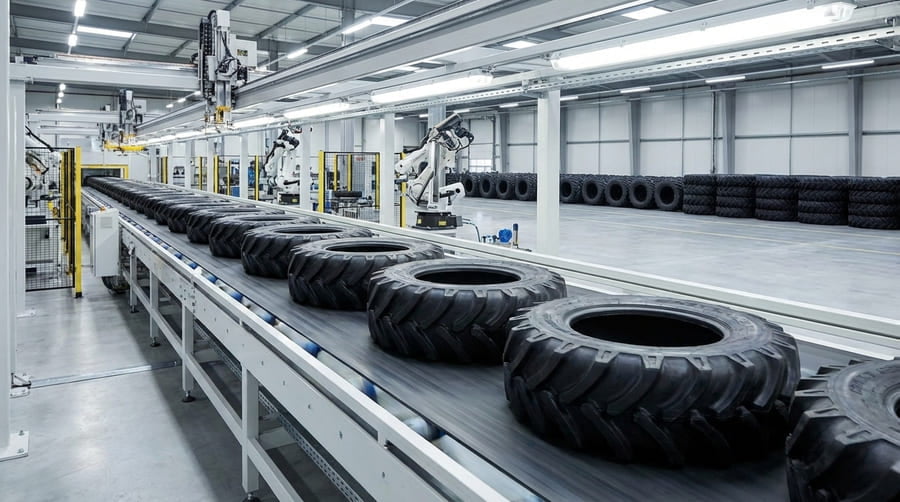
Excellence is great, but consistency is what builds a business. I once worked with a supplier who produced a batch of irrigation tires that were truly phenomenal. The rubber compound was perfect, the durability was off the charts. My dealers were thrilled. But the next shipment, produced just a few months later, was average at best. The raw materials were slightly different, a production line was recalibrated, and the result was a totally different tire experience. This created a huge headache. Customers who got the first batch were happy, but those who got the second felt let down. It made my partners look inconsistent. That's when I made batch-to-batch consistency7 a non-negotiable part of our quality control. A good supplier invests in systems—like raw material testing8 and process monitoring9—to ensure that the 1,000th tire is identical to the first. For a dealer, a predictable, "boring" product is a foundation for a stable, trustworthy business.
How Can Your Supplier Be Your First Line of Defense?
A problem arises in the field, and you're the one who has to figure it out. Your supplier is reactive, only offering a refund or replacement after the damage is done.
A great supplier acts as a proactive partner10. They should identify potential issues based on field data, explain risks before they escalate, and provide solutions—turning them from just a vendor into your first line of defense against seasonal disruptions.
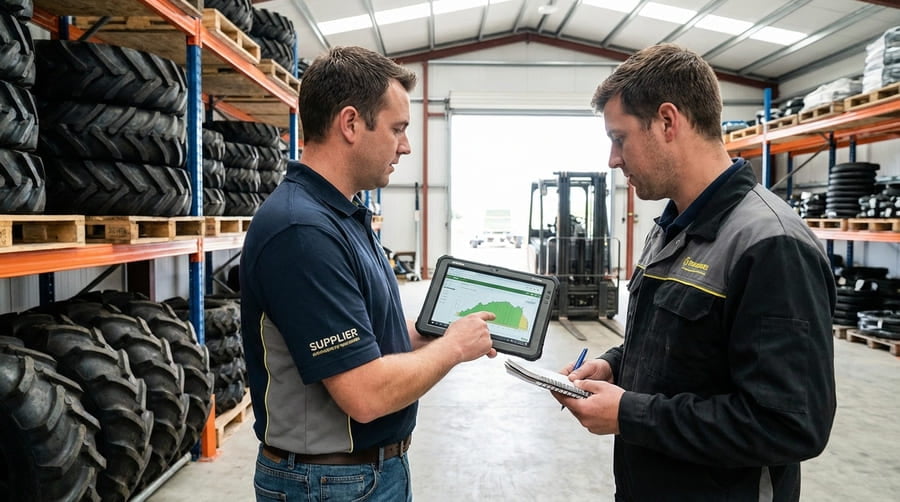
A supplier's job shouldn't end when the container is shipped. A true partner is invested in your quiet season2. At Gescomaxy, we see it as our responsibility to be proactive. For example, if we receive feedback from a dealer in one region about challenges with a specific soil type, we don't just solve their problem. We immediately contact our other partners who might face similar conditions and say, "We're seeing this issue. Here's what's causing it, and here's how to prevent it." This means transparently discussing a tire's limitations, not just its strengths. It means helping you educate your customers on proper inflation11 for their specific environment. This approach transforms the relationship from a simple transaction to a partnership. Your supplier should be the one helping you spot trouble on the horizon, giving you the information you need to prevent problems before they ever start.
Conclusion
A "quiet irrigation season" isn't about luck; it's a strategy. It comes from choosing consistent, predictable tires and working with a supplier who actively helps you eliminate surprises.
Understanding the frequency of emergency replacements helps dealers evaluate tire reliability and plan for uninterrupted service during critical periods. ↩
Understanding the concept of a 'quiet season' can help dealers focus on reliability and operational smoothness, reducing emergency calls and complaints. ↩
Exploring real-world data metrics can provide insights into tire performance, helping dealers make informed decisions beyond theoretical lifespan estimates. ↩
Tracking seasonal return rates helps dealers assess in-field performance, ensuring they choose reliable products that minimize disruptions. ↩
Monitoring complaint rates allows dealers to identify issues early, improving customer satisfaction and reducing emergency replacements. ↩
Predictive power enables dealers to choose suppliers that offer peace of mind, ensuring consistent performance and reducing unexpected failures. ↩
Ensuring batch-to-batch consistency helps dealers maintain a stable reputation, avoiding customer dissatisfaction due to inconsistent product quality. ↩
Raw material testing ensures consistent tire quality, preventing variations that can lead to unpredictable performance and customer complaints. ↩
Process monitoring helps maintain consistent production quality, ensuring each tire meets the same standards and delivers reliable performance. ↩
A proactive supplier helps dealers anticipate and prevent issues, transforming the relationship into a collaborative partnership that enhances reliability. ↩
Proper inflation ensures optimal tire performance, reducing wear and tear and preventing premature failures, thus enhancing reliability. ↩