
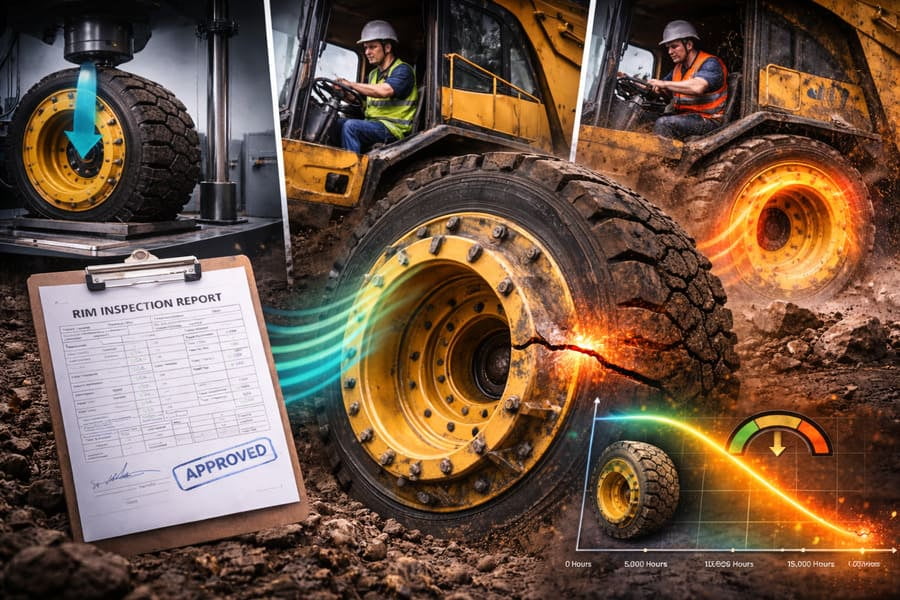
You have a stack of inspection report1s, and every OTR rim2 meets the required specifications perfectly. Yet, months into operation, a rim fails in the field, leaving you confused and holding a useless report.
Inspection reports show a rim's condition at a single moment in time, not the invisible story of how it handles stress over its lifetime. Most failures are caused by metal fatigue3—cumulative damage4 from millions of load cycles5—which is a time-dependent process that a static report can never capture.
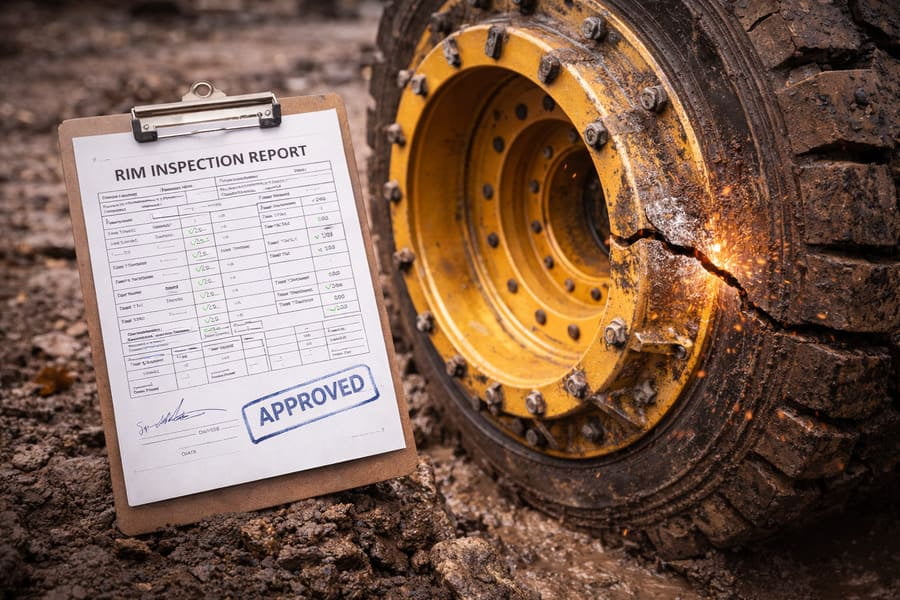
I once had a client who was incredibly meticulous. He insisted on getting detailed dimensional and material reports for every single wheel rim he purchased. He believed that if the numbers were right, the product was perfect. We supplied him with a batch that passed every check with top marks. Six months later, he called me, frustrated. A rim on one of his loaders had developed a crack near a weld. "But the report said the weld size was perfect!" he said. I had to explain that the report was a photo, but the failure was a movie. The report couldn't show him the millions of tiny stresses that targeted that exact spot, day after day, until the metal just gave up.
If the Report is Perfect, Where Do Cracks Actually Come From?
Your inspection report1 confirms the OTR rim2's dimensions, material strength, and weld quality6 are flawless. But then a crack appears from what seems like nowhere, starting a catastrophic failure.
Cracks don’t originate from a flaw you can measure in a one-time inspection. They grow along invisible fatigue paths created by stress concentration7. Repeated, everyday loads target these specific points, accumulating damage until a micro-crack forms and grows over time.
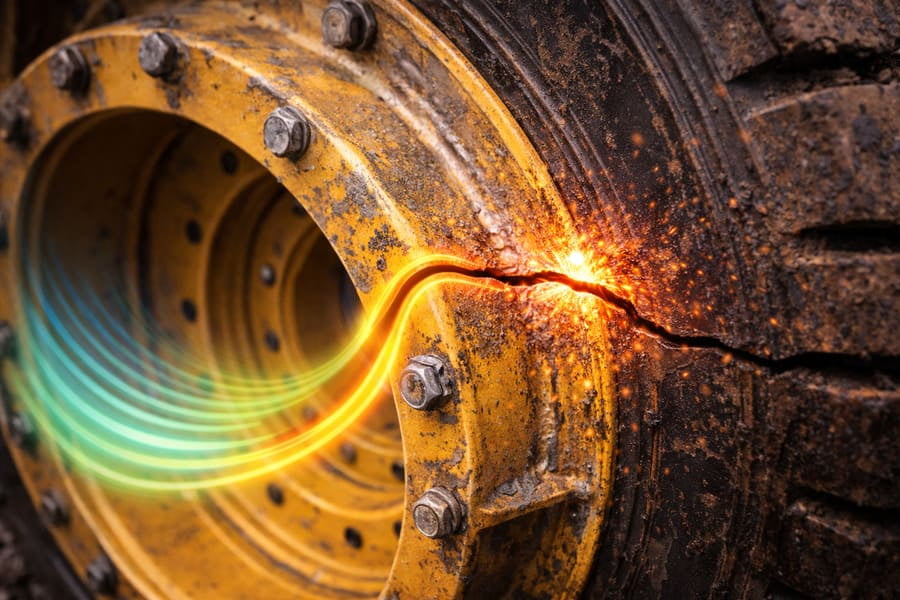
Think of how a river carves a canyon. A single drop of rain doesn't change the landscape. But over thousands of years, trillions of drops follow the path of least resistance, slowly wearing down the rock to form a deep channel. Stress in a steel rim works exactly the same way. An inspection report1 is like measuring the rock's hardness. It tells you the material is strong, but it doesn't tell you where the river will flow. Fatigue paths are the invisible channels where stress naturally concentrates—like at the edge of a weld or a sharp corner in the design. No single load cycle is a problem, but millions of them targeting the same spot will eventually "carve" a crack into the steel.
The Snapshot vs. The Story
| What an Inspection Report Shows (The Snapshot) | What Causes Failure (The Story) |
|---|---|
| Material Hardness | How the material behaves after a million cycles. |
| Dimensional Accuracy | Where stress concentrates due to the shape. |
| Weld Bead Size | Tiny stress risers at the edge of the weld. |
| Surface Condition | Invisible, cumulative damage4 under the surface. |
How Can Operator Habits Cause a "Perfect" OTR Rim to Fail?
You've ensured your rims are top-quality and your machines operate within their official load limits. Still, one operator's machine has far more rim failures than another's.
A "perfect" rim can fail because operator habits8 are outside the scope of any report. Aggressive turning, hard braking, or consistently hitting bumps create shock loads and combined stresses that dramatically accelerate fatigue, far beyond what standard operation assumes.
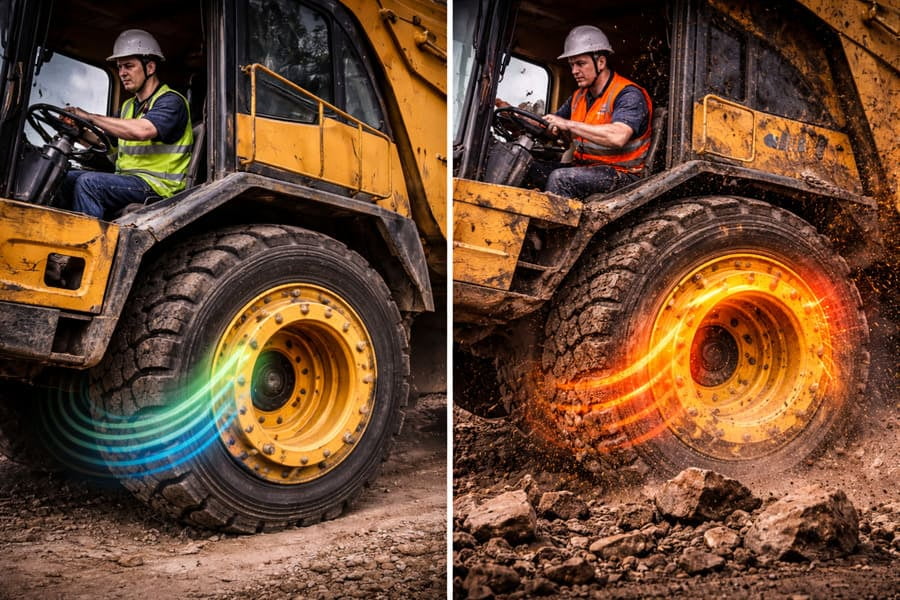
This is one of the biggest variables we see. Imagine two drivers on the same route. One driver smoothly brakes before corners and avoids potholes. The other one brakes late, turns sharply, and drives straight over every bump. Even if they are carrying the same load, the second driver is subjecting the rims to thousands of extra high-stress events every single shift. An inspection report1 assumes a baseline of "normal" use. It cannot account for an operator who slams a fully loaded bucket down, causing a massive shock load through the entire machine. It also can't account for a driver who consistently takes corners at high speeds, putting immense lateral force on the rim disc at the same time it’s under vertical load. These real-world habits are invisible to a spec sheet but are a primary cause of premature failure.
Unreported Stresses That Kill OTR Rims
- Shock Loading: Dropping heavy loads or hitting deep potholes.
- Aggressive Cornering: Creates high side forces that stress the disc and welds.
- "Cowboy" Driving: Rapid acceleration and hard braking that put torque stress on the mounting points.
- Consistent Overloading: Even small, consistent overloads drastically shorten a rim's fatigue life9.
Why Is Time the Biggest Risk Factor for OTR Rims?
You have two identical rims from the same batch, with identical inspection report1s. One fails after 6,000 hours, while the other is still going strong at 10,000 hours.
Time is the biggest risk because most rim failures are caused by fatigue, which is a time-dependent process. A OTR rim2 doesn't have a strength limit that it suddenly hits; it has a finite life of load cycles5 it can endure before a crack starts. Time is just a measure of how many cycles have been used up.
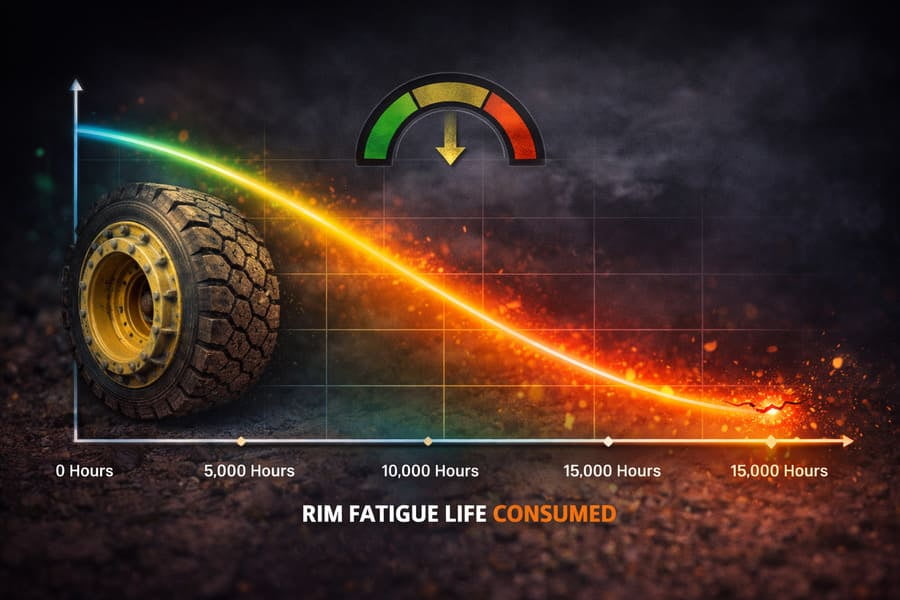
A new OTR rim2 is like a new battery. It starts with a 100% "charge" of fatigue life9. Every rotation, every bump, and every turn uses up a tiny bit of that charge. An inspection report1 can confirm the battery was built correctly, but it can't tell you how much charge is left. The failure doesn't happen because the rim suddenly becomes "weak." It happens because it has run out of its budgeted number of stress cycles. This is why a rim used in a harsh, 24/7 mining application might fail in two years, while an identical OTR rim2 on a farm tractor used seasonally could last for twenty years. The risk isn't in the rim's initial data; it's in the accumulation of cycles over its service life. A good design and quality manufacturing just give it a bigger "battery" to start with.
Conclusion
Inspection reports confirm initial quality, but they don't predict real-world failures. The true risk lies in the invisible, time-dependent process of fatigue, shaped by both design and daily operation.
This resource outlines essential elements of an inspection report, ensuring comprehensive evaluations. ↩
Explore this link to understand the common problems associated with OTR rims and how to prevent them. ↩
Learn about metal fatigue and its impact on machinery to better understand rim failures. ↩
Discover the concept of cumulative damage in materials and its significance in engineering. ↩
Learn about load cycles and their critical role in material fatigue and equipment longevity. ↩
Understand the importance of weld quality in maintaining structural integrity in machinery. ↩
This resource explains stress concentration and its role in material failure, crucial for understanding rim issues. ↩
Discover how operator habits can significantly impact machinery performance and maintenance. ↩
Explore the concept of fatigue life in engineering materials to understand how it affects durability. ↩