
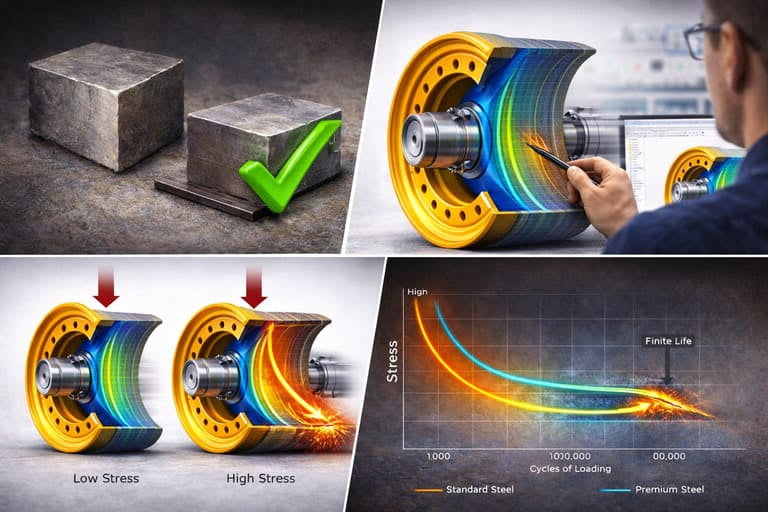
Your wheels are cracking, so you upgrade to a stronger, more expensive steel. But the failures continue, costing you a fortune in downtime and replacements.
Fatigue life1 is determined by structural design2, not just material strength. A wheel's geometry3, especially its offset4, dictates the stress on critical points. A poor design creates bending forces5 that will crack even the strongest steel over time.
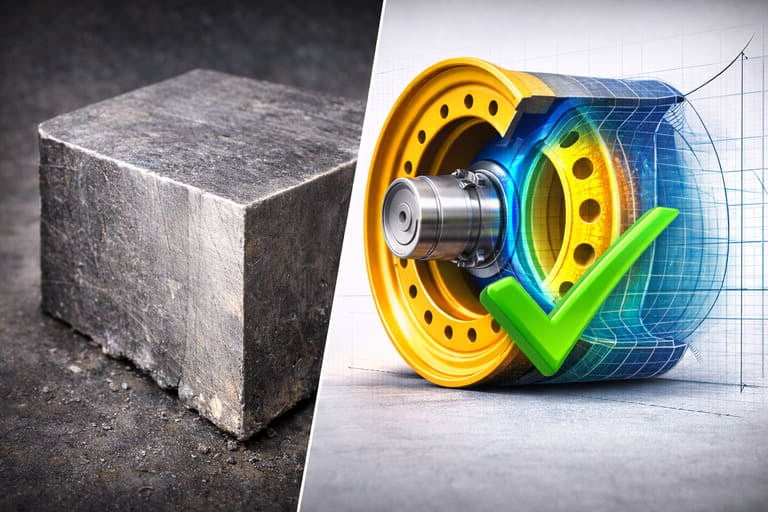
I'll never forget a conversation with a procurement manager for a large mining operation. He was frustrated. "We're paying a premium for wheels made from high-tensile steel, and they're still cracking," he told me. "We need even stronger material." He was falling into a common, expensive trap: believing that the solution to fatigue failure is simply using a stronger material. It makes intuitive sense, but in the world of OTR wheels, it's a fundamental misunderstanding of the problem. The real issue wasn't the quality of his steel; it was the forces his wheels were being subjected to, forces dictated entirely by their structural design2.
Why Doesn't a 'Stronger' Steel Grade Solve Fatigue Cracks?
You've specified a higher-grade steel, like Q355 instead of Q235, expecting it to be indestructible. Yet, you're still seeing cracks form after a few thousand hours of operation.
Because higher-grade material primarily increases static strength6—the ability to resist a single, large impact. It does not proportionally increase fatigue resistance7, which is the ability to endure millions of small, repetitive bending cycles.
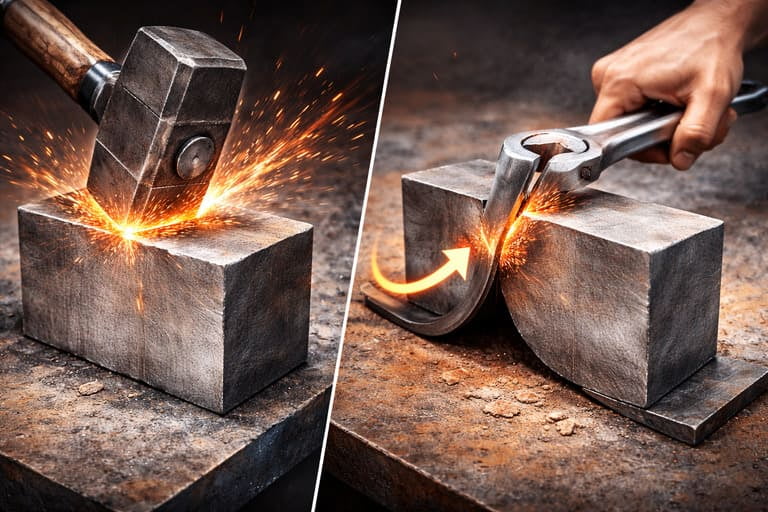
Think about the difference between a bodybuilder and a marathon runner. The bodybuilder has incredible static strength6; they can lift a massive weight once. But they can't run 26 miles. The marathon runner has incredible fatigue resistance7; they can endure a low-level stress for a very long time. OTR wheel steel is similar. Upgrading the steel grade is like switching from one bodybuilder to a slightly stronger one. You've increased its ability to survive a huge pothole hit without denting (static strength6). But OTR wheel failure is rarely from a single impact. It's from the millions of rotations under load, each one causing a tiny flex. This is a marathon, and the steel's ability to run that race (fatigue life) is determined by the stress it feels with every step, not its one-rep max lift.
How Can the Wrong Offset Make Great Steel Meaningless?
You have OTR wheels made from top-tier, certified steel. You've seen the material reports. How can something as simple as offset4 completely nullify this advantage?
An incorrect offset4 acts as a lever, multiplying the bending stress on the wheel's structure. This amplified stress will fatigue any material, regardless of its grade. The problem is no longer the steel's capacity, but the overwhelming force being applied to it.
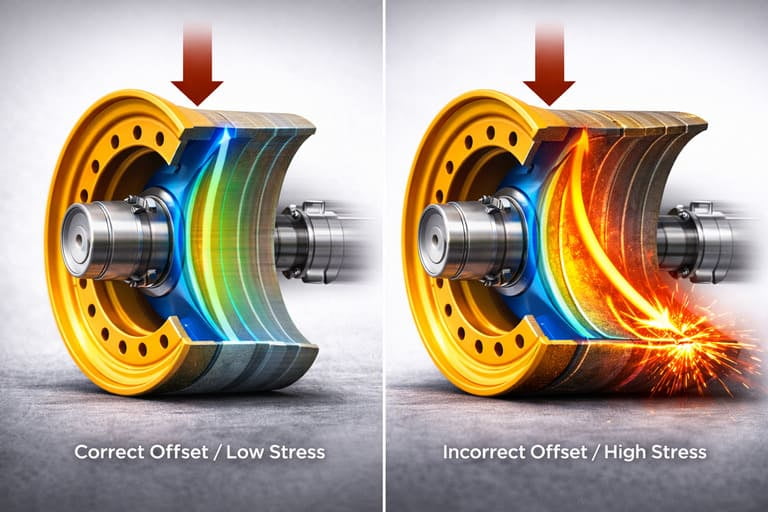
Imagine trying to hold a door shut against someone pushing. If you stand right by the handle, you can hold it. If you try to hold it shut from the hinge side, it's impossible. The force is the same, but the leverage is different. Using the wrong offset4 is like trying to hold the door from the hinge side. You are putting the material at a massive mechanical disadvantage. Even if you use the "strongest" steel, you are applying a bending force that it was never designed to handle in that configuration. The steel itself is still high quality, but the application is flawed. The problem isn't a material failure; it's an engineering failure8. The structure is creating a load that no reasonable material could be expected to endure long-term.
Why Does Premium Steel Still Fail Under Cyclic Loading?
It's tempting to think that "premium" means infinite life. If you spend more on the material, it shouldn't wear out or break from normal use, right? Unfortunately, physics disagrees.
Because fatigue is cumulative. Every single rotation under load adds a tiny amount of damage. Even on premium steel9, if the stress from a bad structural design2 is high enough, this damage accumulates rapidly, leading to premature failure.
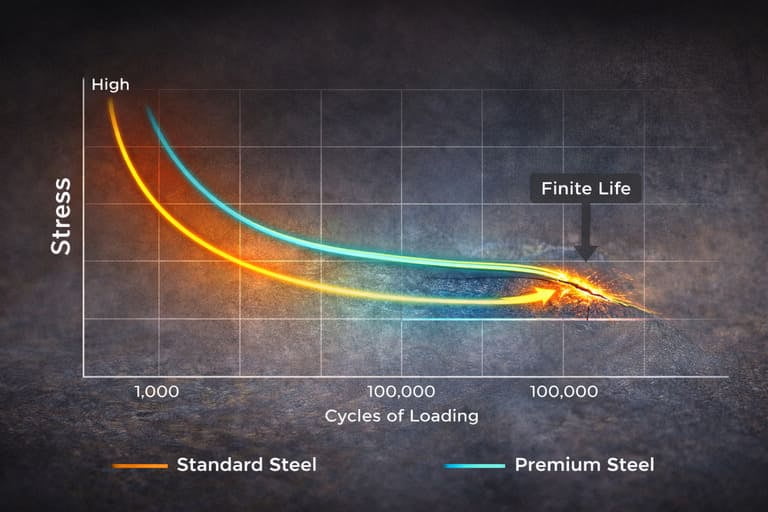
The paperclip analogy is perfect here. You can't break a steel paperclip by pulling on it (static strength6). But bend it back and forth a few times (cyclic loading10), and it snaps easily. Crucially, if you bend it further each time, it breaks much faster.
Stress vs. Cycles to Failure
| Stress Level on the Wheel | Cycles to Failure (Standard Steel) | Cycles to Failure (Premium Steel) |
|---|---|---|
| Designed Stress (Correct Offset) | > 2,000,000 | > 3,000,000 |
| High Stress (Incorrect Offset) | ~ 250,000 | ~ 400,000 |
As you can see, while the premium steel9 performs better, the incorrect offset4 still causes its life to collapse catastrophically. You get a slightly longer service life, but you are still facing a premature failure. You paid a premium for a marginal gain because you didn't solve the root problem: the excessive stress created by the poor structural setup. Fatigue always respects the laws of physics, not the price tag of the material.
Is It Better to Have a Smart Design or Stronger Material?
So, when specifying a wheel for a demanding application, where should your focus be? On demanding the highest material grade, or on ensuring the structural design2 is perfect for the machine?
A smart structural design2 is always more important. A wheel with the correct geometry and offset4 will guide forces harmlessly, allowing standard-grade material to last its full lifespan. A poor design will create stress hotspots11 that destroy even the most advanced alloys.
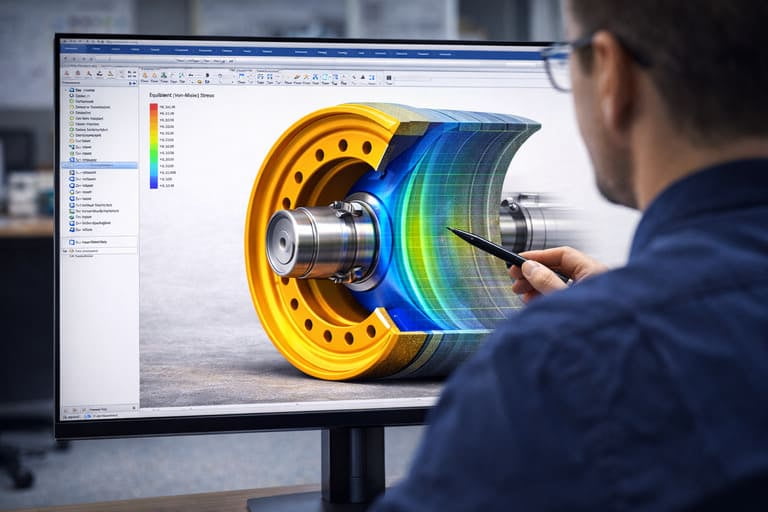
This is the core principle of our work at Gescomaxy. When a client needs a wheel, our first questions are about the machine, the load, and the required track width. We focus on getting the structure—the offset4, the disc profile, the weld placement—perfect. The material selection12 comes second, chosen to meet the demands of that perfected design. Designing the structure correctly is proactive. It prevents high stress from ever occurring. Simply throwing better material at a bad design is reactive. It's a brute-force attempt to contain a problem that shouldn't exist. A well-designed wheel made of standard Q235 steel will always outperform and outlast a poorly designed wheel made of expensive Q355 steel. Always prioritize the path of the load.
Conclusion
Structural design, not material strength, governs a wheel's fatigue life. Correct geometry minimizes stress, while poor geometry, like the wrong offset4, will make even the best materials fail prematurely.
Understanding fatigue life is crucial for optimizing designs and preventing failures in engineering applications. ↩
Explore how effective structural design can enhance material performance and longevity. ↩
Learn about the importance of wheel geometry in ensuring optimal performance and durability. ↩
Discover how offset affects stress distribution and overall wheel performance. ↩
Gain insights into the relationship between bending forces and material fatigue in engineering. ↩
Understanding static strength helps in selecting materials for various engineering applications. ↩
Explore the concept of fatigue resistance and its significance in material selection. ↩
Understanding the causes of engineering failure can help in designing more reliable systems. ↩
Discover the advantages of premium steel and its applications in various industries. ↩
Learn about cyclic loading and its impact on material durability and performance. ↩
Understanding stress hotspots is key to improving design and preventing failures. ↩
Learn about the critical factors in material selection to ensure optimal performance. ↩